Università degli Studi di Torino
Public university of Turin founded in 1404: about 83,000 students, historic seat on via Po, alma mater of Einaudi, Gramsci, Primo Levi and three Nobel laureates.
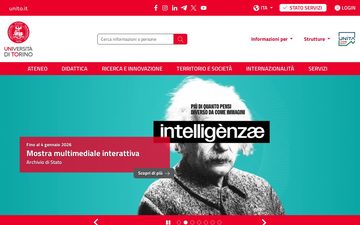
The Università degli Studi di Torino (UniTo) is the general public university of the Piedmontese capital and one of the oldest in Italy: founded in 1404, it trained jurists, physicians and scientists of the Savoy Kingdom and later of the unified Italian state, and in the twentieth century it was the school of two presidents of the Republic and three Nobel laureates. Today it has about 83,000 students, about 15,300 graduates a year and about 120 locations spread across the territory; the rectorate is at via Verdi 8, in Turin[1].
From the 1404 bull to the palace on via Po
The university was born on the initiative of Ludovico di Savoia-Acaia, who promoted a centre of higher learning; recognition came with the bull of Pope Benedict XIII of 27 October 1404. In 1424 Amedeo VIII reorganized it, entrusting its government to a board of reformers. The first decades were unstable: the school was moved first to Chieri and then, in 1434, to Savigliano, and returned to Turin only after 1436. In 1506 Erasmus of Rotterdam obtained his degree in theology there[2].
Under Emanuele Filiberto and Carlo Emanuele I, when Turin became the capital of the duchy, the university grew; among its teachers was Giovanni Battista Giraldi Cinzio, who during his Turin years published the Ecatommiti (1565). In 1720 the school moved into the palace on via Po, which remained its main seat, and in 1739 Carlo Emanuele III established the University Museum there[2].
Revolution, Napoleon and the capital of Italy
In 1791 a student revolt broke out, and with the war against revolutionary France the university was closed. The provisional government of 1799-1800 reopened it as a “National University” on the French model; in the Napoleonic era (1801-1814) it was organized into five faculties: theology, law, medicine, sciences and literature. At the turn of the century, Amedeo Avogadro graduated in law (1796) and Giuseppe Benedetto Cottolengo in theology (1816); in 1817-1818 a course in political economy was introduced[2].
In 1859 a School of Application for Engineers was annexed to the faculty of sciences, from which the Politecnico di Torino would be born in 1906. Even after the capital moved away, the university remained among the country's largest: in the academic year 1891-1892 it had 2,013 students and was, as its official history recalls, “the second university institution in Italy, preceded only by Naples”[2]. The university is also linked to the legacy of Cesare Lombroso, professor of forensic medicine at Turin's prison: his collections now form the Museum of Criminal Anthropology run by the university, reopened on 27 November 2009, a hundred years after the scholar's death: 684 skulls, 183 brains, over a thousand photographs. The skull of the Calabrian Giuseppe Villella was contested in court, until in 2019 the Court of Cassation denied its return, considering it a cultural asset[3].
The twentieth century: statesmen, Nobel laureates and anti-fascism
Between the late nineteenth and mid-twentieth century, some of the central figures of Italian history passed through Turin. Luigi Einaudi graduated in law in 1895, Antonio Gramsci enrolled in 1911, Palmiro Togliatti graduated in law in 1915 and Giuseppe Saragat in economics in 1918. The faculty of medicine produced three future Nobel laureates: Salvatore Luria (1935), Rita Levi-Montalcini and Renato Dulbecco (both in 1936)[2].
With the Gentile reform of 1923 the university joined the group of ten universities fully funded by the State. In the 1930s it was the setting for what the university itself calls an “extraordinary cultural and anti-fascist season”, with Norberto Bobbio, Leone Ginzburg and Cesare Pavese[2]. The racial laws of 1938 banned Jews from public schools, but allowed those already enrolled to finish their studies: this was the case of Primo Levi, who had started chemistry in 1937 and in July 1941 graduated with full marks and honours, on a diploma bearing the note “of the Jewish race”[4]. After the war, in 1954, Umberto Eco graduated there in philosophy[2].
From an elite university to a mass university
From 1968, with the student protests, UniTo moved from an elite model to a mass one and opened new faculties: Political Science (1969), Psychology (1982), Foreign Languages and Literatures (1997). In 2004 it celebrated its six hundredth anniversary[2]. The largest building project is the Campus Luigi Einaudi, built between 2001 and 2011 on the disused areas of the former Italgas plant, between the Dora and corso Regina Margherita, purchased by the university in the late 1990s. The project, won through an international competition by a group led by Foster and Partners with Benedetto Camerana and Giugiaro Design, covers 45,000 square metres, with 70 classrooms and the library named after Bobbio under a single undulating roof; it houses law and political science and was inaugurated in 2012[5].
The university today
In June 2025 the chemist Cristina Prandi was elected rector with 1,538 votes against 1,135 for the jurist Raffaele Caterina, out of about 4,800 eligible voters: she is the first woman to lead the university in over six hundred years. She took the place of the physician Stefano Geuna, elected in 2019[6].
Recent years have also brought disputes and protests. In April 2024 the Council of State, overturning the November 2022 ruling of the Regional Administrative Court, ordered the university to repay 39 million euros to students: in 2018 it had collected almost 95 million in fees, against a legal limit equal to 20% of the ordinary funding fund, about 55 million[7]. In the spring of the same year, pro-Palestine collectives occupied Palazzo Nuovo and the Physics building for about 39 days, demanding the suspension of collaborations with Israeli universities in fields linked to the military sector; the occupation ended on 19 June 2024, after the academic senate had suspended participation in a ministerial call for proposals in March and the Psychology department had approved a motion to halt such agreements[8].
In June 2026 an enrolment campaign featuring the face of Primo Levi and the slogan “Freshman in 1937. If This Is a Man in 1947. Your story starts here too” drew criticism from students; the UniTo Coordination group wrote: “Let us draw a merciful veil over the possible double meaning of a university enrolment number and a prisoner number at Auschwitz.” The university announced that the posters would be removed[9].
Pages linking here
- Alessandro Antonelli
- Amedeo Avogadro
- Antonio Gramsci
- Archdiocese of Turin
- Askatasuna
- Avigliana
- Beppe Fenoglio
- Carlo Levi
- Cavallerizza Reale
- Cesare Lombroso
- Cesare Pavese
- Chieri
- Emmanuel Philibert
- Francesco Faà di Bruno
- Galileo Ferraris
- Gianduiotto
- Gianni Vattimo
- Giovanni Giolitti
- Giulio Einaudi
- Giuseppe Luigi Lagrange
- Guido Gozzano
- Job Placement - Facoltà di Economia di Torino
- Luca Argentero
- Luciana Littizzetto
- Luigi Einaudi
- Luigi Rolando Museum of Human Anatomy
- Mario Soldati
- Molinette Hospital
- Moncalieri
- Monte Rosa
- Museo Egizio
- Natalia Ginzburg
- Nebbiolo
- New Collettivo Autorganizzato Universitario encampment in front of Palazzo Nuovo (October 2026)
- Nobel per la Fisica a Francis Halzen annunciato a Torino
- Norberto Bobbio
- Orbassano
- Parco del Valentino
- Piero Gobetti
- Politecnico di Torino
The jpecon.to.it domain in the web archive (2007-2016)
The domain jpecon.to.it was for years the address of the Job Placement service of the Faculty of Economics of the University of Turin, documented in the web archive since 2007. In the July 2016 copy the site already redirected students to the Job Placement section of sme.unito.it for information and the job board.
Related articles: Amedeo Avogadro, Avigliana, Cesare Lombroso, Emmanuel Philibert, Job Placement - Facoltà di Economia di Torino, Norberto Bobbio
Sources
- Università degli Studi di Torino
- Università degli Studi di Torino
- Il Post — 1 December 2024
- Centro Internazionale di Studi Primo Levi
- MuseoTorino
- Il Post — 12 June 2025
- Il Post — 11 April 2024
- Il Post — 20 June 2024
- Il Post — 24 June 2026
- Università di Torino — portale
- Internet Archive — 19 October 2007
- Internet Archive — 2 July 2016