Antonio Gramsci
Antonio Gramsci (Ales, 22 January 1891 – Rome, 27 April 1937) was a journalist, political leader and thinker, one of the founders of the Communist Party of Italy. Born in Sardinia, he was formed intellectually in Turin, where he lived from 1911 to 1922: there he studied, discovered the workers' movement, founded «L'Ordine Nuovo» and developed the theory of factory councils. The writings he composed in prison under fascism have made him one of the most studied figures in twentieth-century culture.[1]
From Sardinia to Turin
Born in Ales, between Cagliari and Oristano, he suffered from childhood from Pott's disease, which deformed his spine.[2] In the autumn of 1911 the Carlo Alberto College announced a competition for poor students: thirty-nine scholarships of 70 lire a month for ten months. Gramsci was one of two students from Cagliari admitted to the examinations in Turin.[3] With the scholarship he enrolled in the Faculty of Letters at the University of Turin, where he attended the lectures of the linguist Matteo Bartoli, of Arturo Graf, Rodolfo Renier and Arturo Farinelli; in 1912 he became friends with Palmiro Togliatti, who had also won a scholarship.[1]
Years later he would recall that departure in these words: «I left for Turin as if I were in a sleepwalking state». He arrived in the city with 55 lire in his pocket, and the Piedmontese climate became a recurring torment in his letters: «my worry about the cold does not let me study».[4] Among his first lodgings, according to Marco Travaglini's reconstruction, was a room at lungo Dora Firenze 57, less than a kilometre from Porta Palazzo, for 25 lire a month.[3]
The socialist journalist
His contact with the workers' movement came in 1913, during the strikes by Turin's metalworkers; it was probably in that year that he joined the Socialist Party. On 31 October 1914 he published his first political article, «Neutralità attiva ed operante», in «Il Grido del Popolo».[1] Between 1916 and 1918 he interrupted his studies and worked as an editor for «Il Grido del Popolo» and for the Piedmontese edition of «Avanti!».[1] In «Avanti!» he wrote news, politics and culture pieces for «Sotto la Mole», the new city news column devised by the socialist Giuseppe Bianchi, and he signed more than half of the theatre reviews published in those pages at least until May 1916.[5]
In February 1917 the one-off issue «La città futura» appeared, published by the Piedmontese Socialist Youth Federation. It contained the text that would become his most quoted:[3]
«I hate the indifferent. I believe that to live means to take sides.»
In that same year, 1917, he became editor of «Il Grido del Popolo».[6]
«L'Ordine Nuovo» and the factory councils
On 1 May 1919 Gramsci founded, together with Togliatti, Angelo Tasca and Umberto Terracini, «L'Ordine Nuovo», conceived as a «weekly review of socialist culture», with its editorial office in via dell'Arcivescovado, at the same address as the Turin edition of «Avanti!».[7] The magazine's motto, later also adopted by the Pistoia communists for the masthead of their newspaper, began: «Educate yourselves, for we shall need all our intelligence».[8] The paper soon presented itself as «the newspaper of the Factory Councils»: bodies inspired by the Russian soviets, conceived by Gramsci as the embryos of a workers' state.[6]
The Biennio Rosso found its laboratory in Turin. In April 1920 the city experienced the «strike of the clock hands»; in September the workers occupied the factories.[1] Both disputes ended with the defeat of the movement, which according to Alberto Burgio heralded the reactionary offensive of fascism.[6] Gramsci gave an account of that season for the Communist International, «Il movimento torinese dei Consigli di fabbrica», written for the November 1920 issue of the journal «Communist International»; the original manuscript is preserved in the Comintern archives.[9]
From Livorno to prison
In January 1921, at the Livorno congress, he helped found the Communist Party of Italy; from 1 January of that year «L'Ordine Nuovo» had become a daily.[1] In May 1922 he left Turin for Moscow, as the party's representative to the International; there he met Giulia Schucht, who would become his wife.[1] In 1924 he founded «l'Unità», was elected to parliament, and in August became secretary of the party.[1]
On 8 November 1926 he was arrested in Rome. After being held at San Vittore prison in Milan, he was tried in Rome by the Special Tribunal: on 4 June 1928 the sentence condemned him to more than twenty years' imprisonment. He served his sentence mainly in the prison of Turi, in the province of Bari, until November 1933, after which he was admitted to the Cusumano clinic in Formia.[1] He died on 27 April 1937, after being transferred to the Quisisana clinic in Rome.[1] His ashes, kept at first at the Verano cemetery, were later moved, on the initiative of his sister-in-law Tatiana Schucht, to the Non-Catholic Cemetery of Rome.[2]
The «Prison Notebooks»
On 8 February 1929 he began writing the notebooks at Turi: thirty-three in all, twenty-one of which were composed in that prison.[1] Published after his death, the «Prison Notebooks», with their reflection on the political role of intellectuals, made him, in Burgio's words, «one of the greatest figures of twentieth-century culture».[6] His works, from the «Notebooks» to the «Letters from Prison», have been published by the Turin publishing house Einaudi.[2]
Gramscian places in Turin
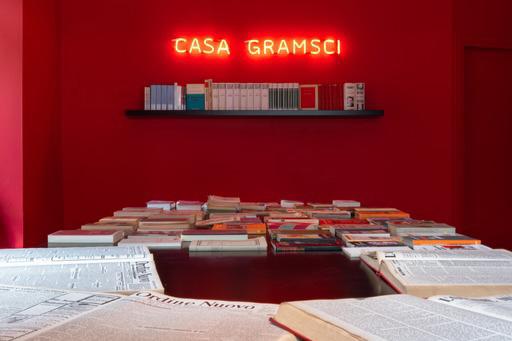
From 1913 to 1922 Gramsci lived at piazza Carlo Emanuele II 15, Piazza Carlina, between via Maria Vittoria and via San Massimo.[4] The building is now a hotel; in its rear courtyard, on 27 April 2016, the anniversary of his death, the «Casa Gramsci» space was inaugurated, promoted by the Piedmontese Antonio Gramsci Foundation. Its location, a cramped and barely visible space behind the hotel, was criticised by the press even before the opening.[10]
At via dell'Arcivescovado 7, almost at the corner with via XX Settembre, where the editorial office of «L'Ordine Nuovo» was based, a plaque commemorates «the strong will/ and the luminous mind/ of Antonio Gramsci».[4] A photograph of the plaque, taken by Giuseppe Garelli, is preserved in the archive of the Piedmontese Antonio Gramsci Institute Foundation at the Polo del '900.[11] For the eightieth anniversary of his death, on 27 April 2017, the Polo del '900 dedicated a day of meetings to Gramsci along with the theatrical performance «Tutto tranne Gramsci».[12]
Pages linking here
- Giulio Einaudi
- Giulio Einaudi editore
- Guido Gozzano
- Piazza Carlo Emanuele II
- Piero Gobetti
- Università degli Studi di Torino
Sources
- Treccani – Dizionario Biografico degli Italiani —
- Giulio Einaudi editore
- Consiglio regionale del Piemonte (Medium) — 23 July 2019
- Torino Oggi — 28 September 2024
- LUISS Guido Carli – tesi di laurea
- Treccani – Storia della civiltà europea
- GramsciOnline — 22 September 2020
- Toscana Novecento – Rete degli Istituti storici della Resistenza in Toscana
- GramsciOnline — 18 February 2024
- Eddyburg (da Tiscali.it) — 29 April 2016
- Polo del '900 – 9centRo
- Il Torinese —