Cesare Lombroso
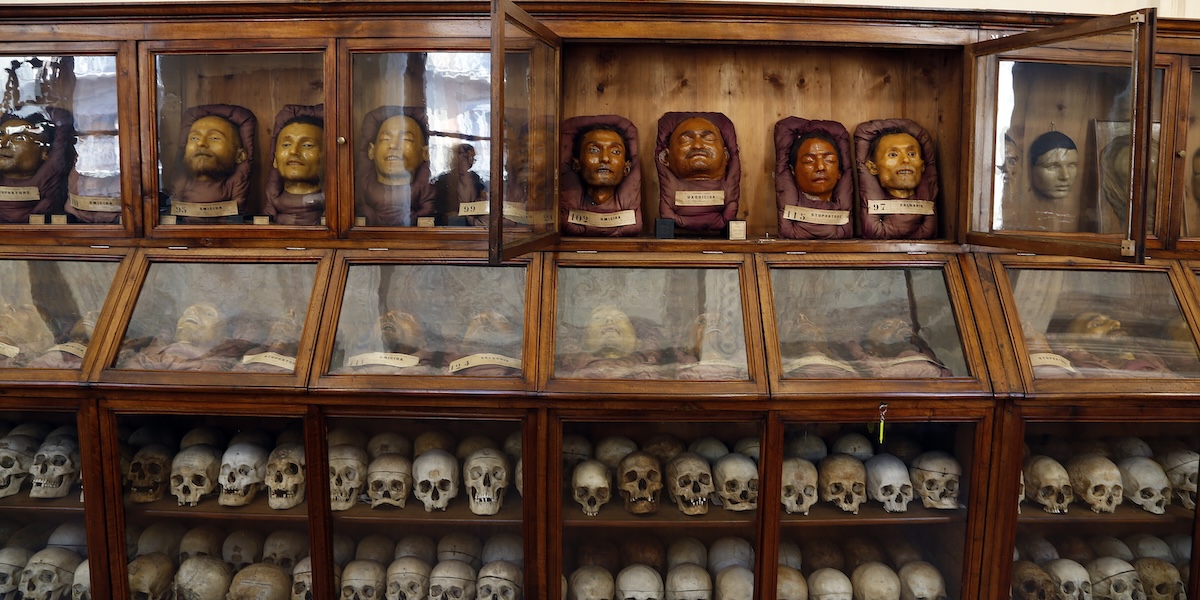
Cesare Lombroso (Verona, 6 November 1835 – Turin, 19 October 1909) was a physician, psychiatrist and anthropologist, regarded as the founder of criminal anthropology. Having arrived in Turin in 1876 as professor of legal medicine, he spent the last thirty-three years of his life in the city: there he wrote successive editions of L'uomo delinquente (Criminal Man), founded the museum that still bears his name, and sat on the city council. His theories on the «born criminal» are today considered groundless, and for that very reason his Turinese legacy remains one of the most debated in the city.[1][2]
From Jewish Verona to the Sardinian army
His birth name was Ezechia Marco; he was born into a Jewish family, the son of Aronne Lombroso and Zefora Levi, and only later adopted the name Cesare.[1] In 1853 he enrolled in medicine and surgery at Pavia, graduating in 1858 with a thesis on cretinism in Lombardy; he completed his training in Padua and Vienna.[1] In 1859 he enlisted as a volunteer physician in the army of the Kingdom of Sardinia, and in 1862 he was sent to Calabria during the campaign against brigandage.[1] It was during his years in the army that he began collecting human remains, the first core of his future collections.[3]
Back in Pavia, from 1863 he taught a free course in psychiatry and worked on pellagra and cretinism; in 1871 he took charge of the provincial asylum of San Benedetto in Pesaro.[1][4] In 1864 he published Genio e follia (Genius and Madness), reissued as a book in Milan in 1872 and republished several times since.[2][1]
Villella's skull and «L'uomo delinquente»
The turning point, in Lombroso's own account, dates to 1870: examining the skull of the Calabrian brigand Giuseppe Villella, he found at its base a small hollow in place of the normal occipital crest.[1] From this he drew the idea that criminals bore on their bodies the marks of a more primitive stage of human evolution: the theory of atavism.[3][5] Lombrosian thought is usually summed up in a phrase attributed to him:[4]
«The criminal is an atavistic being who reproduces in his own person the fierce instincts of primitive humanity and of the lower animals.»
To support this theory, Lombroso studied the shape and dimensions of the skulls of many brigands killed in southern Italy and brought to Piedmont.[4] In 1876 L'uomo delinquente was published in Milan; the much-expanded fourth edition was printed in Turin in 1882, and the definitive one, in four volumes, again in Turin in 1896-1897.[1] The book made him famous in international academic circles as one of the pioneers of criminal anthropology, and for a time his theories had great influence in Europe.[4][5]
The chair in Turin
In November 1876 Lombroso moved to the University of Turin as full professor of legal medicine.[1] In the central buildings on Via Po he set up a laboratory of legal medicine and experimental psychiatry.[1] By 1886 he was also a physician for the city's prisons, where he was able to intensify his studies of inmates.[6][4] From 1890 he held the post of psychiatry, from 1896 the full chair; in 1907 he obtained the chair of criminal anthropology.[1] The Enciclopedia Italiana instead dates this appointment to 1905.[6]
Turin was also the center of his school. In 1880 he founded, with Raffaele Garofalo, the Archivio di psichiatria, antropologia criminale e scienze penali; in 1885 he was among the organizers of the first congress of criminal anthropology, held in Rome.[1] In 1893 he published in Turin La donna delinquente, la prostituta e la donna normale (The Female Offender), written with his son-in-law Guglielmo Ferrero; his other son-in-law, Mario Carrara, succeeded him in 1904 in teaching legal medicine.[1] Il delitto politico e le rivoluzioni (Political Crime and Revolutions) dates from 1890.[6]
Socialism, spiritualism, final years
In 1893 he joined the Socialist Party, and from 1902 to 1905 he served as a city councillor of the City of Turin.[1] In 1906 he was appointed inspector of asylums for Piedmont.[6] In his final years the materialist scientist revised his own views on mediumistic phenomena, eventually accepting a spiritualist interpretation: Ricerche sui fenomeni ipnotici e spiritici was published in Turin in 1909, after his death.[6][1] He died in Turin during the night between 18 and 19 October 1909.[1][5]
The museum at the Palazzo degli Istituti Anatomici
His collection of skulls, brains, photographs and inmates' objects received official recognition in 1892 as the Lombrosian Museum of Criminal Anthropology.[1] In its current form the «Cesare Lombroso» Museum of Criminal Anthropology was inaugurated by the University on 27 November 2009, a hundred years after his death[3]; it is housed in the Palazzo degli Istituti Anatomici, facing Parco del Valentino.[4] It holds 684 skulls, 183 human brains, 27 skeletal remains, more than a thousand photographs, around five hundred knives and other objects, and dozens of wax and plaster death masks.[3] The inauguration stirred controversy in the city over fears that long-discredited theories might be revived.[4]
In 2012 the municipality of Motta Santa Lucia, in the province of Catanzaro, Villella's hometown, and the No Lombroso Committee accused the museum of illegally holding the skull and demanded its return; the committee called the museum «obscene, inhuman, racist». At first instance the court of Lamezia Terme ruled in their favor, ordering the skull's return to Calabria; five years later the decision was overturned on appeal, and in 2019 the Court of Cassation denied the restitution.[3] Curator Cristina Cilli argues that the museum «touches on issues that are still very topical today» and points out that Lombroso was not racist specifically toward people from the South, but toward anyone displaying traits he deemed non-conforming.[3] On the choice to display human remains, Alberto Garlandini, president of the ICOM Foundation, has observed:[3]
«Museums exist so that the memory of history and of the past is not forgotten, even if this touches the sensibilities of some people.»
A rejected legacy
Already in the twentieth century Lombroso's insistence on the hereditary causes of crime was abandoned in favor of environmental factors.[5] Today science regards his criminal anthropology as a pseudoscience related to phrenology: environmental conditions and genes do influence physical appearance, but this does not determine behavior.[4] The Turin museum displays his collections in order to document his research, while highlighting the parts that have proven mistaken.[3]
Pages linking here
- Edmondo De Amicis
- Luigi Rolando Museum of Human Anatomy
- Mario Soldati
- Monumental Cemetery of Turin
- Museo della Frutta Francesco Garnier Valletti
- Università degli Studi di Torino
Related articles: Università degli Studi di Torino