Ferrero
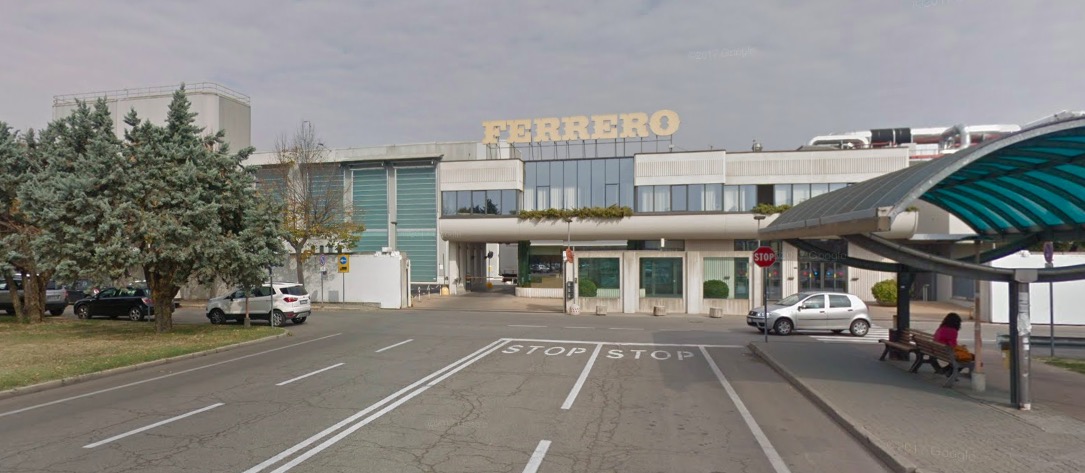
Ferrero is the confectionery group founded in 1946 in Alba, in the Langhe, out of a small family pastry shop, which grew into one of the largest companies in the sector worldwide: it makes, among other products, Nutella, Kinder, Tic Tac and Ferrero Rocher, sold in more than 170 countries.[1] It is the largest Italian confectionery company.[2] Although its holding company is based in Luxembourg, Alba remains the place of origin and one of the group's production centres.[3]
The Alba pastry shop and gianduia paste
In 1946 brothers Pietro and Giovanni Ferrero began working together in the family workshop in Alba, in the province of Cuneo.[1] The product on which the business grew was a sweet paste of hazelnuts, sugar and a little cocoa, derived from the Piedmontese tradition of gianduia: it was called Giandujot and was sold in bars, to be eaten as they were or spread on bread. In the postwar years cocoa was expensive to import, and the hazelnuts from the hills around Alba made it possible to use little of it. A second version, SuperCrema, was already sold in jars.[4]
Pietro Ferrero died in 1949. Leadership passed to his brother Giovanni, his widow Piera Cillario and his son Michele[4], who that year took the company in hand and ran it for decades.[5]
The era of Michele Ferrero
Under Michele Ferrero the company soon moved beyond Italy's borders: in 1956 it opened its first major plant abroad, in Germany, followed by one in France.[1] On 20 April 1964 the first jar of Nutella, a direct descendant of SuperCrema, was produced and put on sale; production began at the Alba plant, where it still continues, and the product reached Germany in 1965, France in 1966, Australia in 1978 and the United States in 1983.[4] Today the largest Nutella plant is not in Alba but in Villers-Écalles, near Rouen, in Normandy, where about 900 workers produce 600,000 jars a day, a quarter of the world total.[6]
Then came the brands that turned the group into a global name: Kinder Chocolate in 1968, Tic Tac in 1969, Kinder Surprise in 1974, Ferrero Rocher in 1982.[1] Michele Ferrero always preferred to grow through his own products rather than buying competitors.[3] At his death, on 14 February 2015 in Monaco, Forbes named him the richest man in Italy, with an estimated fortune of about 20 billion euros.[5]
In 1983 he founded the Opera Sociale Ferrero in Alba, recognised in 1991 as a foundation and now named after Piera, Pietro and Giovanni Ferrero: it assists former employees of the group and organises exhibitions, conferences and programmes on active ageing, under the motto "Work, Create, Give".[7] Michele Ferrero explained its purpose in these terms:[7]
"I have come to believe that the Ferrero Group must make a human and financial effort to tangibly thank its elders, and in particular its pensioners."
The third generation and the acquisitions
By the time Michele died, the third generation was already in charge: the eldest son Pietro had died in 2011, and the chief executive was the second son Giovanni.[5] Having become, from 2015, the sole family figurehead and, from September 2017, executive chairman, Giovanni Ferrero reversed his father's strategy, focusing on acquisitions.[3] In 2015 the group bought the British company Thorntons, in 2017 the American companies Fannie May and Ferrara[3]; in 2018 it acquired Nestlé's US confectionery division for 2.4 billion euros, including brands such as Butterfinger, Crunch and Baby Ruth.[2] In 2019 came the biscuit brands Keebler and Famous Amos, followed by other brands in subsequent years[1], up to the North American cereal business of WK Kellogg, acquired through an offer announced in July 2025 worth 3.1 billion dollars.[8] Through this growth Ferrero has become the world's third-largest confectionery group, behind Mars and Mondelez.[3] In 2018 Giovanni Ferrero described his relationship with the family legacy in these terms:[1]
"Tradition is like a bow. The further back we manage to draw the string, the further forward we can launch the arrow of modernity, of vision, of innovation."
As for employment figures, the 17th sustainability report, published in June 2026, speaks of more than 50,000 employees worldwide[9], while Il Post in 2025 put the figure at 61,000, of whom more than 14,000 in North America, noting that the group has had a presence in the United States since 1969.[8]
Hazelnuts and the supply chain
Hazelnuts are the raw material that ties Ferrero to its place of origin, yet most of them come from abroad: Turkey accounts for about 70% of world production. To boost Italian supply, the group launched the Progetto Nocciola Italia (Italian Hazelnut Project), aiming for 20,000 hectares of new hazelnut groves by 2025 and committing to buy 75% of the annual harvest from participating growers. At the time, Piedmont produced about 20,000 tonnes a year, less than Lazio and Campania.[10] According to the group, in the 2024/25 financial year 97% of the hazelnuts it purchased were traceable back to the farmer.[9]
Ferrero in Italy today
In Italy the group has four plants[3]: besides Alba, Pozzuolo Martesana in Lombardy and, in Basilicata and Campania, Balvano and Sant'Angelo dei Lombardi. All of them are covered by the company agreement signed on 21 September 2026 with Fai-Cisl, Flai-Cgil and Uila-Uil, which sets a performance-linked bonus for the 2025/2026 financial year with a target amount of 2,730 euros gross; in Alba the amount actually paid out is 2,545.86 euros, with the option of converting part of it into welfare services.[11]
Pages linking here
- Alba
- Anpi
- Castello di Moncalieri
- Cesare Lombroso
- FIAT
- Fifth edition of the Festival Car International Concours d'Elegance (September 2026)
- Gianduja chocolate
- Gianni Rodari
- Giovanni Agnelli (1866–1945)
- Inauguration of Ambulance and Doblò for the Rivarolo Canavese Italian Red Cross Committee
- Juventus Football Club
- Langhe
- Marella Caracciolo Inheritance Case
- Michele Ferrero
- Nutella
- Officina Ortopedica Maria Adelaide
- Piazza Bodoni
- Prisma Investigation into Juventus Finances
- Prosthesis with Michelangelo Pistoletto's «Third Paradise» made by Officina Ortopedica Maria Adelaide (September 2026)
- Protesi con il Terzo Paradiso di Pistoletto per un bambino di Gaza curato dall'Officina Ortopedica Maria Adelaide (settembre 2026)
- Protests over Roberto Vannacci's visit to Turin (18 September 2026)
- The first Turin domains
- Torino
- Venchi
The renewal of the company supplementary agreement (September 2026)
On Friday 25 September 2026 Ferrero signs with the trade unions a draft renewal of the company supplementary agreement, valid until June 2030 and covering 7,000 workers at the Italian plants. The deal provides for new welfare measures, investment in the Italian production system and a performance-linked bonus of up to 3,100 euros, an average increase of 10% compared with the previous three-year period; the agreement must now be put to a vote by workers in plant assemblies.
Related articles: Gianduja chocolate, Langhe, Michele Ferrero, Nutella