Cuneo
Capital of the "Granda" province, founded in 1198 at the confluence of the Stura and the Gesso: a Savoy stronghold of seven sieges and a Gold Medal city of the Resistance.
Cuneo is a city in southern Piedmont, capital of the province known as the "Granda." It stands at 534 metres on an alluvial terrace at the point where the Stura di Demonte and the Gesso stream meet: it is these two watercourses, cutting into the plateau, that give the historic centre the wedge-like shape («cuneo» meaning wedge) from which the name comes. Set at the mouth of the valleys leading to the passes toward France and Liguria, for centuries it was a stronghold and an obligatory passage for the trade of the Savoy state; in 2020 the municipality had 56,311 inhabitants.[1][2]
A rebel commune
The city was born at the end of the twelfth century. On 23 June 1198 the consuls and rectors of the "Pizzo del Conio," backed by the commune of Asti, rose up against the marquises of Saluzzo and set up a de facto self-governing commune.[2] Independence lasted until 1259, when Cuneo passed to the Angevins; the marquises of Saluzzo and the Visconti followed, until in 1382, after a brief Angevin return, the city entered permanently into the domains of the House of Savoy.[1]
The stronghold of the seven sieges
Cuneo's history in the modern age is above all a history of sieges: the Enciclopedia Italiana counts seven notable ones.[2] In 1542 the French withdrew after twelve days; in 1556 the siege was lifted after twenty-five days, and Emanuele Filiberto rewarded the resistance by granting Cuneo the title of city.[1][2] Two further sieges, in 1639 and 1641, fell in the years of the civil war between the regent Christine of France and her brothers-in-law: in the first the city repelled the attackers, in the second, harsher one, it was occupied; in 1691, after the battle of Staffarda, the French were again repelled. In 1744 the Saxon governor Friedrich Wilhelm von Leutrum withstood the siege from 17 August to 11 October. The last siege, in 1799, was conducted by the Austro-Russians, who subjected the city to heavy bombardment until the French garrison abandoned it.[1][2]
The city of the porticoes
At the start of the twentieth century Cuneo showed two faces: the old core, narrow at the tip of the wedge and made of tight streets, and the expansion to the south, with wide, straight streets crossing at right angles. Stitching the two parts together is via Roma, lined with porticoes, which runs from piazza Torino to piazza Vittorio Emanuele II, a vast rectangle at whose centre once stood the monument to the jurist Giuseppe Barbaroux.[2] Among the religious buildings, San Francesco stands out, a thirteenth-century church in Romanesque-Gothic forms with a marble portal from 1481, and the church of the Angeli, which preserves fragments of late-fifteenth-century frescoes; Santa Croce and Sant'Ambrogio were rebuilt in the eighteenth century.[2]
In 1861 the city had about 23,000 inhabitants, rising to 35,000 by 1936.[1] The railway to Turin and the Cuneo-Nice line made it an important market for livestock and silk cocoons;[2] even today the livestock market is among the leading ones in Italy, alongside industries in rubber, clothing and mechanics.[1]
26 July 1943 and the Resistance
On 26 July 1943, the day after Mussolini's fall, the crowd celebrating gathered in piazza Vittorio Emanuele beneath the windows of the office of the lawyer Tancredi "Duccio" Galimberti, born in Cuneo in 1906, son of the minister Tancredi Galimberti and the scholar Alice Schanzer.[3] To Badoglio's proclamation Galimberti replied by reversing its meaning:[4]
"Yes, the war goes on until the last German is driven out, until the last traces of the fascist regime disappear…"
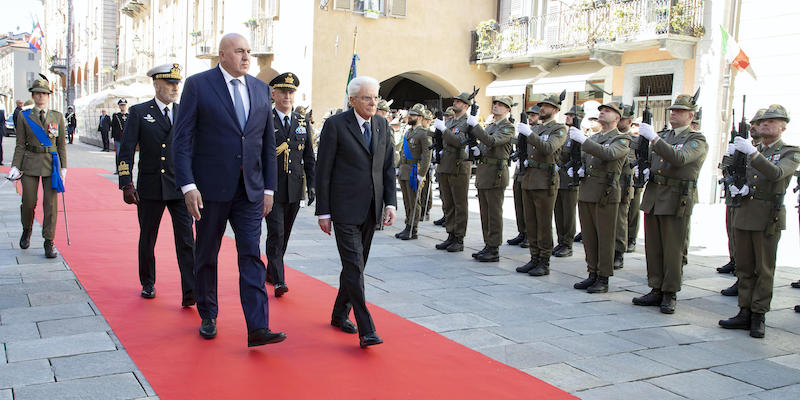
On the night of 12 September 1943, with Dante Livio Bianco, Galimberti set up the first partisan band, "Italia libera," at the chapel of the Madonna del Colletto; he later worked to coordinate and unify the bands from which the Giustizia e Libertà formations of the Cuneo area were born.[3] Arrested in Turin on 28 November 1944, he was brought back to Cuneo, tortured by the Black Brigades and killed at dawn on 3 December 1944 at Tetti Croce di Centallo; the gold medal for military valour awarded to his memory calls him a "supreme example of military, political and civic virtues."[3] The city of Cuneo itself holds the gold medal for military valour, as does nearby Boves, where on 19 September 1943 a German reprisal burned 350 houses and killed 24 people; from Borgo San Dalmazzo, on the city's edge, 328 Jews were deported to Auschwitz. On 25 April 2023 the President of the Republic Sergio Mattarella marked the Liberation precisely in Cuneo, Boves and Borgo San Dalmazzo.[4]
Roads, mountains and a legendary stage
On 10 June 1949 Cuneo was the start of the Giro d'Italia stage that many consider the greatest in the history of cycling: 254 kilometres to reach Pinerolo, barely fifty away as the crow flies, passing through France over the Maddalena, the Vars, the Izoard, the Montgenèvre and the Sestriere. Fausto Coppi attacked on the first climb and arrived alone after more than nine hours, almost twelve minutes ahead of Gino Bartali. Mario Ferretti's radio commentary opened with the words "A man alone at the front, his jersey is blue and white, his name is Fausto Coppi."[5]
Its border position remains the city's dominant trait. The Tenda pass, at 1,908 metres, is crossed by a long road tunnel on the international route to Ventimiglia, flanked by a railway tunnel.[6] The rains of 2 October 2020 (up to 500 millimetres in twelve hours according to the Cuneo prefecture, cited by la Repubblica) made the Vermenagna overflow, isolated Limone Piemonte, brought down a bridge in the Tenda area and closed the tunnel and state road 20.[7] Toward the plain, the motorway link to Asti and Alba, the A33, remained unfinished for more than thirty years: begun in the late 1990s, halted for about eight years after 2012, it was completed on 30 December 2025, with 90 kilometres and an overall cost of 1.457 billion euros.[8]
The capital of the Granda
As provincial capital, Cuneo is the reference point for a territory that has given the country leading figures: born in the province, in Carrù, was Luigi Einaudi, whom the Province of Cuneo commemorated in 2024 as "a great son of the Cuneo area."[9] Local sport, too, has had episodes that made national headlines: on 17 February 2019 Cuneo, then in Serie C, beat Pro Piacenza 20-0, as the latter took the field with seven players in the midst of a corporate crisis, a match the president of the football federation called "the last farce."[10]
Related articles: Asti, Fausto Coppi, Limone Piemonte, Luigi Einaudi, Pinerolo
Pages linking here
- 2026 regional call for the protection of prized white truffle trees
- Abbey of Staffarda
- Alba
- Alberto Cirio
- Archdiocese of Turin
- Arpa Piemonte
- Asti
- Asti DOCG
- Asti-Cuneo S.p.A.
- ATL del Cuneese
- Bagna càuda
- Baldissero d'Alba shooting
- Barbera
- Barolo (wine)
- Bollito misto alla piemontese
- Car-motorcycle crash in Villanova Mondovì on October 4, 2026
- Carlo Petrini
- Carte in Dimora
- Centro Einaudi
- Cervasca Chestnut Festival (October 2026)
- Cesare Pavese
- Chivasso
- Circolo dei Lettori
- CSI Piemonte
- Cuneo Granda Volley
- Cuneo24
- Cuneocronaca.it
- Cuneodice.it
- Cuneotrekking
- Edizione 2026 di Bra's nel ricordo di Carlo Petrini
- Edmondo De Amicis
- Elva
- Experimenta::::::2001
- Fatal accident on the SS589 state road in Saluzzo (24 September 2026)
- Fatal pedestrian accident on Via Torino in Mondovì
- Fatal Tractor Accident in Serralunga d'Alba (October 2026)
- Fausto Coppi
- Federalberghi Piemonte
- Ferrero
- Fondazione CRC
Sources
- Treccani
- Treccani - Enciclopedia Italiana —
- Treccani - Dizionario Biografico degli Italiani
- Il Post — 25 April 2023
- Il Post — 10 June 2019
- Treccani
- Il Post — 3 October 2020
- Il Post — 30 December 2025
- Cuneo24 —
- Il Post — 17 February 2019