Asti
Provincial capital in the Tanaro valley: Roman Hasta, a commune of merchants and bankers, the city of Vittorio Alfieri, of the Palio and of spumante.
Asti is a municipality of Piedmont and the capital of the province of the same name: it lies at 123 metres above sea level in the Tanaro valley, covers 151 km² and in 2020 had 75,051 inhabitants[1]. A Roman city, later a free commune among the richest in northern Italy thanks to its merchants and bankers, it is the birthplace of Vittorio Alfieri and gives its name to one of the best-known sparkling wines in the world. For those arriving from Turin, it is the gateway to the Monferrato and the wine hills.
Roman Hasta and the early Middle Ages
The Roman settlement of Hasta dates back to the 2nd century BC, older, according to the Musei di Asti, than the Roman centres of Alba and Turin themselves[2]; it became a municipium of the 9th Augustan region[1]. From the late-antique poet Claudian survives the phrase «moenia vindicis Astae», the walls of avenging Asti[3]. In via del Varrone, just north of the main decumanus, visitors can see a domus of the 1st-2nd century AD with a floor mosaic of rare quality for Piedmont and the remains of a hypocaust, the underfloor heating system[2]. The decumanus corresponds to today's corso Alfieri, and slabs from the forum of Hasta still surface in the crypt of Sant'Anastasio[4].
A bishop's seat from at least the 5th century, Asti was later a Lombard duchy and a Frankish county[1]. Right beneath Sant'Anastasio, burials have been found that radiocarbon dating places between the end of the 7th and the end of the 9th century; the Romanesque church, built shortly after the year 1000, housed an important women's monastery[4].
The commune of the merchants
Already in the 10th century judges, notaries and merchants emerged as the leading groups, and in the first half of the 12th they took on public powers[3]. In 1094 the emperor Henry IV granted the city comital authority[1]; in 1154 Frederick Barbarossa took and sacked it[5], but in 1159 he recognized its autonomy[1]. In 1255 Thomas II of Savoy, defeated and taken prisoner by the people of Turin, was handed over to the people of Asti; in 1275 the victory of Roccavione against Charles of Anjou marked Piedmont's revenge against the foreigner[5]. The city minted its own coin, the silver “astigiani”, between the 12th and 14th centuries[1].
The strength of the commune lay in credit. The “casane” (banking houses) of the Asti families had branches throughout Europe and financed political and military ventures[3]; having learned the art of exchange from the Genoese, the people of Asti practised it across Europe, and in France and Flanders stood in the front rank alongside the merchants of Milan, Piacenza, Siena, Lucca and Florence[5]. One of them, the spice merchant Guglielmo Ventura, was among the city's four consuls in 1305 and left a Memoriale in 114 chapters, a family chronicle recounting events from half of Italy[6]. Another chronicler, Ogerio Alfieri, captured the city at its peak:
«In the year of the Lord 1280 the city of Asti, by the grace of God, was almost entirely renewed, full of wealth, girded with good new walls, and nearly all filled with numerous buildings, towers, palaces and new houses»
The passage is quoted by the Enciclopedia dell'Arte Medievale, which notes how those fortified houses leaning against the older towers still mark the historic centre today[3].
Towers and churches
Of the noble towers, mostly from the 13th century, the Solara, the Comentina, that of the Natta family and the Troiana survive among others[5]. The Troyana tower, belonging to the Troya family, lenders active throughout Europe, is about 44 metres tall and is climbed by 199 steps; from 1560, under duke Emanuele Filiberto, it served as a public clock, and its bell of 1531 is among the oldest in Piedmont[7]. It is open from 1 April to 31 October[7].
The cathedral was consecrated in an earlier form by Pope Urban II in 1096; the longitudinal body collapsed in 1321 and was rebuilt until the 1350s[3]. It preserves a Gothic monstrance of 1446[5]. The collegiate church of San Secondo, dedicated to the city's patron saint, was rebuilt between the late 13th and mid-14th century[3] and houses a polyptych by Defendente Ferrari; next to the fifteenth-century small church of San Pietro in Consavia stands the ancient baptistery, a small circular building with a dome[5].
From the Visconti to the Savoy
In the 14th century factional struggles opened the way to lordships[1]. In 1387 Gian Galeazzo Visconti included Asti in the dowry of his daughter Valentina, bride of a member of the House of Orléans[5]; the dispute between the Visconti and the Orléans lasted until 1447, and between 1494 and 1536 the city was a French base in the wars of Louis XII and Francis I[1]. In 1530 Charles V assigned it to Beatrice of Portugal[5], and from 1538 it passed under the House of Savoy; the treaties of 1614 and 1615 were signed in Asti[1]. From 1799 to 1814 it was French, capital of the Département du Tanaro[1].
The Baroque of Asti is centred on Palazzo Mazzetti, where Benedetto Alfieri designed the staircase and the hall of honour in 1751-1752; it hosted James Stuart in 1717, King Carlo Emanuele III in 1727 and Napoleon in 1805. Today it houses the civic collections, founded in 1887[8].
The city of Alfieri
Vittorio Alfieri was born in Asti on 16 January 1749 to Antonio Alfieri and Monica Maillard de Tournon; at the age of nine he entered the Royal Academy of Turin, where he studied until 1766, and he died in Florence in 1803[9]. His birthplace, Palazzo Alfieri, was redesigned in the mid-eighteenth century by his uncle, the architect Benedetto Alfieri, and today houses the museum and the Centro di Studi Alfieriani[10]. The museum recalls one of his sentences on the power of writing[10]:
«It is true that the pen in the hand of an excellent writer turns out by itself to be a far more powerful and terrible weapon, and of far longer effect, than any sceptre or sword could ever be in the hands of a prince»
Among the natives of Asti in the twentieth century is Paolo Conte, born in the city in 1937, author of Azzurro and, in 2023, the first singer-songwriter to perform at La Scala[11].
Wine, the Palio and the present
In 1865 Carlo Gancia applied the classic method to white moscato grapes and the first Italian sparkling wine was born, the forerunner of Asti Spumante; in 1898 Federico Martinotti perfected sparkling-wine production in autoclaves[12]. The protection consortium was established on 17 December 1932, Asti obtained the DOC designation in 1967 and the DOCG in 1993[12]. In 2014 the vineyard landscapes of Langhe-Roero and Monferrato were inscribed on the UNESCO World Heritage List[13]. In 2006 vineyards occupied 21% of the municipality's agricultural land, alongside an industry ranging from electromechanics to paper goods and glassworks[1].
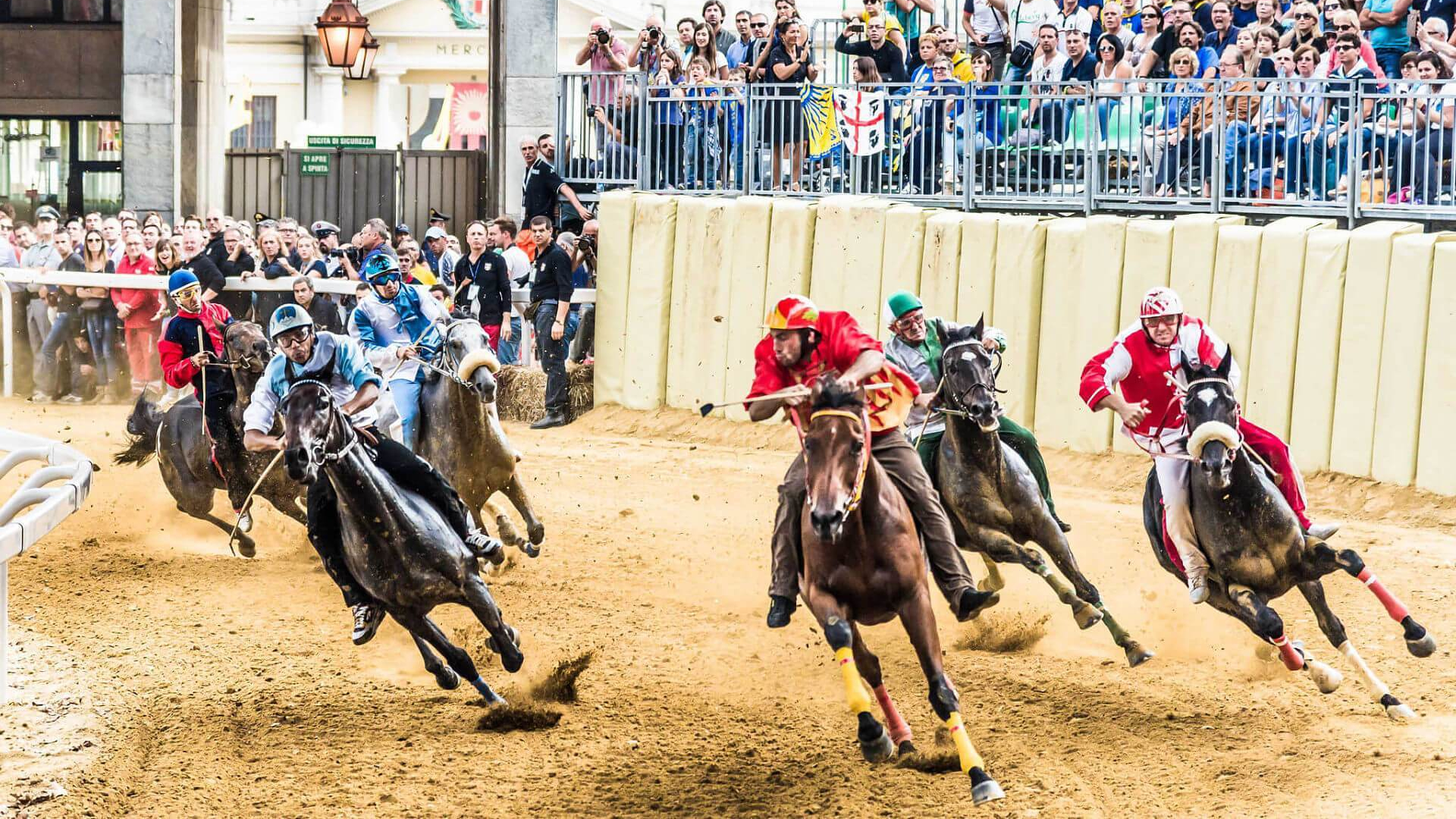
The Palio, a horse race in honour of San Secondo, involves the whole city in its preparations and is run on Sunday afternoon[14]; already in the 1930s the Enciclopedia Italiana listed it among the palios “recently revived”[15]. On 30 December 2025, after more than thirty years, the A33 motorway linking Asti to Cuneo was completed: 90 kilometres for 1.457 billion euros, with works at a standstill for about eight years after 2012[16].
Pages linking here
- Alba
- Bagna càuda
- Casale Monferrato
- Chieri
- Cuneo
- Giuseppe Benedetto Cottolengo
- Guido Crosetto
- Incidente mortale sulla linea Torino-Genova tra Asti e Felizzano (6 ottobre 2026)
- La Stampa
- Langhe
- Martini & Rossi
- Michele Miravalle Nominated Centre-Left Candidate for Mayor of Asti (October 2026)
- Monferrato
- Nebbiolo
- Paolo Conte
- Piedmontese language
- Piemonte
- Rita Levi-Montalcini
- Rocciamelone
- Turin Metropolitan Railway Service
- Vermouth di Torino
- Vittorio Alfieri
Chronology
- — Michele Miravalle, professor of Philosophy and Sociology of law at the University of Turin, is presented as the mayoral candidate of a centre-left coalition for Asti's 2027 municipal elections. → ANSA Piemonte Quotidiano Piemontese
Related articles: Cuneo, Langhe, Monferrato, Paolo Conte, Vittorio Alfieri