Montferrat
Historic hill region between the Po, the Tanaro and the Bormida: a marquisate of the Aleramici, the Palaiologoi and the Gonzaga, later Savoy; the land of Barbera, infernot cellars and UNESCO landscape.
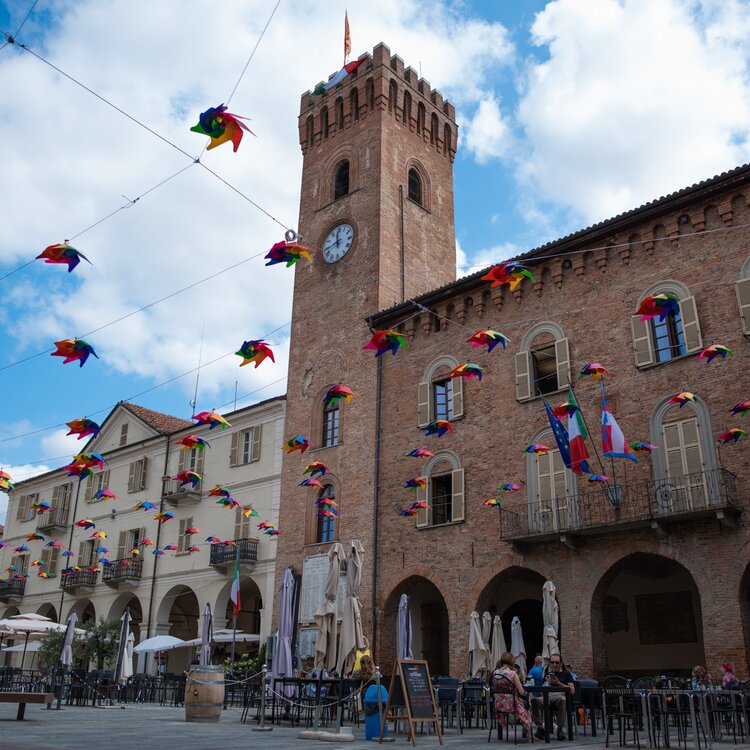
Montferrat (Monferrato) is a historic region of Piedmont that occupies most of the province of Alessandria and part of that of Asti: to the north it is bounded by the Po, to the south by the courses of the Tanaro, the Belbo and the Bormida[1]. A land of hills planted with vines, from the tenth century to 1708 it was a state of its own, a marquisate and later a duchy that contested territories and towns with the Savoys until it was absorbed by them[1]. Since 2014 part of its wine-growing landscape has been a UNESCO World Heritage site together with the Langhe and the Roero[1].
Territory
Tradition distinguishes the Basso Monferrato (Lower Montferrat), the northern belt towards the Po, from the Alto Monferrato (Upper Montferrat), to the south[1]. The economy has remained largely agricultural, and the dominant crop is the vine: Barbera, Freisa and Grignolino are the grape varieties with which the territory identifies itself[1]. In the Monferrato casalese, the subsoil is made of pietra da cantoni, a limestone that the Ecomuseo della Pietra da Cantoni, active since 2003, considers one of the finest Miocene-age building stones[2].
Aleramo and the birth of the march
At the origin of the state is Aleramo, a count, a «fidelis» of kings, who appears in the documents in July 933, when Kings Hugh and Lothair granted him the court of Auriola[3]. He married Gerberga, daughter of Berengar II, and on 23 March 967 he obtained from Otto I, at the request of the Empress Adelaide, a diploma granting him, according to the Dizionario Biografico degli Italiani, «certain courts situated in deserted places between the Tanaro, the Orba and the sea»[3]. He was margrave of the march of Savona-Monferrato, which ran from the Po to the sea and also included the counties of Loreto and Acqui[3]. The very name of the region arises in this context: the properties that Aleramo donated to the monastery of Grazzano lay in the county of Torre, «which was later called that of Monferrato»[3].
Around this founding figure the chronicler Friar Iacopo of Acqui built a romance-like legend: Aleramo born at Sezzè to a noble German woman, fled with the emperor's daughter, Adelasia, and lived with her as a charcoal-burner before obtaining pardon and investiture[3].
Aleramici, Palaiologoi, Gonzaga
The marquisate took shape between the tenth and eleventh centuries from the break-up of the great Aleramici march and remained with the Aleramici until 1305, when John I died without male heirs[1]. The title then passed to the descendants of his sister Violante, wife of the Byzantine emperor Andronikos II Palaiologos: their son Theodore I landed at Genoa in the summer of 1306 and on 15 September began operations from Casale to take possession of the marquisate[4]. The dynasty of Greek origin ruled Montferrat until 1533[1]. The Palaiologoi kept the state united through the principles of indivisibility and primogeniture, until in 1533 Giangiorgio died without direct heirs[1].
In 1536 Charles V entrusted Montferrat to the Gonzaga, who united it with their Mantuan domains and took full possession of it after the Peace of Cateau-Cambrésis of 1559; in 1575 Emperor Maximilian II raised it to a duchy[1]. For the Savoys, who ruled from Turin, that duchy just a few kilometres from the capital was a constant target: two wars, in 1612-1617 and in 1627-1631, ended with the Peace of Cherasco, which brought the Savoys the territory of Alba and Trino[1].
To the Savoys
The last duke, Ferdinand Charles, twice ceded Casale to the French, in 1681 and in 1701; the emperor declared him guilty of felony and in 1708 assigned Montferrat to the Savoys, then ruled by Victor Amadeus II, and the treaties of Utrecht (1713) and Rastatt (1714) confirmed the transfer[1]. After the Napoleonic interlude, during which from 1798 the area was included in the French department of the Tanaro, in 1814 Montferrat was definitively joined to the Kingdom of Sardinia[1].
Wine
Barbera, considered the most important red grape variety of Piedmont, has been grown around Nizza Monferrato for more than five centuries: in the roughly 2,300 hectares of the Nizza zone, together with Montegrosso, Mombercelli, Agliano Terme, Castelnuovo Calcea, Vinchio and Vaglio Serra, there are 880 vineyards, almost all planted with Barbera, 229 wine estates and several cooperative wineries, such as those of Vinchio and Vaglio Serra[5]. Nizza regards itself as the commercial and cultural capital of this wine and is home to a regional enoteca[5]. Further south, at Canelli, cellars cut into the hillside form kilometres of brick-vaulted galleries, where in the second half of the nineteenth century the research of the oenologist Federico Martinotti opened the way to sparkling Moscato bianco and Asti spumante[6].
The Consorzio Barbera d'Asti e Vini del Monferrato, founded in 1946 and based in Costigliole d'Asti, brings together 430 wineries and protects twelve denominations: three DOCG (Barbera d'Asti, Ruché di Castagnole Monferrato, Terre Alfieri) and nine DOC, including Grignolino d'Asti, Freisa d'Asti, Malvasia di Castelnuovo Don Bosco and Monferrato itself[7].
The infernot
The most distinctive feature of the Basso Monferrato are the infernot: small underground chambers carved by hand into the pietra da cantoni, without light or ventilation, reached from the cellars of houses and used to store bottled wine[2]. They were dug by farmers and master stonemasons beneath nine hill villages; the association that manages the UNESCO site writes: «Nowhere else do they exist in these forms and with such a wealth of variants»[8]. The Ecomuseo opens some of them to visitors, by appointment, in fourteen municipalities[2].
World heritage
The nomination of the wine-growing landscapes was launched by the Piedmont Region in 2003; in 2008 a protocol bound together the Region, the provinces of Alessandria, Asti and Cuneo and the ministry, and the dossier was submitted in 2011[9]. The first attempt was rejected and the dossier had to be rewritten[10]. On 22 June 2014, in Doha, the World Heritage Committee inscribed The Vineyard Landscape of Piedmont: Langhe-Roero and Monferrato as Italy's fiftieth site and the country's first wine-growing cultural landscape[9][11]. The serial site covers 10,785 hectares, with a buffer zone of more than 76,000, and is made up of five wine-growing areas and the castle of Grinzane Cavour[12]: Montferrat contributes Nizza and its Barbera, Canelli and Asti spumante, and the Monferrato degli infernot, alongside the Langa of Barolo and the hills of Barbaresco[8].
«The hills of Langhe-Roero and Monferrato are an exceptional example of a cultural landscape»
This was the minister's comment on the inscription[11]. Years later Roberto Cerrato, president of the site's association, told the UNESCO Committee in Kraków of the «difficult but very exciting months in which we agreed to start over, after the first attempt was rejected»[10].
Pages that link here
- A+A Monferrato
- Piedmontese agnolotti
- Alba
- Alessandria
- Two men arrested after a knife-and-gun fight in Nizza Monferrato (October 2026)
- ASL AT
- Asti
- ATNews
- Bagna càuda
- Barbera
- Barolo (wine)
- Beppe Fenoglio
- Borgo Po
- Bunet
- Canavese
- Casale Monferrato
- Case of illegal labour brokering in the Montferrat vineyards at Grazzano Badoglio (October 2026)
- Chivasso
- Turin Cathedral
- Francesco Faà di Bruno
- Turin breadstick
- Il Monferrato
- Ivrea
- Langhe
- Lavazza
- Piedmontese language
- Martini & Rossi
- Monviso
- Nebbiolo
- Novara
- Palazzo Madama
- Piedmont's participation in Ithic 2026
- Piazza Castello
- Piedmont
- Kingdom of Sardinia
- Settimo Torinese
- Tajarin
Timeline
- — At Grazzano Badoglio the carabinieri uncover a case of illegal labour brokering in the vineyards of the lower Montferrat, with Romanian farm workers paid two euros an hour and housed in a dilapidated house with fifteen beds and mattresses on the floor: three people reported. → Quotidiano Piemontese Il Torinese
Related articles: Alba, Asti, Barolo (wine), Casale Monferrato, Langhe
Sources
- Treccani
- Ecomuseo della Pietra da Cantoni
- Treccani – Dizionario Biografico degli Italiani
- Treccani – Dizionario Biografico degli Italiani
- Associazione per il Patrimonio dei Paesaggi Vitivinicoli di Langhe-Roero e Monferrato
- Associazione per il Patrimonio dei Paesaggi Vitivinicoli di Langhe-Roero e Monferrato
- Consorzio Barbera d'Asti e Vini del Monferrato
- Associazione per il Patrimonio dei Paesaggi Vitivinicoli di Langhe-Roero e Monferrato
- Associazione per il Patrimonio dei Paesaggi Vitivinicoli di Langhe-Roero e Monferrato
- Gazzetta d'Alba — 5 July 2017
- Gazzetta d'Alba — 26 June 2014
- UNESCO World Heritage Centre