Barolo (wine)
A DOCG red wine made from nebbiolo grapes in the Langhe, born in the nineteenth century among the Falletti family, Cavour and the Savoy court: “the king of wines, the wine of kings.”
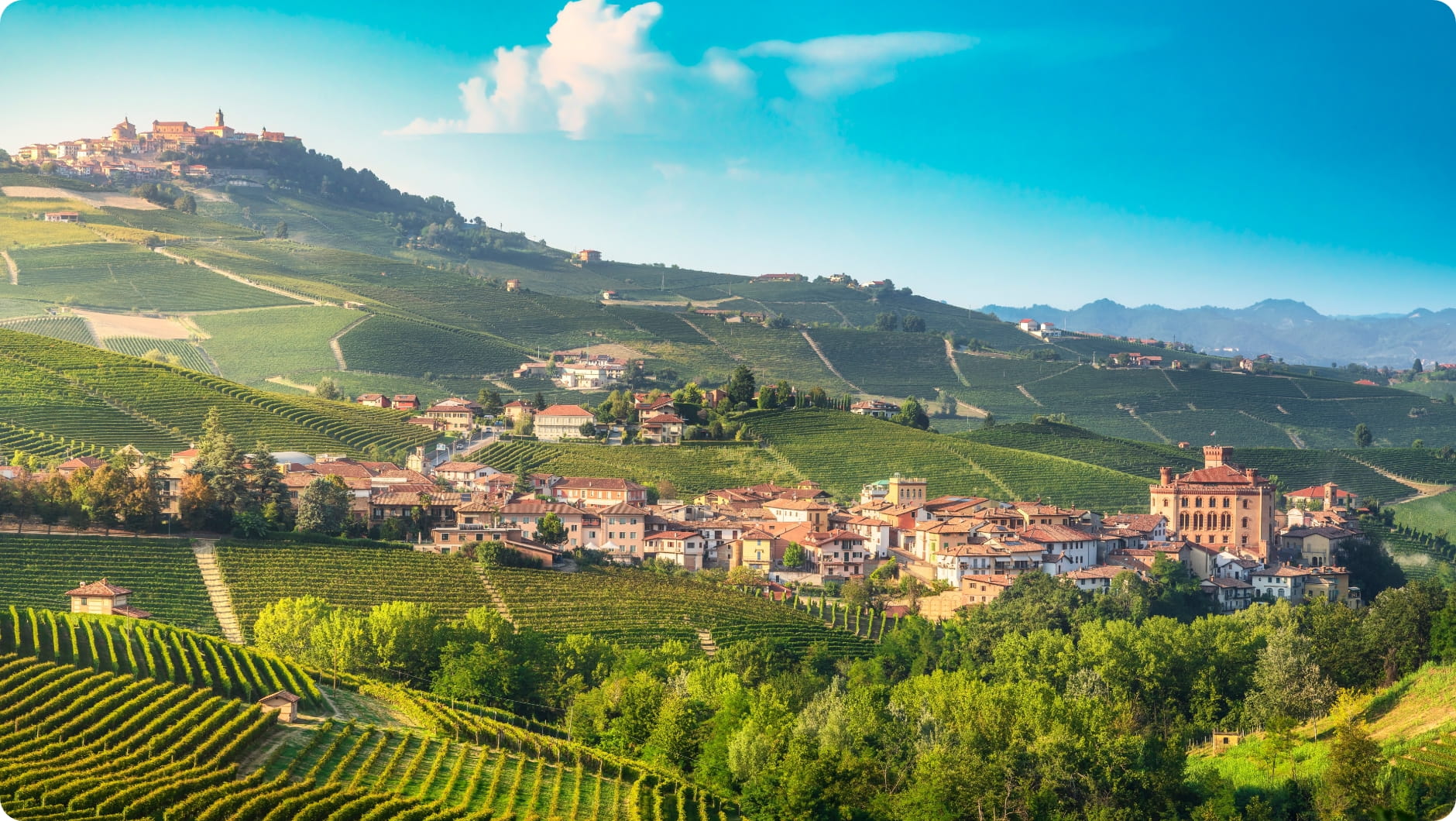
“Barolo” is a red wine with Denominazione di Origine Controllata e Garantita (DOCG) status, produced exclusively from nebbiolo grapes in eleven municipalities in the province of Cuneo, on the hills of the Langhe south of Alba: entirely in Barolo, Castiglione Falletto and Serralunga d'Alba, and partly in Monforte d'Alba, Novello, La Morra, Verduno, Grinzane Cavour, Diano d'Alba, Cherasco and Roddi.[1] The consortium for its protection presents it as the wine that became, in the nineteenth century, “the ambassador of Savoy Piedmont in the courts of all Europe,” hence the phrase “the king of wines, the wine of kings.”[2] Its history runs largely through Turin: through the Savoy court, through the Falletti marquises’ Turin palace, and through the government of Cavour.
Before Barolo
Nebbiolo had been grown in Piedmont for centuries, but the wine it produced was different from today’s. Passing through Turin on 17–18 April 1787, Thomas Jefferson noted in his travel diary: “There is a red wine of Nebiule made in this neighborhood which is very singular. It is about as sweet as the silky Madeira, as astringent on the palate as Bordeaux, and as brisk as Champagne.”[3] A wine, then, that was sweet and lively, far removed from today’s. The account of Barolo’s history published by the Comune di Grinzane Cavour describes the Barolo of that time as probably rosé and sweet, and places the shift toward a wine that was “dry, with more color and, above all, suited to a certain amount of aging” in the middle decades of the nineteenth century.[4]
The Falletti and Cavour
In 1814 the Marquis Carlo Tancredi Falletti di Barolo, born in 1782 at Palazzo Barolo in Turin, and his French wife Juliette Colbert, whom he had married in Versailles in 1806, settled in the family palace in the city. Giulia, as she came to be called in Italy, recognized the potential of the family’s vineyards in the Langhe: together with her husband she expanded the Cascina del Pilone and had underground cellars dug to vinify nebbiolo under controlled conditions.[5] According to the tradition preserved by the Marchesi di Barolo winery, the marchioness, urged by King Carlo Alberto to let him taste her wine, had 325 “carrà” — the transport casks of the time — brought to him, one for each day of the year except the forty days of Lent.[5] In Turin, Giulia di Barolo is remembered above all for her social commitment: she was the first in Italy to raise the issue of women’s prisons, and, dying without heirs in 1864, she left her entire estate to the Opera Pia Barolo that she had founded, which today, as Opera Barolo, continues her work.[6]
In the same years Camillo Benso di Cavour was mayor of Grinzane from 1832 to 1849 and introduced agricultural improvements and the production of quality wines on the family estates.[7] Between 1835 and 1845 two innovators worked in the area — at Verduno, in the castle bought by Carlo Alberto, and at Grinzane, in Cavour’s farmsteads: General Francesco Staglieno and the French enologist Louis Oudart, who pressed for dry, fully fermented wines. In the 1847 inventory of the cellars of the castle of Grinzane, “the Staglieno-style wine” and “the French-style wine” appear side by side.[4]
The House of Savoy also entered the world of Barolo. In 1858 Vittorio Emanuele II bought the Fontanafredda estate, at Serralunga d'Alba, and two years later passed it on to the children he had with Rosa Vercellana, the “Bela Rusin”; from 1878 his son Emanuele Guerrieri, Count of Mirafiore, began producing wine there.[8][9] Having passed to Monte dei Paschi di Siena in 1932, the company returned to Piedmontese hands in 2008 with Oscar Farinetti and his partners.[8][9]
The rules of the designation
Barolo received DOC status by decree on 23 April 1966 and DOCG status by decree on 1 July 1980. The production regulations require at least 38 months of aging, of which 18 in wood, with release from 1 January of the fourth year after the harvest; for the Riserva the period rises to 62 months. The maximum yield is 8 tonnes of grapes per hectare and the minimum alcohol content on release is 13 degrees.[1] In 2010 the additional geographical designations, the “MGA,”[2] were delimited — a long list of vineyard and locality names that may appear on the label, such as Cannubi, Brunate, Bussia, Cerequio, Monprivato and Rocche dell’Annunziata.[1] The Marchesi di Barolo winery, owned by the Abbona family since 1929, vinified its historic crus Cannubi, Coste di Rose and Sarmassa separately as early as 1973.[5]
Traditionalists and modernists
After three difficult harvests between 1975 and 1977, during which many growers were forced to sell their grapes to brokers at very low prices, Elio Altare began vinifying on his own and adopted the barrique, in part because he did not have enough wine to fill the large casks. In the 1980s he was followed by Luciano Sandrone, Roberto Voerzio, Domenico Clerico, Elio Grasso and others: the so-called “Barolo Boys,” set against producers loyal to the large casks, such as Giovanni Conterno. The dispute also had a conciliatory moment: after a comparative tasting organized in Turin by Carlo Petrini, Conterno admitted: “today we have tasted some excellent Barolos.”[10]
The symbol of the opposing side was Bartolo Mascarello, who died in 2005, custodian of a Barolo winery whose first label dates back to 1918: he refused the barrique and continued to blend the grapes of four vineyards in the traditional Langhe manner. One of the winery’s labels bears the motto “No barrique No Berlusconi.” A film, Barolo Boys, was dedicated to the affair in 2014.[11]
Landscape, museums and market
On 22 June 2014, in Doha, the wine-growing landscapes of Langhe-Roero and Monferrato became Italy’s fiftieth UNESCO World Heritage site; one of its components is the Langa del Barolo, comprising the municipalities of Barolo, Castiglione Falletto, Grinzane Cavour, La Morra, Monforte d'Alba, Novello and Serralunga d'Alba.[12] The castle of Grinzane has housed, since 1967, the Enoteca Regionale Piemontese Cavour, the first regional wine library opened in Piedmont;[7] in the municipal Falletti castle in Barolo, the WiMu, a wine museum designed by François Confino, stands alongside the Enoteca Regionale del Barolo, housed in the cellars.[13]
In 2020 Barolo counted about 2,200 hectares of vineyard and around 350 producers, with annual production of around 14.5 million bottles. That summer, with the price of bulk wine having fallen 42% in a year, the assembly rejected, by 163 votes to 70, the consortium’s proposal to set aside part of the harvest.[14] In 2024 bottling rose again to 13.75 million bottles (+3.8%), while the price of bulk wine fell to 7.90 euros per liter and stocks reached the equivalent of 74.9 million bottles.[15] In 2025 the president of the Consorzio di tutela Barolo Barbaresco Alba Langhe e Dogliani, Sergio Germano, described the denomination’s wines as “an integral part of the table.”[16]
Pages linking here
- Alba
- Alessandro Antonelli
- Carlo Petrini
- Comencini's Pinocchio Puppet on Display in Turin
- Giovanni Bosco
- La voce di Alba
- Langhe
- Libreria San Paolo (Torino)
- Monferrato
- Monumental Cemetery of Turin
- Museo Nazionale del Risorgimento Italiano
- Nebbiolo
- Quadrilatero Romano
- Slow Food
- Theft of Over Three Thousand Bottles of Barolo from the Conterno e Fantino Winery in Monforte d'Alba (September 2026)
Related articles: Alba, Langhe, Monferrato
Sources
- Consorzio di Tutela Barolo Barbaresco Alba Langhe e Dogliani
- Consorzio di Tutela Barolo Barbaresco Alba Langhe e Dogliani
- National Archives – Founders Online
- Comune di Grinzane Cavour
- Marchesi di Barolo
- WineNews
- Castello di Grinzane Cavour
- Unioncamere – Registro delle imprese storiche
- Fontanafredda
- Cronache di Gusto
- Aste Bolaffi
- Gazzetta d'Alba — 22 June 2014
- WiMu – Museo del Vino di Barolo
- Fondazione Qualivita — 15 July 2020
- ItaliaOggi
- Targatocn — 9 October 2025