Paolo Conte
Singer-songwriter, composer and pianist from Asti (b. 1937), a lawyer who turned to music: author of Azzurro and of an auteur jazz that sings of rural Piedmont.
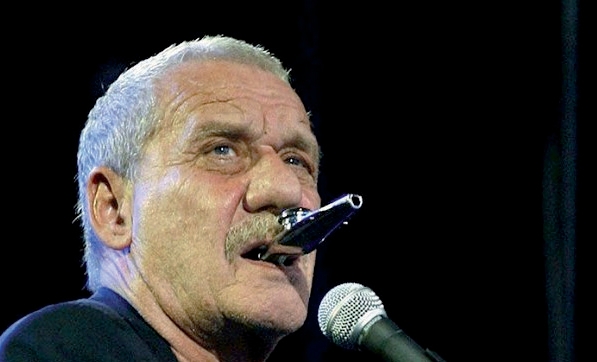
Paolo Conte (Asti, 6 January 1937) is a Piedmontese singer-songwriter, composer and pianist, a law graduate and practising lawyer[1]. In the late 1960s he wrote highly successful songs for other performers, from Azzurro to Insieme a te non ci sto più, and from the middle of the following decade he established himself as the performer of his own songs, sung with irony and in a jazz-inflected style[2]. The historic Asti magazine «Astigiani» calls him the most famous living native of Asti in the world, and the landscapes of rural Piedmont return constantly in his songs[3].
Asti, family and jazz
He was born on corso Dante in Asti, at what is today number 60. His father Luigi, known as Gigi, was a notary like his grandfather and played the piano well; his mother Carlotta also played. His brother Giorgio, four years younger, would likewise become a lawyer and singer-songwriter. Paolo attended the city's classical lyceum named after Vittorio Alfieri and graduated in law from the University of Parma[3].
His first musical schooling came from a teacher who had arrived from Genoa. In the early 1950s the clarinettist Domenico «Mingo» Chiodo, who had played in Genoa and Turin with bands such as the Gate Avenue Strawhatters, settled in Asti, and a group of young people gathered around him to form the Original Barrelhouse Jazz Band, with Conte on trombone[4]. Conte later described that amateur apprenticeship in writing:
«So began two years of empirical lessons, repeated daily, which consisted of walking along corso Dante and corso Alfieri four abreast, each of us making a sound with our mouth to learn rhythms and counterpoints»
The recollection is reported by «Astigiani»[4]. There followed the Paul Conte Quartet, in which he played vibraphone, and the Lazy River Band Society, founded by semi-professional musicians from Asti, with which Conte took part in the late 1950s in the «Coppa del Jazz», a Rai radio competition in Rome[3].
The lawyer who wrote for others
He practised law in the firm he shared with his brother Giorgio, and it also fell to him to act as a bankruptcy trustee. For years, in the afternoon and in any weather, he drove with his brother to Milan to meet music publishers[3]. In the 1960s his music reached the wider public through other voices: La coppia più bella del mondo and Azzurro for Adriano Celentano, and songs for Caterina Caselli, Patty Pravo (Tripoli '69) and Bruno Lauzi[1]. For Caselli he wrote Insieme a te non ci sto più, for Lauzi Onda su onda, for Enzo Jannacci Messico e nuvole[5].
Azzurro, with lyrics by Vito Pallavicini, was recorded by Celentano in 1968[6]. Conte recounted its origin as follows: «I composed the music right here, in my house, and recorded it on the piano with the old Geloso tape recorder, the one with the red, yellow and blue keys». Conte took the recording to his Milanese publisher, Franz Leonardi, whose factotum Oreste Corecà managed to get Celentano to listen to it while he was shaving[3].
The singer-songwriter
In the mid-1970s he decided to sing his own songs himself. He explained the choice this way: «I had realised that young people wanted an author to bear personal witness to what he wrote, even if his singing had a thousand limitations, as mine did»[3]. In 1974 and 1975 two albums simply titled Paolo Conte came out; popular success arrived in 1979 with Un gelato al limon, followed by Paris Milonga (1981) and Appunti di viaggio (1982)[1]. From 1981 comes Parigi, with the line «pioggia, pioggia, pioggia e Francia» («rain, rain, rain and France»)[7].
That same year Conte was at the Club Tenco festival, named after Luigi Tenco, where Roberto Benigni addressed him from the stage with a joking dedication, and Conte replied by dedicating Il loggione «to Benigni's aunt, with whom he is hopelessly in love»: the episode is recounted by Vincenzo Mollica in Giorgio Verdelli's documentary[8].
From the second half of the 1980s he played in Paris at the Théâtre de la Ville and the Olympia, and in 1988 at the Blue Note in New York; Aguaplano (1987), Parole d'amore scritte a macchina (1990) and Novecento (1992) followed[1]. His later discography includes Una faccia in prestito (1995), Elegia (2004), Psiche (2008), Nelson (2010), Gong-oh (2011), Snob (2014) and his first instrumental album, Amazing Game (2016); in 2017 Zazzarazàz retraced forty years of his career[2].
The "landscape painter" of Piedmont
Amid the theatres of half of Europe, Conte has continued to recognise himself in his native land:
«In my feigned or genuine modesty, I consider myself perhaps the best musical landscape painter of our land. Songs like Genova per noi and Diavolo Rosso capture precisely the essence of our deep, archaic countryside.»
The words are taken from the interview with Luigi Florio and Sergio Miravalle[3]. His bond with the area has also left minor traces. In the spring of 1980 he composed Torretta Calipso for the Asti team Torretta Santa Caterina, which on 25 May, beating Pontedecimo 1–0 in the last match of Serie D, celebrated promotion to Serie C2. The track was recorded in Turin, in a studio on corso Casale, with professional musicians such as bassist Paolo Berardi, on a text written with Piero Fassio that mixed Italian with the Piedmontese language; played over the stadium's loudspeakers and on a cassette tape printed for the occasion, it was forgotten after the club's merger with Asti on 15 June 1980[9]. Conte is also an enigmistics (puzzle) enthusiast: for the same magazine he composed seven mnemonic cryptograms[10].
Painter and author of musical theatre
Alongside music, Conte cultivates drawing and painting. In 2000 he staged Razmataz, a musical comedy set in Paris in the autumn of 1925, dedicated to old Europe's encounter with the jazz of Black Americans; in 2019 Feltrinelli published the script with his intensely coloured plates and a conversation with musicologist Manuela Furnari[11]. In 2007 the Academy of Fine Arts of Catanzaro awarded him an honorary degree in painting[2].
Awards and recent years
In 1991 he received the Librex-Guggenheim «Eugenio Montale» prize for lyric-writing; in 1999 he was made a Cavaliere di Gran Croce, in 2001 a Chevalier dans l'Ordre des Arts et des Lettres in France, and in 2003 the University of Macerata awarded him an honorary degree in Modern Literature[2]. In Macerata he opened his speech by declaring «the embarrassment of someone absolutely unable to deliver a lectio doctoralis for you»[12].
In 2020 the Venice Film Festival presented, out of competition, Giorgio Verdelli's documentary Paolo Conte, via con me, with testimonies from, among others, Roberto Benigni, Francesco De Gregori, Vinicio Capossela and Jane Birkin[13]. On 20 February 2023 Conte became the first singer-songwriter to perform at Milan's Teatro alla Scala[2]: accompanied by his eleven-piece orchestra, he opened with Aguaplano and closed with Via con me to a standing ovation from the whole theatre, after the doubts of the eve: in the past La Scala had turned down artists such as Bob Dylan and Paul McCartney[14]. The concert became the film Paolo Conte alla Scala. Il Maestro è nell'anima by Giorgio Testi, premiered at the Torino Film Festival and released in cinemas on 4, 5 and 6 December 2023[15].
Pages linking here
Related articles: Asti
Sources
- Treccani
- Treccani
- Astigiani — 17 March 2026
- Astigiani — 23 January 2020
- Il Post — 6 January 2017
- Il Post — 24 June 2012
- Il Post — 23 April 2012
- Il Fatto Quotidiano — 25 September 2020
- Astigiani
- Astigiani — 19 June 2024
- Astigiani
- Astigiani — 17 November 2021
- Il Fatto Quotidiano — 12 September 2020
- Il Fatto Quotidiano — 20 February 2023
- Il Fatto Quotidiano — 20 November 2023