Piedmontese language
Romance vernacular of Piedmont, with Turinese as the shared model: eight centuries of texts, an 1783 grammar, and a regional recognition struck down in 2010.
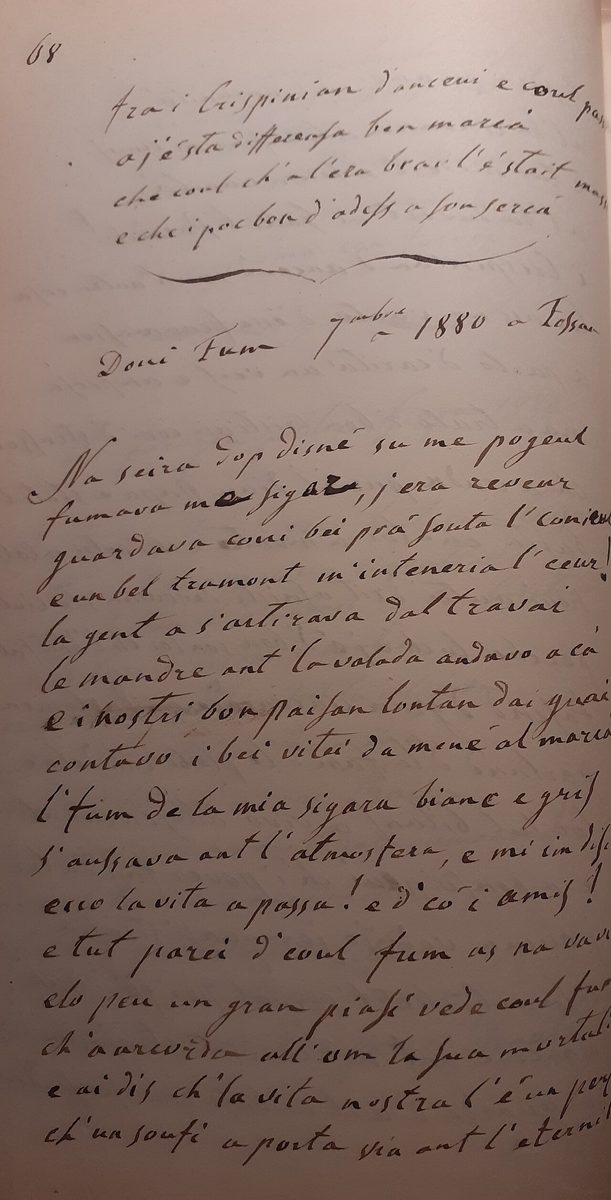
The Piedmontese language (piemontèis) is the Romance vernacular of the plains and hills of Piedmont, centred on the variety spoken in Turin: Turinese, which has spread from the capital toward the countryside and the larger towns over the last three centuries, has become the shared model and the basis of modern literature.[1] In international language catalogues it has its own code, pms, and the Glottolog database, which places it among the Gallo-Italic varieties, considers it vulnerable, since its use has declined especially in cities and among younger speakers.[2]
Where it is spoken
Administrative Piedmont does not coincide with the area where Piedmontese is spoken. Left out are the Occitan- and Franco-Provençal-speaking communities of the western valleys, the Lombard-type varieties east of the Sesia, and the Walser-speaking enclaves. Within the area, subgroups with their own features are recognised: Canavesano, Biellese, Valsesiano, Alessandrino, Monferrino and Langarolo — the varieties of Canavese, Biella, Monferrato and the Langhe.[1] A broader division, reported by the Treccani encyclopedia, separates an Upper Piedmontese group, which includes Turin and Cuneo, from a Lower Piedmontese group, which includes Vercelli and Alessandria.[3]
The same work notes that these varieties are not sharply distinct from the other dialects of northern Italy, with which they share, for instance, the loss of final vowels other than -a, and that they were originally closer to the varieties north of the Alps, later diverging under Italian influences arriving from the south and east.[3]
Turinese, the language of the capital
Turin's weight as the Savoy capital explains why a single dialect became the reference point for all the others. Linguist Davide Ricca sums it up this way:
"The dialect of the regional capital, Turin, gradually expanded over the last three centuries, giving rise to a fairly linguistically uniform area"
The first codification was born at court. In 1783 Maurizio Pipino published the first Gramatica piemontese, written in Italian.[1] Born in Cuneo in 1739, Pipino also published, that same year, a Vocabolario piemontese and a volume of Poesie piemontesi; the grammar and vocabulary were dedicated to Maria Adelaide Clotilde Saveria of France, Princess of Piedmont by marriage into the House of Savoy, who had insisted on learning the local speech; Pipino stated that he was describing the "Turinese or courtly" Piedmontese, that is, the cultivated language of the capital rather than that of the countryside.[4] In 1859 came the great dictionary of Vittorio di Sant'Albino.[1]
Sounds and grammar
To an Italian ear, Piedmontese is immediately recognisable for three vowels unknown to Italian: ö and a "French-style" u, and an indistinct vowel written ë. Syllables can pile up consonants, and the simple past tense is entirely absent. In syntax two features stand out: short subject pronouns, obligatory with the second and third person singular and the third person plural, and negation placed after the verb. "I have not eaten" is rendered, in phonetic transcription, i l aj nèn mangià: literally "I have not eaten."[1]
The spelling used today is largely phonemic but Italian in appearance, with one quirk that confuses first-time readers: the letter o stands for [u] and u for [y], as in French. It was fixed in the 1930s by the poet Pinin Pacòt (1899-1964), a promoter of an elevated literary use of Turinese.[1]
Eight centuries of writing
The oldest texts are the so-called Sermoni subalpini, sermons possibly dating from the late 12th century. The first printed book dates from 1521: the Opera Jocunda by Giovan Giorgio Alione, a collection of farces in the dialect of Asti. In the eighteenth century Ignazio Isler (1702-1788) wrote in Piedmontese.[1]
The Turinese Edoardo Ignazio Calvo (1773-1804), a physician at the San Giovanni Battista hospital and a Jacobin sympathiser, is regarded as the founder of a strand of Piedmontese dialect poetry: his Favole morali, in terza rima, appeared in 1802 with no printer's details, because they attacked Bonapartist politics; he died of typhus contracted while practising medicine.[5] Angelo Brofferio, born in 1802 in Castelnuovo Calcea in the Asti area, wrote politically inspired songs in Piedmontese, was arrested in 1831 for belonging to the secret society of the Knights of Liberty, edited the Messaggiere torinese from 1836 to 1849, and from 1848 sat in Parliament among the radical democrats.[6]
The most successful text is a play. Le miserie 'd monsù Travèt by Vittorio Bersezio opened on 4 April 1863 at the Teatro Alfieri in Turin with Giovanni Toselli's company; translated into Italian as Le miserie del signor Travetti, it was praised by Alessandro Manzoni and toured theatres in Italy and abroad. The name of its protagonist, a humble clerk, entered Giorgio Petrocchi's dictionary as a synonym for a petty bureaucrat: the Italian common noun "travet" comes from it.[7]
Language or dialect: the 2009 law
Regional law no. 11 of 7 April 2009, "Protection, promotion and advancement of Piedmont's linguistic heritage," listed "the Piedmontese language" among the languages to be protected. Challenged before the Constitutional Court, the law was scaled back: in ruling no. 170 of 10 May 2010 the Court declared unlawful the provisions referring to Piedmontese, because the Region had given Piedmontese a status equivalent to that of the minorities listed in national law 482 of 1999, which does not include it.[8] According to the Court, the region's authority over culture does not confer
"the autonomous and unrestricted power to identify and protect — for every purpose — a 'language' of its own, regional or otherwise minority, even beyond what has been recognised and established by the national legislature"
Piedmontese therefore remains, under Italian law, outside the exhaustive list of minority languages set out in Article 2 of Law 482; the regional law continues to apply to Piedmont's other vernaculars.[8]
Use today
According to 2006 ISTAT data cited by Ricca, 9.8% of those surveyed in Piedmont said they spoke only dialect at home, and 25.4% said they alternated it with Italian. Exclusive use at home had more than halved since 1988, but the remaining share appeared to have stabilised; Piedmont is among the regions where dialect vitality is particularly low, especially in urban areas.[1] Internationally, the language is listed among those at risk, with a sharp decline in use in urban centres and among younger generations.[2]
Related articles: La Stampa, Piemonte
Pages linking here
- Battista Pininfarina
- Bicerin
- Chieri
- La Stampa
- Macugnaga
- Paolo Conte
- Piemonte
- Pietro Micca
- Pininfarina
Sources
- Treccani – Enciclopedia dell'Italiano —
- Glottolog (Max Planck Institute)
- Treccani – Enciclopedia Italiana
- Treccani – Dizionario Biografico degli Italiani
- Treccani – Dizionario Biografico degli Italiani
- Treccani – Dizionario Biografico degli Italiani
- Treccani – Dizionario Biografico degli Italiani
- Corte costituzionale — 13 May 2010