La Stampa
Turin's daily newspaper, founded in 1867 as the Gazzetta piemontese; owned by the Agnelli family for a century, and by the Sae group since 2026.
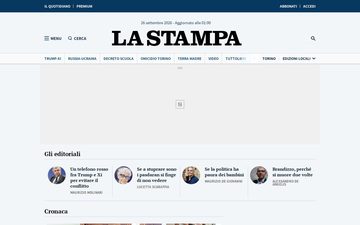
La Stampa is Turin's daily newspaper. Born in 1867 as the Gazzetta piemontese, it took its current name in 1895; for a century it was tied to the Agnelli family, and since 2026 it has belonged to a company built around the Sae publishing group[1].
Bersezio's Gazzetta piemontese
The paper was founded in Turin in 1867 by Vittorio Bersezio, who ran it from February of that year until January 1880[1][2]. Turin had just lost its role as capital, and the paper was born with an openly regional and moderate stamp: Bersezio made it the voice of Turin's lower and middle bourgeoisie, backed the campaigns of small landowners hit by fiscal policy, and took a leading part in the paper's polemic against the Historical Right. Alongside the daily he ran a weekly supplement, the Gazzetta letteraria[2].
Frassati and the liberal paper
The leap in scale came with Alfredo Frassati, born in 1868 in Pollone, near Biella. On 31 December 1894 he signed the agreement that made him co-owner of the publishing house, and on 1 January 1895 the paper appeared under its new masthead, «La Stampa – Gazzetta piemontese»[3]; the old name survived as a subtitle until 1908[1]. The early period was shared with Luigi Roux, editor and owner, made a senator in 1898; when in 1900 Giolitti called Roux back to Rome to head La Tribuna, the paper passed to a new company in which Frassati held two-thirds of the ownership and the post of editor[3], and from 1901 he was its sole editor[1].
Already under Roux, from 1897, the young economist Luigi Einaudi wrote for the paper, carrying the card of "staff writer and contributor": his were the reports on the strikes of Biella's textile workers in autumn 1897 and on the Genoa port dispute between 1900 and 1901, before he moved to the Corriere della sera in 1903[4].
Frassati transformed the company: he widened the network of contributors, strengthened the corps of correspondents, reorganised the paper's technical layout, and in 1906 secured the right to publish the telegrams of the Times and the Matin simultaneously. In May 1915 circulation reached three hundred thousand copies[3]. Its line was liberal and close to Giovanni Giolitti: the paper backed the Libyan campaign but opposed Italy's entry into the Great War[1]. Frassati argued for a «vigile neutralismo» ("watchful neutrality") and called the looming conflict «inutile e immane» ("useless and immense")[3].
Fascism and the arrival of the Agnellis
In the early postwar years La Stampa was among the few dailies to openly oppose the 1923 decree on the press, and after the Matteotti murder it mounted a genuine indictment of fascism[3]. 1925 was also the year Frassati lost his son Pier Giorgio, who died on 4 July. On 29 September the prefect suspended the paper; the industrialist Riccardo Gualino tried to buy it, but Frassati refused, and on 3 November the paper returned to newsstands under two co-editors. On 9 November Frassati announced his withdrawal "for reasons of a personal nature", and his stake passed to senator Giovanni Agnelli, founder of FIAT[3]. Under the new ownership, formalised in 1926, the paper was brought into line with the regime's directives[1].
In 1938, under the racial laws, the Asti-born journalist Giulio De Benedetti, who was Jewish, was struck off the professional register; Agnelli arranged for him to keep working for La Stampa unsigned[5].
The postwar years and the De Benedetti era
Suspended after the Liberation, the paper resumed publication in 1945 under the editorship of Filippo Burzio; from 1947 to 1992 it was accompanied by the afternoon edition Stampa sera[1]. In January 1948 the editorship passed to De Benedetti, born in Asti in 1890, who held it until 4 December 1968: in twenty years he made La Stampa the second Italian paper by weight and circulation after the Corriere della sera, chosen by a secular, progressive readership[5]. He introduced columns for young readers, humour, fashion and sport, strengthened the network of provincial correspondents, and invented «Specchio dei tempi» ("Mirror of the Times"), the readers' letters column that became a powerful instrument of Turin's public opinion. De Benedetti personally read hundreds of letters and controlled how they were published, as he told Eugenio Scalfari in an interview published after his death[5]:
«The paper would record, let off steam, but moderate things with headlines, always balancing one kind of opinion against its opposite. The whole secret lay in the dosage and in the headlines.»
Politically the editor backed centre-left governments and the opening towards the Socialist Party[5]. Later editors include Mario Calabresi, from 2009 to 2015, and Andrea Malaguti, from 2023[1].
From the Agnelli family to the new publishers
In 2014 the paper was folded into Italiana Editrice S.p.A. and in 2017 into the GEDI group; in March 2026 GEDI signed a preliminary agreement to sell it to the Sae group[1]. The negotiations were accompanied by a state of agitation among the staff, suspended in mid-May when the newsroom committee judged «soddisfacenti le garanzie offerte dal gruppo Sae» ("the guarantees offered by the Sae group" to be "satisfactory") on jobs and pay[6].
On 28 May 2026 the paper passed to the new company La Stampa Sae Spa, effective from 1 June. The majority, 51%, belongs to a Piedmontese holding company held by Alberto Leonardis's Sae and by the Toto group; 22% belongs to the Fondazione 9 febbraio 1867, tied to the Elkann family and to Exor and traceable to John Elkann; smaller stakes belong to the Fondazione di Modena, to Reale Mutua, to Piedmontese industrial associations, to the Fondazione Cassa di Risparmio di Cuneo and to the Fondazione La Stampa[7].
On 5 June 2026 the new board of directors appointed Paolo Ceretti as chairman and Massimo Briolini as chief executive; from 1 July 2026 the editorship has been entrusted to Antonio Di Rosa[8]. After nearly a century of ownership by the family that founded FIAT, Turin's daily has returned to a shareholder base weighted mainly towards owners from the Piedmontese territory[7].
Pages linking here
- Alberto Cirio
- Alberto Cirio's statements on a possible military conversion of Iveco (September 2026)
- Alberto Leonardis
- Alessandro Baricco
- Announcement of Car Tax Exemption in Piedmont for 2027
- Antonio Di Rosa
- Askatasuna
- Biella
- Cappella della Sindone
- Carlo Petrini
- Chiara Appendino
- Cinema Statuto fire
- Claviere
- Eataly
- Emilio Salgari
- Festival Insieme 2026
- Fondazione Paideia
- Gianni Agnelli
- Gianni Rodari
- Giovanni Agnelli (1866–1945)
- Giovanni Bosco
- Giovanni Giolitti
- Grissino torinese
- Guido Crosetto
- Guido Gozzano
- John Elkann
- la Repubblica Torino
- Luigi Einaudi
- March of the Forty Thousand
- Massimo Gramellini
- Mole Antonelliana
- Mole24
- Museo Egizio
- Natalia Ginzburg
- Novara
- Parco del Valentino
- Piazza San Carlo tragedy
- Piedmontese language
- Pier Giorgio Frassati
- Piero Fassino
Timeline
- — The SAE Group presented at Turin's OGR the English-language digital portal La Stampa Usa, which will debut on 13 October in New York to tell the US public about Italy. → La Stampa La Stampa
- — Piedmont regional president Alberto Cirio, interviewed on stage in Alba at a La Stampa event, says he would not be scandalised if Iveco were to convert to producing military vehicles, against a backdrop of crisis in the car industry. → ANSA Piemonte La Stampa
Related articles: Biella, Giovanni Agnelli (1866–1945), Giovanni Giolitti, John Elkann, Luigi Einaudi, Piedmontese language
Sources
- Treccani
- Treccani, Dizionario Biografico degli Italiani
- Treccani, Dizionario Biografico degli Italiani
- Treccani, Dizionario Biografico degli Italiani
- Treccani, Dizionario Biografico degli Italiani
- Prima Comunicazione (primaonline.it) — 14 May 2026
- Prima Comunicazione (primaonline.it) — 28 May 2026
- Prima Comunicazione (primaonline.it) — 8 June 2026
- ANSA — La Stampa, dal 1867 una lunga storia — 4 March 2026
- Gruppo SAE — La Stampa
- ANSA — La Stampa passa al gruppo Sae — 4 March 2026
- Teleborsa — Gruppo SAE completa l'acquisizione de La Stampa — 28 May 2026
- Storia Digitale — LA STAMPA.it: Archivio storico — 31 October 2010