Luigi Einaudi
Piedmontese economist trained in Turin, journalist for La Stampa and the Corriere, governor of the Bank of Italy and President of the Republic from 1948 to 1955.
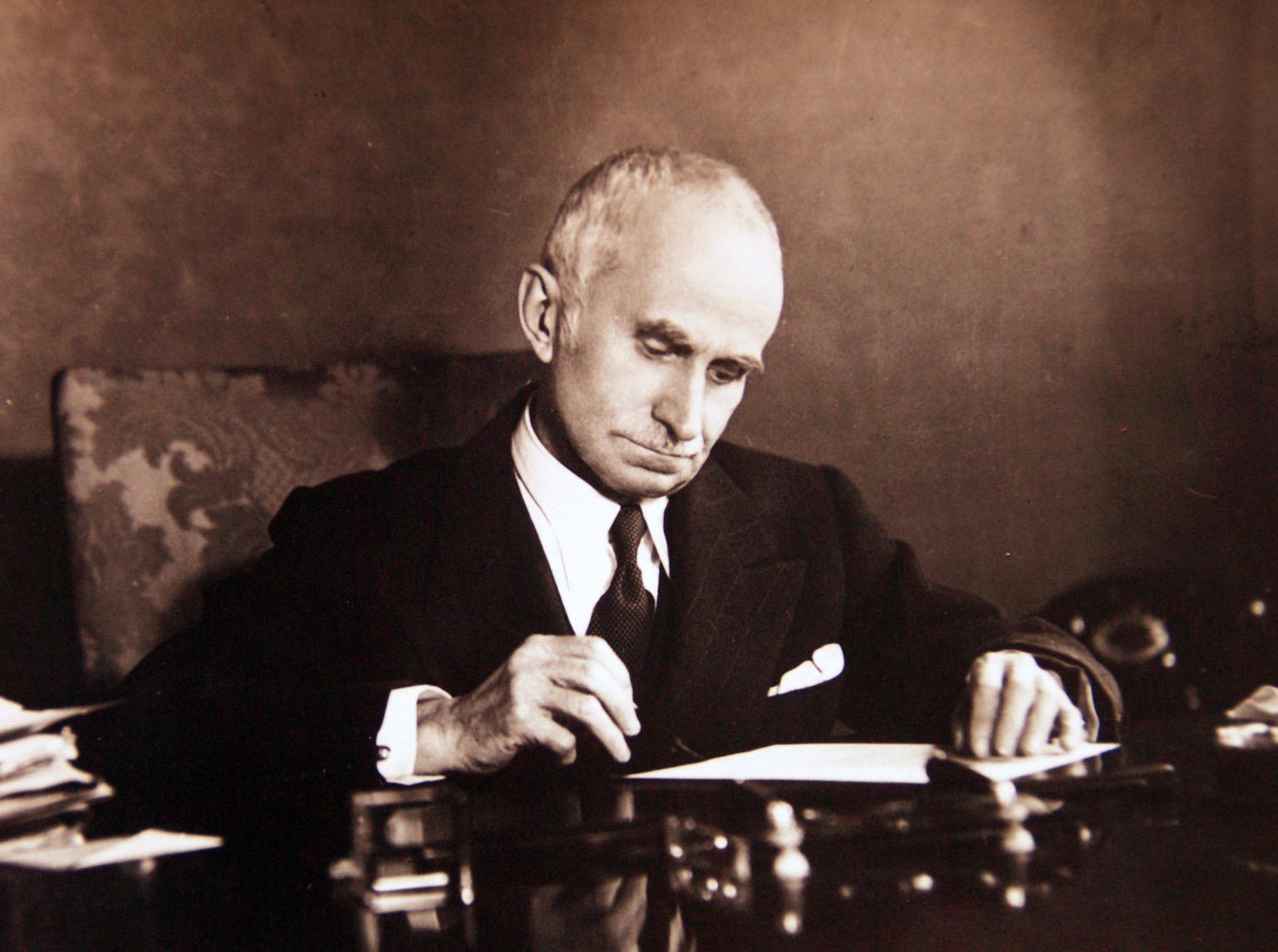
Luigi Einaudi (Carrù, 24 March 1874 – Rome, 30 October 1961) was a Piedmontese economist, journalist and politician, governor of the Bank of Italy and President of the Republic from 1948 to 1955, the first to be elected by the republican Parliament.[1] Shaped and formed in Turin, where he studied, taught for decades and was appointed rector of the university in the summer of 1943, he left the city the library and archive now held by the foundation that bears his name.[2]
From the Langhe to the Cavour lyceum
He was born at Carrù, in the province of Cuneo, to Lorenzo Einaudi and Placida Fracchia. After his father's death in 1888, the family moved to Dogliani, in the Langhe hills; young Luigi attended the Cavour lyceum in Turin and in 1891 enrolled in Law at the University of Turin, graduating in 1895.[1] He joined the Laboratory of Political Economy founded by Salvatore Cognetti De Martiis, obtained a lectureship in political economy in 1898, and also taught at technical institutes, including the Sommeiller.[1][3] In 1902 he won the chair of public finance at Pisa, but moved immediately back to Turin, where he would remain until retirement; for years he also lectured at the Bocconi in Milan.[1][4]
His ties to Dogliani never broke: at twenty-three he bought a vineyard, later enlarged with further holdings (today the Podere San Giacomo), and every year he followed the grape harvest in person; in the town he served as a town councillor, and since 25 June 2011 the town hall has housed a museum dedicated to him, while his tomb lies in the Dogliani cemetery.[5]
The economic journalist
Alongside his professorship, Einaudi was one of the most prolific economic commentators of his time. From 1896 he contributed to La Stampa, for which he wrote reportage on the textile strikes in the Biella area (1897) and on the Genoa port strike (December 1900 – January 1901).[1][2] In 1903 he moved to Luigi Albertini's Corriere della Sera, for which he wrote around 1,700 articles.[1] He was also the Italian correspondent of the London weekly The Economist: from 1908 according to the Einaudi Foundation, from 1922 according to the Dizionario Biografico degli Italiani.[2][1] Between late 1907 and 1908, after having been deputy editor, he took over the direction of the Turin journal La Riforma sociale, which gathered around him scholars such as Pasquale Jannaccone and Giuseppe Prato.[1][3]
Senator and anti-fascist
On 6 October 1919 he was appointed a senator of the Kingdom.[1] A liberal, after the murder of Giacomo Matteotti in 1924 he moved into open opposition to fascism: on 1 May 1925 he signed the manifesto of anti-fascist intellectuals promoted by Benedetto Croce, and on 27 November of the same year his last article appeared in the Corriere, from which he was forced to withdraw; in 1926 he also left the Bocconi.[1] In the Senate he voted against the single list of 1928 and, on 18 March 1935, against the war in Ethiopia.[1] That same year, 1935, La Riforma sociale was suspended for "activity contrary to the institutions of the State"; the following year Einaudi founded the Rivista di storia economica, which he directed until 1943.[3][4]
In 1903 he had married Ida Pellegrini, with whom he had three children, Mario, Roberto and Giulio.[2]
Rector, exile, governor
When the regime fell in July 1943, Einaudi was appointed rector of the University of Turin during the forty-five days of the Badoglio government.[3] He did not have time to take up the post: wanted by the authorities after 8 September, on 26 September, aged sixty-nine and together with his wife, he fled to Switzerland over the Col Fenêtre, in a snowstorm.[1] Back in Italy, on 5 January 1945 he was appointed governor of the Bank of Italy; he sat in the National Consultative Assembly and, in 1946, in the Constituent Assembly.[4] In May 1947, in a government led by Alcide De Gasperi, he became deputy prime minister and minister of the Budget: his tight credit policy halted inflation and stabilised the lira; already in his March 1947 report to the Bank of Italy he had written that saving is a function of confidence in the stability of the currency.[1]
At the Quirinale
On 11 May 1948 Parliament elected him President of the Republic on the fourth ballot, with 518 votes; he took the oath the following day.[4] In his message to the Houses on 12 May he described the passage from monarchy to Republic as «wonderful for the lawful, peaceful manner of its coming about».[6] During his seven-year term he used the presidential powers with rigour, sending back to the Houses, under article 74 of the Constitution, laws that lacked the necessary financial coverage.[1] When his term ended in 1955 he became a senator for life by right and professor emeritus.[2]
"Prediche inutili" and his legacy
From 1955 he returned to writing for the Corriere[1] and gathered his pieces in the Prediche inutili (Useless Sermons), published by Einaudi in Turin from 1956.[7] The first, Conoscere per deliberare (To Know in Order to Decide), is still cited today in debates on public policy:
«Is it any use deciding without knowing?»
In the same text he observed: «Deciding must, indeed, be followed by action».[7] Among the targets of his polemics was monopoly, which he called «the number one enemy of a free economy».[8] He died in Rome on 30 October 1961 of bronchopneumonia and was buried at Dogliani.[1]
In Turin his name is tied to specific places. The Luigi Einaudi Foundation, which holds his library and historical archive and publishes his writings, is housed in the seventeenth-century Palazzo d'Azeglio, once the home of Massimo d'Azeglio, at via Principe Amedeo 34.[2][5] In 2012 the university opened the Luigi Einaudi Campus, designed by Foster and Partners on the former Italgas site along the Dora: 45,000 square metres for the Law and Political Science departments, with the great library named after Norberto Bobbio.[9] In the city, corso Luigi Einaudi also bears his name, known for its Liberty and Art Deco buildings.[5] In southern Piedmont his memory is just as alive: at Cuneo, on the 150th anniversary of his birth, the president of the Province, Luca Robaldo, recalled him as «a great man of Cuneo whose authority and seriousness in living and governing are today an example for many».[10]
Pages linking here
- Battista Pininfarina
- Controversy over the October 7 debate on Gaza at Campus Luigi Einaudi
- Corriere di Novara
- Cuneo
- FIAT
- Fourth edition of the course «Male violence against women» at the University of Turin (September 2026)
- Gianni Vernetti
- Giornate della Legalità
- Giovanni Agnelli (1866–1945)
- Giulio Einaudi
- Giulio Einaudi editore
- La Stampa
- Luciana Littizzetto
- Norberto Bobbio
- Piero Gobetti
- Telefono Rosa Piemonte
- Torino Esposizioni
- Umberto II
- Università degli Studi di Torino
- Vittorio Alfieri
Related articles: Cuneo, La Stampa, Norberto Bobbio, Università degli Studi di Torino