Canavese
Historic region of northern Piedmont between the Serra d'Ivrea, the Dora Baltea and the Graian Alps: the land of King Arduin, of the tuchinaggio revolts, and of Olivetti.
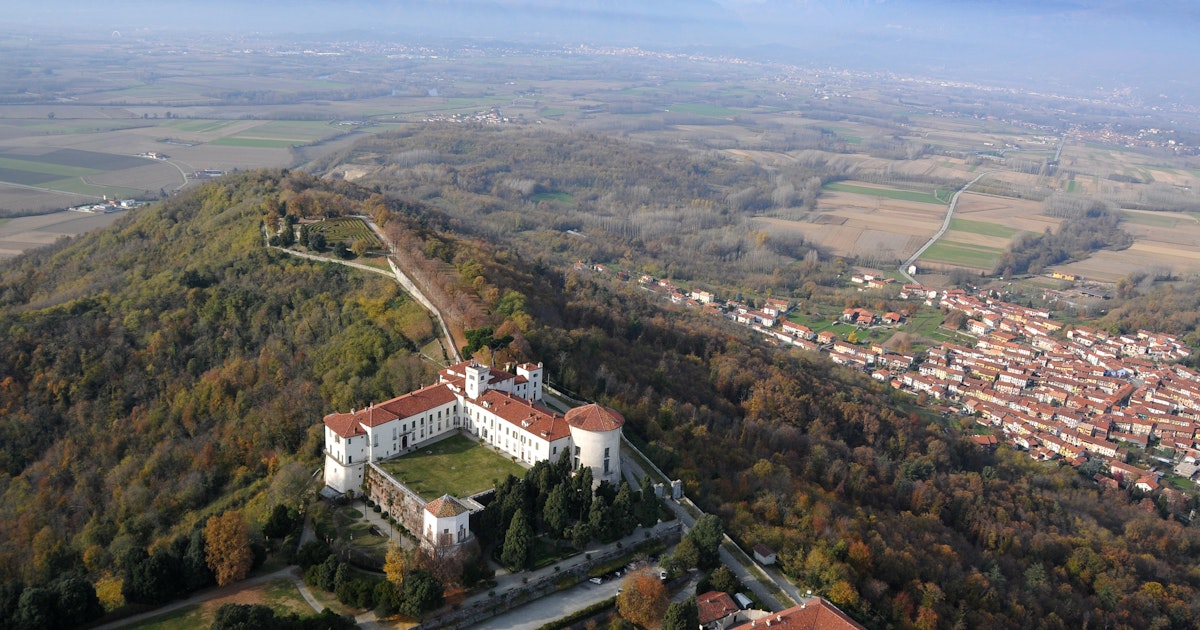
The Canavese is a historic region of northern Piedmont, lying between the Aosta Valley, the Lanzo valleys and the Turin plain[1]. Today it belongs almost entirely to the Metropolitan City of Turin and has its main centre in Ivrea. It is a territory that, without administrative borders of its own, has kept a recognizable name and identity for a thousand years: the land of King Arduin, of warring feudal counts, of the peasant revolts of the fourteenth century and, in the twentieth century, of the Olivetti factory.
Boundaries and landscape
The 1930 Enciclopedia Italiana traced the Canavese between the Serra d'Ivrea and the lower course of the Dora Baltea, from Mazzè to its confluence with the Po, and north-west to the peaks of the Graian Alps, from Levanna to Gran Paradiso, the massif now protected by the Gran Paradiso National Park[2]. The Serra is the great moraine ridge left by the glacier that descended from the Aosta Valley: the castle of Masino stands on one of its heights, and FAI describes it as one of the best-preserved glacial moraine formations in Europe[3].
The territory has two faces. The lower part, on the plain, is agricultural; in the valleys, such as the Orco valley, the economy has long been agro-pastoral, based on vineyards, cereals, fodder crops, woodland and cattle and sheep farming[1]. In the upper Orco valley, the Ceresole Reale basin, more than four kilometres long, feeds hydroelectric plants[1].
A name that does not come from hemp
For a long time it was believed that the name came from hemp, grown abundantly in the area. The authors of the 1930 entry, Pietro Gribaudi and Luigi Cesare Bollea, denied this: «The region took its name not from the abundant cultivation of hemp, but from Canava, a destroyed settlement near the Orco»[2]. Canava had belonged first to the church of Turin, today the Archdiocese of Turin, and around the year 1000 to Count Guiberto of Pombia, brother of King Arduin[2]. Its inhabitants are called canavesani[2].
Eporedia, the march and King Arduin
The oldest centre is Eporedia, a Roman colony founded around 100 BC on the road that ran from Vercelli up the Dora Baltea valley towards the Alps. The colonists coexisted uneasily with the Salassi, who diverted the river's waters for their mines and damaged the irrigation works, until Aulus Terentius Varro Murena defeated them around 25-24 BC[4]
In the 10th century Ivrea became the capital of a march. Around 990 Arduin took over its government, succeeding his cousin Conrad Cono; on 15 February 1002 the magnates of the kingdom crowned him King of Italy at Pavia[5]. His reign was a long struggle against Henry II of Germany and against Bishop Warmund of Ivrea[4]. Defeated, in 1014 Arduin became a monk at the Canavese abbey of Fruttuaria, where he died the following year[5]. The great families of the Canavese traced their own lineage back to his blood: the Valperga of Masino, for instance, claimed descent from him and held their family castle for more than nine centuries[3].
Counts, tuchini and Savoy
After the age of Arduin the Canavese broke up among feudal houses: the counts of Biandrate, of Valperga, of Masino and of San Martino[2]. In 1266, after years of war with Ivrea and Vercelli, the various counts submitted to Marquess William of Montferrat[2]; on 15 November 1313, however, Ivrea swore fealty to Count Amadeus V of Savoy and to Philip, Prince of Achaea[4]. From then on the Canavese was contested between the House of Savoy and Montferrat[2].
In the second half of the fourteenth century the Canavese was the main theatre of the tuchinaggio, a series of anti-feudal peasant revolts that Marquess Theodore II of Montferrat fostered in order to weaken the Savoys[6]. The revolts, together with the campaigns of the condottiero Facino Cane, devastated the Canavese and Ivrea[4], and ended in 1387 with the intervention of Amadeus VII, the Red Count[6]. It was under Amadeus VII that the Savoys consolidated their control of the region, confirmed in 1435 by a cession from the Marquess of Montferrat[2]. The memory of the rebellions against the feudal lord still lives on in the Carnival of Ivrea, whose Battle of the Oranges re-enacts a medieval popular uprising led by the young Violetta: the orange-throwers on foot represent the people, those on the carts the feudal forces[7]. For the 2023 edition a thousand tonnes of oranges were bought, most of them from Calabria[8].
Castles and country retreats
Of the feudal castles, some became country houses. At Masino the Valperga family turned the fortified stronghold into an aristocratic and holiday residence; in 1988 FAI bought the complex from Luigi Valperga di Masino, thanks to a donation from Giulia Maria Crespi and one from FIAT. The library holds more than 25,000 volumes, and the Salone dei Savoia reopened in 2022 after restoration[3]. The Castle of Agliè, meanwhile, is part of the Savoy Residences, the «crown of delights» arranged around Turin[9], inscribed on the UNESCO World Heritage List in 1997[10].
At Agliè the parents of Guido Gozzano had met, acting in Giuseppe Giacosa's Partita a scacchi. The family owned three houses there: Villa Amarena, Casa Mautino, near the castle, and Villa Il Meleto, the setting of the Primavere romantiche. The poet, who died on 9 August 1916, is buried at Agliè[11].
The Olivetti century
As early as 1930 the Enciclopedia Italiana noted a flourishing industry at Ivrea, Rivarolo and Cuorgnè, alongside heavy seasonal emigration: «Especially in the valleys and in the foothill area, temporary emigration to nearby France is considerable»[2]. Hydroelectric power, partly drawn from the Aosta Valley, favoured the growth of industries at Ivrea, Cuorgnè, Castellamonte, Pont Canavese and Ciriè[1].
The turning point was Olivetti. Camillo Olivetti founded the company in Ivrea in 1908 with twenty workers; by 1933 it had 870 employees, and by 1955 more than eleven thousand in Italy. Under the leadership of Adriano Olivetti, general manager from 1932, the company produced the Lettera 22 typewriter (1950), the Elea 9003 electronic computer (1959) and the Programma 101 (1965); in 1955 production was extended to the nearby plant at Agliè[12]. In July 2018 UNESCO inscribed «Ivrea, industrial city of the 20th century» on the World Heritage List, the first Italian recognition for twentieth-century industrial heritage, following a nomination launched by the Fondazione Adriano Olivetti in 2008[13]. The site comprises 27 buildings and complexes built between the late nineteenth century and the 1960s[14]. The ministry explained the choice as follows:
«Ivrea represents a distinctive example of the experimentation of social and architectural ideas on industrial processes, and an innovative experience of world-class industrial production that pays special attention to the well-being of local communities».
The statement was reported by the national press[14].
Councillor Gabusi responds to Ravinale's question on school transport links with Ivrea (September 2026)
In September 2026 the regional transport councillor Marco Gabusi responds to a question from regional councillor Alice Ravinale about public school transport links between the Alto Canavese and Ivrea, defending the timing and cost of the current service.
Overcrowding on the Gtt 3429 Chivasso-San Benigno Canavese line discussed in the Regional Council (October 2026)
The Regional Council of Piedmont discusses overcrowding on the Gtt 3429 inter-urban bus line between San Benigno Canavese and Chivasso, following a question from Democratic Party councillor Alberto Avetta and a reply from Democratic Party group leader Gianna Pentenero to the response given by transport councillor Marco Gabusi.
Overcrowding on the Gtt 3429 bus line between San Benigno Canavese and Chivasso (October 2026)
Timeline
- — The carabinieri arrest a 37-year-old man in the Canavese for threatening to kill and punching his ex-partner, triggering the Codice Rosso (fast-track domestic violence) protocol. → TorinoOggi La Stampa
- — Coldiretti Torino joins the new renewable energy community set up in the Canavese, having the community's internal rules include a rejection of photovoltaic plants that consume farmland. → Obiettivo News CronacaQui Torino
Related articles: Adriano Olivetti, Camillo Olivetti, Carnevale di Ivrea, Ivrea, Olivetti, Overcrowding of Gtt Bus Line 3429 Between San Benigno Canavese and Chivasso (October 2026)
Pages that link here
- Adriano Olivetti
- Alessandro Antonelli
- Alice Ravinale
- State Archives of Turin
- Royal Armoury of Turin
- Arrest in the Canavese for domestic abuse under the Codice Rosso protocol
- Arrest under the Codice Rosso protocol in Settimo Vittone (September 2026)
- Arrest for domestic abuse in a municipality of the upper Canavese (October 2026)
- Asl 9 Ivrea
- ASL TO4
- Canavese Industrialists' Association
- Augusto Geminiani
- Time Banks of the Province of Turin
- Baratti & Milano
- Camillo Olivetti
- Carnival of Ivrea
- Castle of Agliè
- Castle of Castellamonte
- Castle of Masino
- Who runs Turin's digital help desk
- Chapel of San Ferreolo
- Chivasso
- Metropolitan City of Turin
- Coldiretti Torino
- Renewable Energy Community of the Canavese
- Alto Canavese Mountain Community
- Orco and Soana Valleys Mountain Community
- Confindustria Canavese
- Italian Red Cross
- Dda di Torino
- Emilio Salgari
- Commendation for the Municipal Police and Carabinieri of San Maurizio Canavese for foiling a theft (September 2026)
- 2026 Feast of the Chapel of the Assumption at the Castle of Castellamonte
- Turin foundations with a default page
- Theft at the volunteer fire brigade station in Volpiano (October 2026)
- Diesel theft reported by the carabinieri of Strambino (September 2026)
- Gigi D'Agostino
- Giornale La Voce
- Giovanni Ravalli
- Grugliasco
Sources
- Treccani
- Treccani – Enciclopedia Italiana —
- FAI – Fondo per l'Ambiente Italiano
- Treccani – Enciclopedia Italiana
- Treccani
- Treccani
- Fondazione dello Storico Carnevale di Ivrea
- Il Post — 24 February 2023
- Commissione Nazionale Italiana per l'UNESCO
- UNESCO World Heritage Centre
- Treccani – Dizionario Biografico degli Italiani
- Associazione Archivio Storico Olivetti
- Fondazione Adriano Olivetti
- il Giornale — 1 July 2018
- Prima il Canavese — 27 September 2026
- La Stampa — 2 October 2026
- TorinoOggi — 2 October 2026