Carnevale di Ivrea
Carnival festival of Ivrea, with medieval roots, the legend of the Mugnaia and the Battle of the Oranges between orange-throwers on foot and on carts.
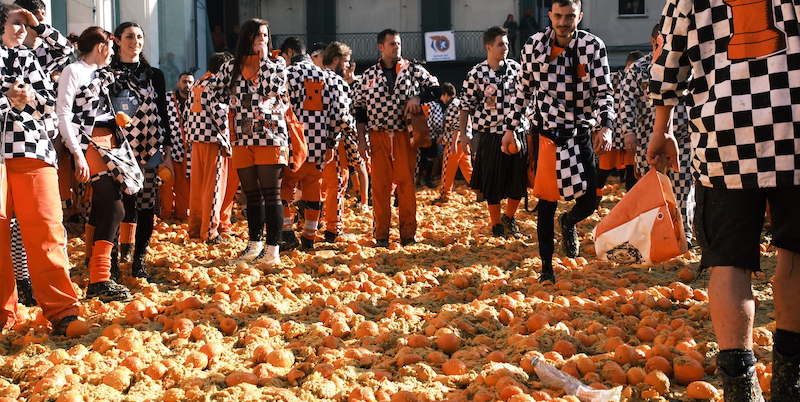
The Historic Carnival of Ivrea is the carnival festival of Ivrea, the main town of Canavese in the Metropolitan City of Turin. It is best known for the Battle of the Oranges, but it is a broader civic rite, with its own ceremonial, its own founding legend and a heroine, the Mugnaia; the Foundation that organises it traces its first records back to the 13th century[1]. For the turnover it generates it is considered Italy's third carnival, after those of Venice and Viareggio[2].
Eight centuries of history
According to the Foundation of the Historic Carnival, explicit references to the festival already appear in 1246 and 1325; the carnival was originally tied to the agricultural cycle and its protagonists were the young people of the town[1]. Between the 15th and 16th centuries the youth “badie” took shape, companies that kept order during the masquerades and that are considered the forerunner of today's General Staff[1]. Ivrea was, after all, a carnival town of some standing: in 1931 the Enciclopedia Italiana listed it alongside Venice, Florence, Rome, Turin and Nice among the places where the festival had reached its «greatest splendour»[3].
The modern form dates back to the 19th century. The list of Generals who lead the carnival, kept by the Foundation, starts in 1808[4]; that of the Mugnaie begins in 1858, with Giuseppina Gamacchio Fumel[5]. In 1956 the event was included in the calendar of Italian events of international standing[1].
The legend of Violetta and the Phrygian cap
At the centre of the story is Violetta, a miller's daughter who, according to tradition, rebelled against the ius primae noctis claimed by the lord of the town and with her act freed Ivrea from tyranny[1]. The Mugnaia who plays her every year is the symbolic figure of the festival and, since 1858, an emblem of freedom[1]. As early as 1931 the ethnologist Raffaele Corso described the festival in these terms[3]:
«that of Ivrea, where every year a great many people flock in red caps to watch the procession of the ‘bela mulinera’, in memory of the girl who, centuries ago, is said to have freed the people from the abuses of the feudal lord.»
That red cap is the Phrygian cap: from Giovedì Grasso (Fat Thursday) onwards it is worn by residents and visitors alike, and for the Foundation it signifies ideal adherence to the revolt and the aspiration to freedom[1].
The Battle of the Oranges
Oranges entered the festival between 1830 and 1860, when bourgeois girls threw them from balconies to passers-by as a gallant tribute; chronicles of the time called them «innocent projectiles»[6]. The courteous game turned over time into a battle, and only after the Second World War did the first organised teams of orange-throwers on foot emerge[6].
Today there are nine teams, each with its own square: Asso di Picche (1947) and Morte (1954) in Piazza di Città, Tuchini del Borghetto (1964) in Borghetto, Scacchi (1964) and Scorpioni d'Arduino (1966) in Piazza Ottinetti, Pantera Nera (1966), Diavoli (1973) and Mercenari (1974) in Piazza del Rondolino, Credendari (1985) in Piazza Freguglia[6]. The orange-throwers on foot represent the people in revolt; against them parade more than fifty throwing carts drawn by pairs or four-horse teams, whose occupants, who in the fiction of the festival represent the nobility[2], wear leather masks and padding[6]. The clash, the Foundation explains, rests on unwritten chivalrous rules, shared by everyone, that guarantee everyone's safety[6].
The numbers and the oranges
In the 2023 edition the teams numbered about 8,000 orange-throwers on foot, while 2,000 people rode on the 54 carts[2]. 1,000 tonnes of oranges were bought, mostly from the Turano company of Acri, in the province of Cosenza, with additional supplies from Corigliano Calabro and Palermo, paid at 60 cents a kilo[2]. To criticism over food waste, the Foundation's president, Piero Gillardi, replied that these were second- or third-grade citrus fruit, otherwise destined for pulping or cheap sale for orange drinks; since 2015 suppliers have had to comply with an anti-mafia and anti-labour-exploitation code of conduct drawn up with the association Libera[2].
The entrance ticket, charged only on the first day and only to non-residents, was raised to 15 euros to cover the roughly 300,000 euros needed for the oranges and the organisation; the rest of the costs were covered by the Piedmont Region, with 50,000 euros, and by the teams and the orange-throwers themselves, who self-taxed for 85,000 euros[2]. Over the three days there were about 100,000 attendances; according to a study by CNA the turnover was 3.5 million euros, and there were 469 injuries, 102 fewer than in 2019[2].
From the squares to compost
Once the battle is over, the crushed oranges are collected and sent to plants in Asti and Santhià, where they become compost and biomethane[2]. In 2023 Andrea Grigolon, general manager of Canavesana Multiservice, described the process thus: «the pulped oranges were collected by workers together with organic waste and horse manure, deposited in tanks and then taken to two composting plants, in Asti and Santhià, where they will be turned into natural fertiliser»[2]. In 2026 the Foundation presented a circular-economy project that returns the resulting compost to the community[7].
The carnival in today's town
The carnival has long been part of Ivrea's image: as early as 1933 the Enciclopedia Italiana, in its entry on the town, noted the «considerable folkloric interest» of the Carnival festivities[8], and since 2018 the town has also been a UNESCO World Heritage Site as «industrial city of the 20th century», the urban and social project built around Olivetti, founded in 1908 by Camillo Olivetti and developed under the direction of Adriano Olivetti[9]. The festival thus brings together two images of Ivrea: the medieval town of the revolt against the tyrant, and the community that every winter, for three days, returns to its squares to fight with oranges[2].
Pages linking here
- Adriano Olivetti
- Camillo Olivetti
- Canavese
- Concerto benefico della Topoband al Teatro Giacosa di Ivrea
- Ivrea
Related articles: Adriano Olivetti, Camillo Olivetti, Canavese, Ivrea
Sources
- Fondazione dello Storico Carnevale di Ivrea
- Il Post — 24 February 2023
- Treccani - Enciclopedia Italiana
- Fondazione dello Storico Carnevale di Ivrea
- Fondazione dello Storico Carnevale di Ivrea
- Fondazione dello Storico Carnevale di Ivrea
- Fondazione dello Storico Carnevale di Ivrea
- Treccani - Enciclopedia Italiana
- UNESCO World Heritage Centre