Camillo Olivetti
Engineer and industrialist from Ivrea (1868-1943), a student of Galileo Ferraris, who founded Olivetti in 1908, Italy's first typewriter factory.
Camillo Olivetti (Ivrea, 13 August 1868 – Biella, 4 December 1943) was a Piedmontese electrical engineer and industrialist, who founded Olivetti in 1908, Italy's first typewriter factory. A student of Galileo Ferraris in Turin, he brought to the Canavese an idea of industry founded on technical competence and attention to workers' conditions, which his son Adriano would later develop on a much larger scale.[1]
Origins and training in Turin
He was born in Ivrea to Salvador Benedetto Olivetti, a cloth merchant, and Elvira Sacerdoti, from a Jewish family in Modena. He was registered at birth as Samuel David Camillo, but always used the third name, chosen by his father «in honour of Camillo Cavour, admired for his greatness as a liberal statesman»: a tribute to Cavour that says much about the family's outlook. He lost his father in his first year of life and was raised by his mother.[1]
After classical secondary school at the Calchi Taeggi boarding school in Milan, he enrolled at the Regio Museo Industriale in Turin, the institute that from 1906 would become part of the Politecnico. He graduated in electrical engineering on 24 December 1891, with a mark of 90/100, under the guidance of Galileo Ferraris, the discoverer of the rotating magnetic field.[1][2]
America and the measuring instruments
After two years working in the mechanical industry in London, in the summer of 1893 he accompanied Ferraris to the international electricity congress at the Chicago Columbian Exposition. He stayed in the United States for about a year: he met Thomas Alva Edison, visited laboratories and factories, and for one semester taught electrical engineering at the university in Palo Alto, Stanford.[1][2]
Having returned to Ivrea in April 1894, in May 1896 he set up a small firm making electrical measuring instruments, the first of its kind in Italy.[1][2] The building that housed it, the so-called Fabbrica dei Mattoni Rossi (Red Brick Factory), a two-storey block in what is now via Jervis, was his own design.[3][4] In 1899 he married Luisa Revel, daughter of the Waldensian pastor of Ivrea, with whom he had six children.[3] In 1903 he moved the firm to Milan, where on 16 June 1905 it became the joint-stock company C.G.S. (Centimetre Gram Second, after the units of measurement); he left it in 1907, though he remained a shareholder and its chairman until 1917.[1][2]
Italy's first typewriter factory
Back in Ivrea, on 29 October 1908 he set up, with a few local partners, the limited partnership «Ing. C. Olivetti & C.», of which he held 44 of the 70 shares. Its capital was 350,000 lire, it had twenty workers, and about 500 square metres of space.[1][5] On the pediment of the plant he wanted an inscription that was also a manifesto:
«Ing. C. Olivetti & C.»
Olivetti personally designed the machine's mechanism, the so-called «kinematic» system of transmission levers, and filed two patents of his own so as not to depend on American ones; to study his competitors' organisation he went back to the United States — according to the Dizionario Biografico degli Italiani in November 1907, according to another Treccani essay between November 1908 and February 1909. The setting-up of the workshop was entrusted to Domenico Burzio, who had come up through the elementary electricity course that Olivetti had organised for the young people of Ivrea.[1][2]
The first model, the M1, was presented in Turin at the 1911 Universal Exposition, held for the fiftieth anniversary of Italian Unification, at a price of 500 lire.[1][5] In the following years the first branch offices opened and production reached 23 machines a week. When the Great War broke out, the company, which by then had more than a hundred employees, was converted to making mechanical parts for the war industry, in particular magnetos for aircraft engines.[5][1]
Growth and the handover to his son
In 1920 the second model, the M20, came out, opening new outlets on the European and South American markets. In 1922 Olivetti set up the foundry and in 1926 OMO, the Officina Meccanica Olivetti, for machine tools.[5][3] That same year Adriano joined the company for good, a freshly graduated chemical engineer from the Politecnico di Torino, after having worked in the factory as a labourer in 1924 and having in turn visited the United States.[2][5]
In 1932 the company became a joint-stock company with 13 million in capital: Camillo kept the chairmanship and the management of OMO, while Adriano was appointed managing director. In 1933, twenty-five years after its founding, Olivetti was producing 15,000 machines a year with 870 employees and was present in 22 countries.[2][5] The 1938 racial laws forced Camillo, who was of Jewish origin, to hand the chairmanship to his son, even though he had been granted an exemption («discriminato») for patriotic merits.[1]
Those who worked with him remembered above all his competence. The writer Bigiaretti noted:
«Even the humblest labourer knew that Ing. Camillo deserved respect not as a 'boss' but as a capable engineer and a capable organiser and guardian of other people's work»
Treccani stresses his attention to the material and spiritual conditions of his workers, to training and to welfare provisions, traits of an entrepreneurial approach that his son would carry much further.[3][2]
The reformist socialist
Olivetti joined the Socialist Party founded in Genoa in 1892 and had personal ties with Filippo Turati. His socialism, the Dizionario Biografico writes, was always ethical and gradualist, not materialist, and tinged with religiosity. In October 1894 he was elected to Ivrea's town council; in 1899 he also entered Turin's, from which he resigned after a few months.[1][2] In 1919 he founded the periodical L'Azione Riformista, published from August 1919 to January 1920 and turned in February 1922 into the Turin-based Tempi Nuovi: in the summer of 1924 fascist squads ransacked its editorial office and the paper closed on 8 January 1925.[1] A file on him held by the Ivrea Commissariat described him as someone who «leaves no means untried to instil his ideas in the working class».[3]
The final years
In his final years he devoted himself to reading the Bible and from 1934 drew close to the Unitarians.[1] After 8 September 1943 he urged the workers to
«take up arms, to defend your homes, your families, your machines»
Sought by the Germans, he took refuge in Pollone, in the Biella area, and died on 4 December 1943 at the hospital in Biella; he was buried in the city's Jewish cemetery.[1]
Legacy
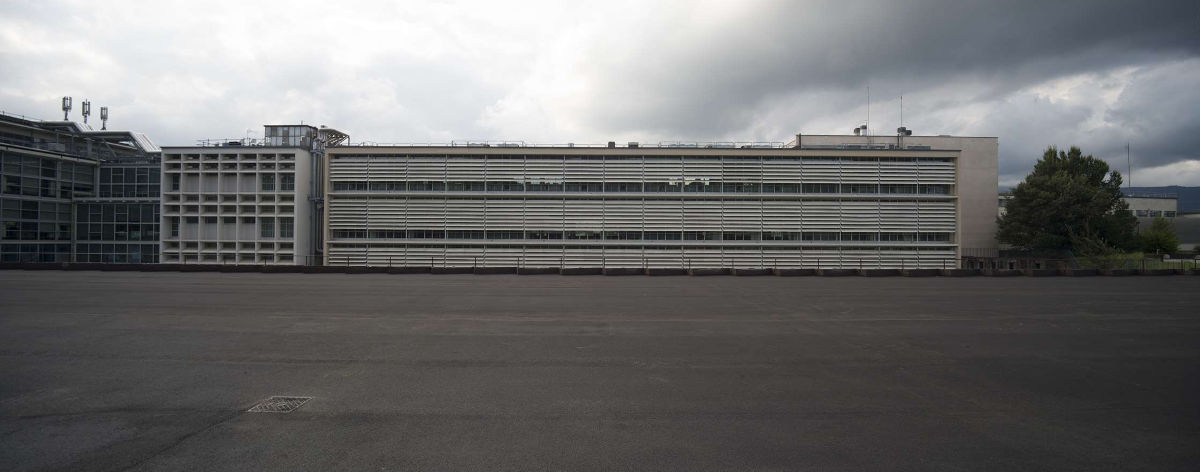
The core of the factory he designed, with the 1922 foundry and the 1926 OMO building, was expanded from 1934 by the architects Luigi Figini and Gino Pollini and is today one of the assets of «Ivrea, industrial city of the 20th century». The site, which UNESCO describes as a project founded in 1908 by Camillo Olivetti, was inscribed on the World Heritage List on 1 July 2018, during the Committee's 42nd session held in Manama.[6][7] The complex comprises 27 buildings and architectural ensembles built between the late 19th century and the 1960s.[7]
Pages linking here
Related articles: Adriano Olivetti, Canavese, Carnevale di Ivrea, Galileo Ferraris, Ivrea, Olivetti
Sources
- Treccani – Dizionario Biografico degli Italiani —
- Treccani – Il Contributo italiano alla storia del Pensiero: Tecnica —
- Associazione Archivio Storico Olivetti
- Ivrea città industriale del XX secolo (sito UNESCO)
- Associazione Archivio Storico Olivetti
- UNESCO World Heritage Centre
- il Giornale — 1 July 2018