Galileo Ferraris
Engineer and physicist (1847-1897), professor at Turin's Industrial Museum, who discovered the rotating magnetic field in 1885 and refused to patent it.
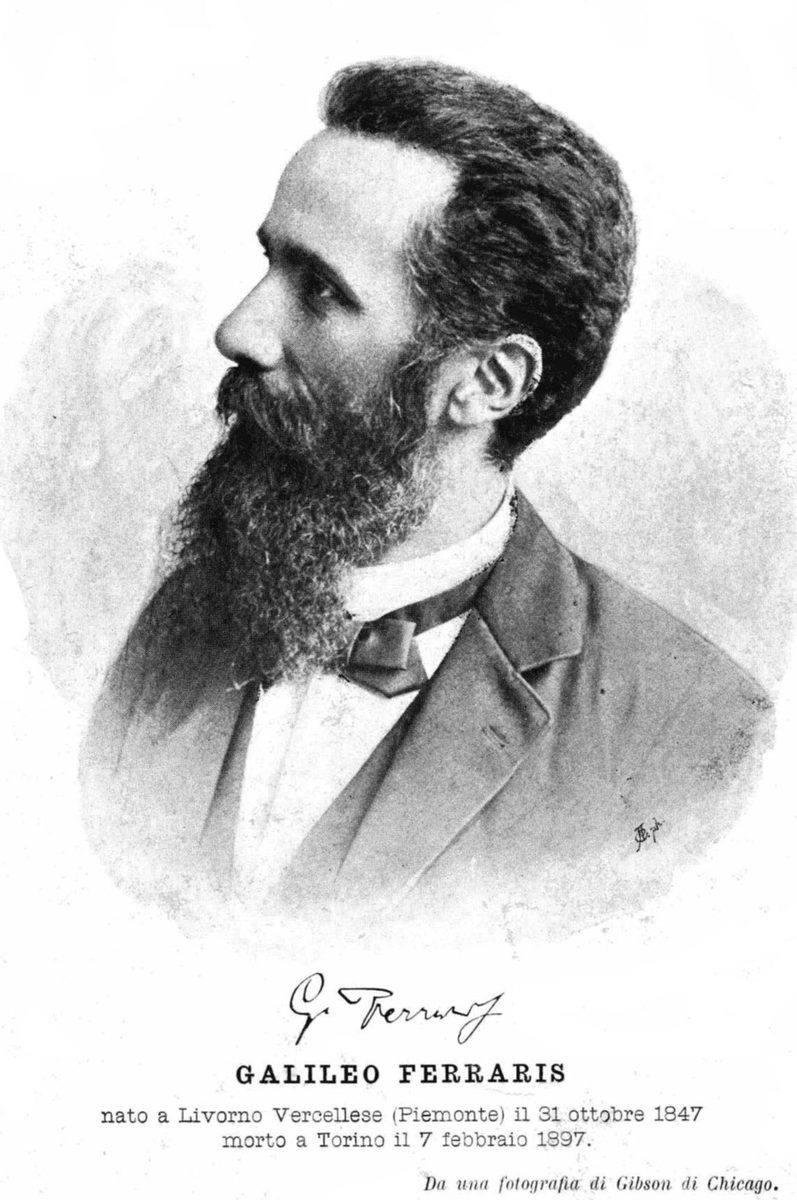
Galileo Ferraris (Livorno Vercellese, 30 October 1847 – Turin, 7 February 1897) was a Piedmontese engineer and physicist, professor of technical physics at the Royal Industrial Museum of Turin and the discoverer of the rotating magnetic field, the principle on which alternating-current electric motors work[1]. He refused to patent the discovery and made the results public, turning down an offer from a large American industrial group[1].
From Livorno Vercellese to Turin
He was born in the hamlet of Livorno, in the Vercelli area, the son of the pharmacist Antonio and of Antonia Messia. At the age of ten he left the town for Turin, where he was taken in by a doctor uncle[1]. In 1925 his native town was renamed Livorno Ferraris in his honour[1]: for the local council it is the most important date in the town's history[2].
In Turin he studied at the University and at the School of Application for Engineers, graduating in civil engineering in 1869, and went on to study physics and mathematics[1]. He was assistant in physics to Giovanni Codazza, whose chair he later took over[1]. From 1877 he taught technical physics at the Royal Industrial Museum, the school that in 1906, by merging with the School of Application for Engineers, would give rise to the Politecnico di Torino[3]; he held that chair for the rest of his life[4]. In 1879 he became full professor «without competition, for his well-earned reputation of singular skill»[1].
From optics to electrical engineering
His early work concerned geometrical optics and acoustics: in 1876 he published a volume on dioptric instruments built on Gauss's theories[1]. In the following years he turned to alternating currents, then a new and much-debated technology: in papers presented to the Turin Academy of Sciences, of which he had been a member since 1880, he analysed the phenomena occurring in transformers, formulated fundamental theorems on the behaviour of alternating currents and clarified the concepts of power and efficiency in alternating-current circuits, including in the presence of ferromagnetic materials[1]. He represented Italy at the 1881 Paris Electricity Exhibition, at the 1882 Paris conference and in Vienna in 1883[4].
Giovanni Giorgi, who wrote his entry for the Enciclopedia Italiana, described him as «a clarifying mind and a supreme teacher», able to make clear theories that others left obscure[4]. At the Industrial Museum he founded Italy's first school of electrical engineering equipped with a laboratory[5]; among his students was Camillo Olivetti, the future founder of Olivetti, who graduated under him in electrical engineering in 1891[6].
The rotating magnetic field
The idea came in August 1885, and it came from optics. Ferraris knew that two plane light vibrations, suitably out of phase, combine into circular polarisation; he carried the reasoning over to electricity and superimposed two perpendicular magnetic fields of the same frequency but out of phase, obtaining a field that rotates[1]. Between August and September he built the device, discussed its principle in public and showed the model in the lecture hall[1]. In Giorgi's words:
«In 1885 he was led by reasoning to build a motor whose inductor received two currents shifted in phase.»
The paper reporting it, Rotazioni elettrodinamiche prodotte per mezzo di correnti alternate («Electrodynamic rotations produced by means of alternating currents»), appeared only in 1888, three years after the experiments; Ferraris sought no patent[1]. The results also appeared in the journal L'Elettricità, while in the United States Nikola Tesla was patenting the induction motor, and the Piedmontese scientist drew no profit from the discovery[5]. At the 1889 Paris World's Fair, Tesla and the American R. Kennedy presented models of rotating-field motors[1].
As early as 1888 Westinghouse had offered him a large sum for the rights to the motor's patent; Ferraris replied, according to his biographer Francesco Lerda, «that he had never kept the results he had obtained secret and wanted them to go on being public»[1].
Recognition
International recognition came in 1891 at the Frankfurt electrotechnical exhibition, where he was hailed as the discoverer of the principle that made rotating-field motors possible[4]. The same year he was named a corresponding member of the Accademia dei Lincei[1]. In 1893 he went to the Chicago electricity congress accompanied by Camillo Olivetti[6] and published the Metodo per la trattazione dei vettori rotanti o alternativi («Method for treating rotating or alternating vectors»), with an application to alternating-current motors[7]; on 3 June 1894 he read a lecture on the electrical transmission of energy to the Accademia dei Lincei[4]. Thomas Edison called him «the greatest living electrical engineer»[5].
In 1896 he was appointed senator of the Kingdom for scientific merit and, in December of that year, elected president of the Italian Electrotechnical Association, just founded in Milan[5]. He had no time to lead it: he died in Turin of pleurisy on 7 February 1897, aged forty-nine[1]. His Teoria geometrica dei campi vettoriali («Geometrical theory of vector fields») was published posthumously that same year[7].
The Turin legacy
Ferraris had proposed giving Italy laboratories for electrical measurement standards. The idea was taken up by Giancarlo Vallauri, who in 1934 became the first president of the Galileo Ferraris National Electrotechnical Institute, based in Turin[8]. In 2006 its activities and those of the Gustavo Colonnetti Institute of Metrology merged into the National Institute of Metrological Research (INRiM), a public body based in the city[8]. The clocks of the Turin institute provide the time-signal synchronisation for national radio and television broadcasts[5]. Since 1925 his name has also been carried by his native town, now Livorno Ferraris, in eastern Piedmont[1][2].
Pages linking here
- Adriano Olivetti
- Andrea Agnelli
- Camillo Olivetti
- Corso Vittorio Emanuele II
- Crocetta (Turin)
- Fondazioni torinesi con pagina predefinita
- Galleria Civica d'Arte Moderna e Contemporanea
- Juventus Football Club
- Monumental Cemetery of Turin
- Museo Nazionale del Risorgimento Italiano
- Politecnico di Torino
- Rita Levi-Montalcini
- Victor Emmanuel II
Related articles: Adriano Olivetti, Camillo Olivetti, Politecnico di Torino