Olivetti
Company founded in Ivrea in 1908 by Camillo Olivetti: typewriters, the Elea 9003, the Programma 101 and the industrial town that is now a UNESCO World Heritage Site.
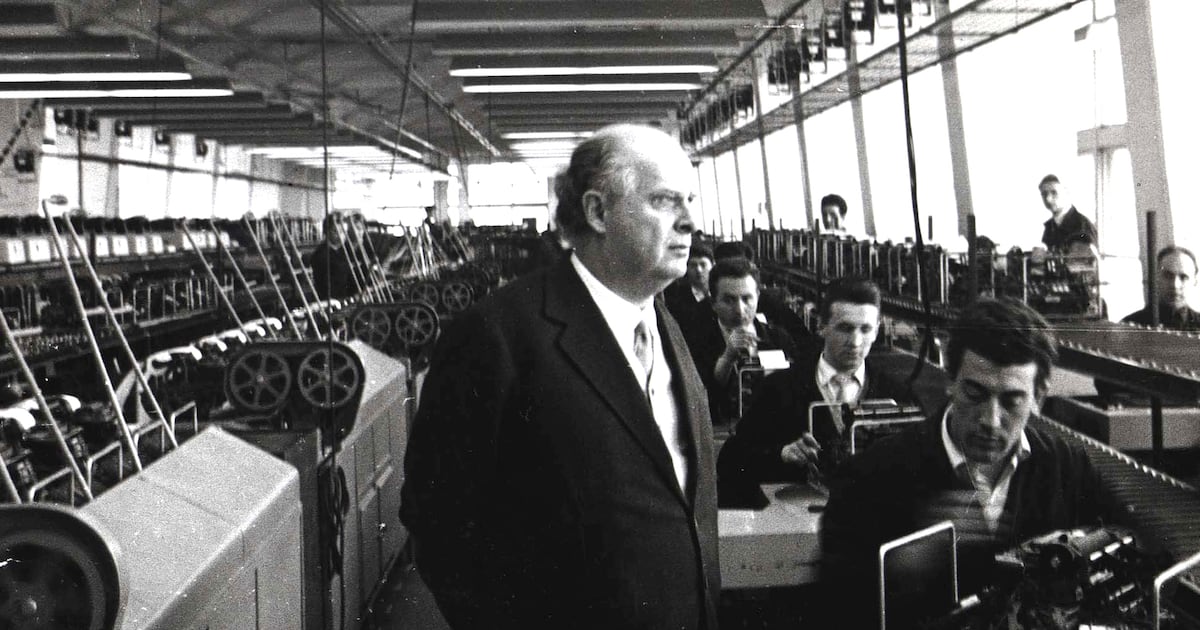
Olivetti is the company founded in Ivrea, in the Canavese, by Camillo Olivetti in 1908: created to build typewriters, in the twentieth century it became one of the world's leading office-machinery groups, built Italy's first electronic computer and anticipated the personal computer.[1] Around the factory, Ivrea was transformed into an industrial town that has been a UNESCO World Heritage Site since 2018.[2] Today Olivetti is a company wholly controlled by the TIM group, still headquartered in Ivrea, in the Metropolitan City of Turin.[3]
From Ivrea to the Turin Exposition
Camillo Olivetti had trained in Turin, at the Museo Industriale Italiano and the Scuola di Applicazione per gli Ingegneri, and in 1893-1894 had worked at Stanford University.[4] On 29 October 1908 he set up the company "Ingegnere Camillo Olivetti & c." in Ivrea;[4] the chronology of the Associazione Archivio Storico Olivetti records a capital of 350,000 lire and twenty workers.[5] The first product, the M1 typewriter, was presented in 1911 at the Turin World's Fair marking the fiftieth anniversary of Italian unification, priced at 500 lire.[4][5] It was followed by the M20 (1920), which opened the European and South American markets, and in 1932 by the MP1, the company's first portable, the same year the firm became a joint-stock company.[5]
Adriano's enterprise
His son Adriano, a graduate in chemical engineering from the Politecnico di Torino, joined the factory alongside his father in 1926 and became its chairman in 1938.[4][1] Under his leadership Olivetti brought in architects and designers such as Luigi Cosenza, Bruno Munari, Marcello Nizzoli, Ludovico Quaroni, Mario Ridolfi and Ernesto Nathan Rogers.[1] In 1948 the Lexikon 80 typewriter and the Divisumma 14 calculator were launched; Nizzoli's Lettera 22 portable (1950) entered the collection of New York's Museum of Modern Art.[5][4] That same year, 1950, the glass-fronted building designed by Luigi Figini and Gino Pollini was completed in Ivrea.[5] Growth was rapid: by 1955 the company had 11,353 employees in Italy and 16,000 worldwide.[5]
For Adriano the factory also had a civic purpose. On 23 April 1955, inaugurating the Pozzuoli plant, he argued that industry should direct "its aims and its greatest concerns to the material, cultural and social advancement of the place where it has been called to operate," and described the building in these terms:[6]
"So, facing the most singular gulf in the world, this factory has risen in respect for the beauty of the place, so that beauty might be a comfort in everyday work."
From 1948 he led the Movimento Comunità, with which he was elected to parliament in 1958.[1] He died suddenly on 27 February 1960.[5]
Electronics: the Elea and the Programma 101
In 1954 Adriano met engineer Mario Tchou in New York; from November 1955 Tchou directed the Laboratorio di Ricerche Elettroniche, first in a villa at Barbaricina, near Pisa, later moved to Borgolombardo, on the outskirts of Milan.[7][4] On 8 November 1959 the Elea 9003, Italy's first commercial electronic computer, was presented to President of the Republic Giovanni Gronchi; the first machine was delivered to Marzotto in September 1960.[7] By the end of 1961 the laboratory employed about 700 people, but on 9 November of that year Tchou died in a car accident near Santhià while travelling to Ivrea.[7]
Without Adriano and without Tchou, in 1964 control of the company passed to an intervention group made up of FIAT, Pirelli, Mediobanca, IMI and Centrale.[8] At FIAT's shareholders' meeting on 30 April 1964, Vittorio Valletta said of the Ivrea company: "Yet a threat hangs over its future, a flaw to be removed: having entered the electronics sector, which requires investments that no Italian company can sustain."[8] That same year 75% of the Electronics Division was sold to General Electric; the remaining 25% followed in 1968.[4]
The team led by Pier Giorgio Perotto, which had stayed in Ivrea, nonetheless developed the Programma 101, presented on 15 October 1965 at the BEMA show in New York.[9][4] The project, begun in 1962, involved Giovanni De Sandre, Gastone Garziera, Giancarlo Toppi and Giuliano Gaiti, with design by Mario Bellini; inside the company the machine was nicknamed the "Perottina," and NASA used it for some calculations in the Apollo programme.[9] It is regarded as a forerunner of the personal computer: it preceded the first Apple by eleven years and IBM's PC by sixteen.[4] In 1970 the group had 73,283 employees, 34,687 of them in Italy.[5]
The De Benedetti years and the end of the listed company
In the late 1970s the company went through a severe financial crisis.[1] In April 1978 Carlo De Benedetti came in, with 20% of the capital through CIR, and became chief executive; that same year the first electronic typewriter was launched.[4][1] In 1982 Olivetti presented the M20 desktop computer, designed by Ettore Sottsass, and in 1983 the IBM-compatible M24; thanks to the agreement with the American company AT&T, by 1985 it was the world's third-largest personal computer maker and the only European one.[4]
In 1991 the balance sheet went into the red for the first time since 1975, and between 1991 and 1993 21,000 employees left the company.[4] Olivetti then turned to telecommunications: in 1994 it founded Omnitel with Bell Atlantic, which became Italy's second mobile operator, and in 1999 it sold Infostrada and its stake in Omnitel to Mannesmann.[1] That same year, under Roberto Colaninno, it launched a 61,000-billion-lira public offer for control of Telecom Italia; in 2003 the two companies merged, and on 12 March of that year Olivetti stock was delisted from the stock exchange.[4][1]
Ivrea as a World Heritage Site, and Olivetti today
The town built for employees between 1930 and 1960 (factories, offices, housing, social services) was added to the World Heritage List on 1 July 2018 by the UNESCO Committee meeting in Manama, Bahrain, as Italy's 54th site: the nomination covers 27 buildings and architectural complexes.[2][10] It is the second Italian company town to receive the title, after Crespi d'Adda.[10] The then minister Alberto Bonisoli called it "the ideal city of the twentieth century's industrial revolution."[2]
The brand lives on today in Olivetti S.p.A., a benefit corporation of the TIM group headquartered on Strada Monte Navale in Ivrea: alongside office products, it develops solutions for the Internet of Things and data analysis, and together with the Politecnico di Torino it supports a master's programme in smart product design.[3]
Pages linking here
- Adriano Olivetti
- Alberto Cirio
- Camillo Olivetti
- Canavese
- Carnevale di Ivrea
- Centesimo anniversario della Squadra di Montagna della Croce Verde di Torino
- Galileo Ferraris
- Ivrea
- Marco Travaglio
- National Automobile Museum
- Piemonte
- Politecnico di Torino
Related articles: Adriano Olivetti, Camillo Olivetti, Canavese, Ivrea
Sources
- Treccani
- Ministero della Cultura — 1 July 2018
- Olivetti S.p.A.
- Treccani
- Associazione Archivio Storico Olivetti (storiaolivetti.it)
- AIDP – HR Online — 7 April 2015
- Associazione Archivio Storico Olivetti (storiaolivetti.it)
- Il Sole 24 Ore – Econopoly — 23 February 2016
- Opportunitaly (Ministero degli Affari Esteri e della Cooperazione Internazionale / ICE)
- il Giornale — 1 July 2018