Chivasso
A town on the Po north-east of Turin, once a stronghold of Monferrato and of the Savoys, site of the Cavour Canal's intake and home of the nocciolini.
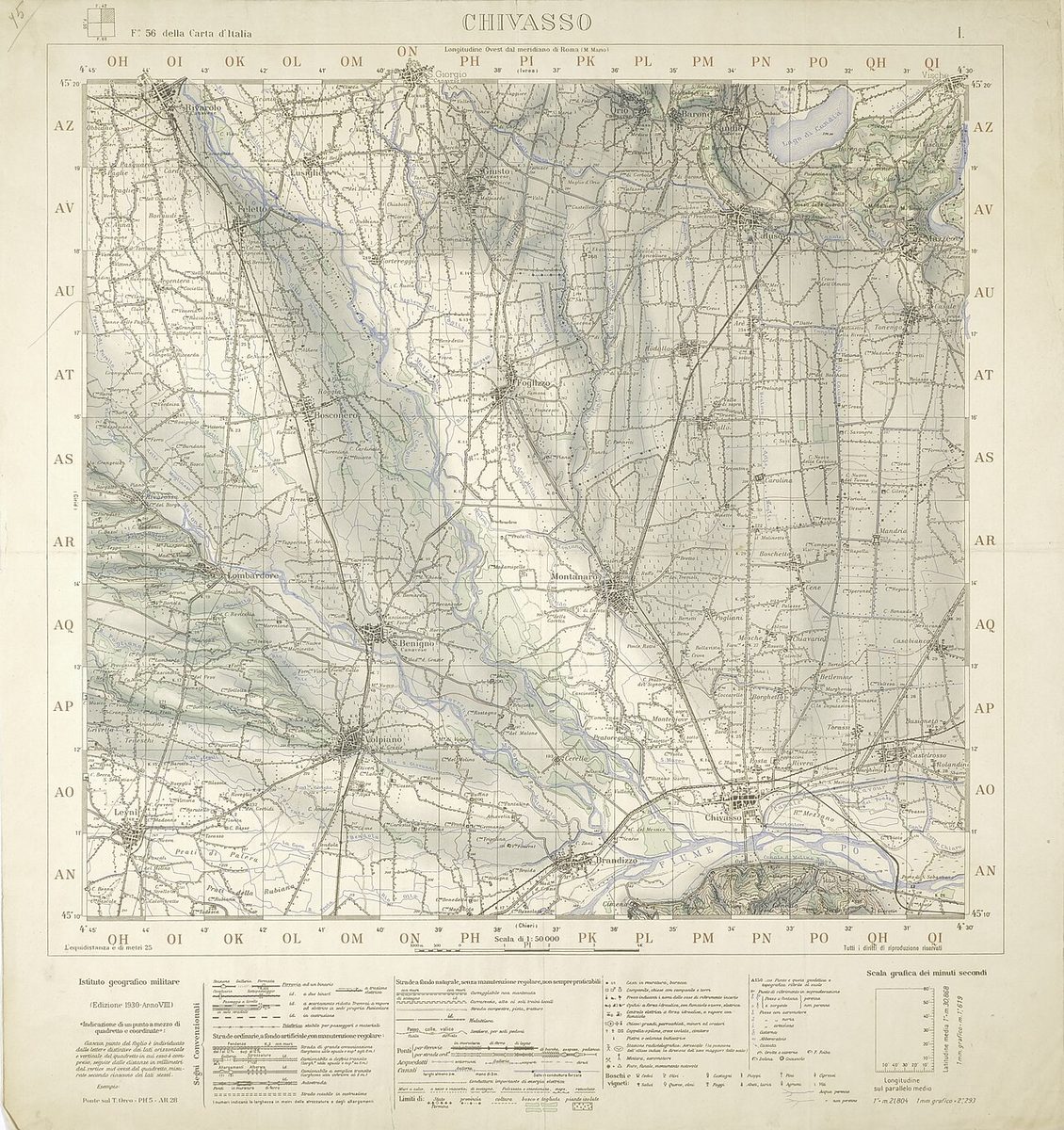
Chivasso is a municipality in the Metropolitan City of Turin, at 183 metres above sea level in the plain of Canavese, on the Po[1]. Once a stronghold of the marquises of Monferrato and later of the Savoys, it is today the reference centre of the Chivassese, one of the Metropolitan City's homogeneous zones, grouping 24 municipalities[2]. Its history brings together a 15th-century printing press, the intake of the Cavour Canal, a Lancia plant, and a hazelnut sweet that made its way onto the king's table.
From the Roman road to the marquises of Monferrato
The area was inhabited by Celtic peoples before the arrival of the Romans, who established a settlement there along the road linking Augusta Taurinorum with Eporedia (Ivrea), Aosta and Milan[3]. The first reliable records date from the Carolingian era, when Chivasso formed part of the march of Ivrea; in 1164 Frederick Barbarossa granted it as a fief to the marquises of Monferrato[1]. The Aleramici built a castle there with towers and walls, and in 1307 Theodore I Palaiologos opened a mint that struck gold and silver coins[3]. Of the castle only an octagonal tower survives, datable to the 12th century[4].
Accounts differ on when the town passed to the Savoys: the Enciclopedia Italiana places the end of Monferrato rule in 1431[4], while the more recent Treccani entry dates the annexation to the Savoyard state to 1453[1]. In the 16th century the town suffered plagues, plundering by Swiss and German mercenary troops and, in 1536, French occupation, which razed the settlements outside the walls; it returned to the Savoys with the Peace of Cateau-Cambrésis in 1559[3].
The cathedral, painters and the «Summa Angelica»
The symbol of the historic centre is the cathedral of Santa Maria Assunta, begun in 1415: the façade and the 1425 portal, in Gothic style, are covered with terracotta decoration, and inside is preserved a Deposition of Christ by Defendente Ferrari[4]. Defendente himself was from Chivasso: a document identifies him as the son of Francesco, resident in the district of Santa Maria, and his training is linked to the workshop of Martino Spanzotti, whose wife was from Chivasso and who worked there in 1502[5]. Works by Defendente are today held at the Galleria Sabauda and the Museo Civico d'Arte Antica in Turin[5].
Chivasso also had one of the first printing presses in Piedmont. In 1486 Giacomo Suigo da San Germano printed there the Summa Angelica[4], the manual for confessors written by the Franciscan Angelo Carletti, born in Chivasso around 1414. Carletti studied theology and law in Bologna, joined the Observants in 1441, served as vicar general of the Order, was papal nuncio for preaching the crusade against the Turks in 1480 and, in the years 1491-1493, was charged with combating the Waldensian heresy in Savoy and Piedmont. He died in Cuneo on 11 April 1495 and was beatified in 1753[6].
A Savoy town and fortress
In 1690 Victor Amadeus II raised Chivasso to the rank of city[1]. Its walls withstood several sieges during the wars between France and Spain[4]; in 1705 the stronghold held out against a siege by French troops, buying the capital time to prepare its defence ahead of the siege of Turin in 1706[3]. Under Napoleonic rule the town was placed within the Département de la Doire and its fortifications were dismantled; with the Restoration it returned to the Savoys[3].
The Cavour Canal and the railway
In the 19th century the arrival of the railway made Chivasso a transport hub, and a livestock market grew up there[3]. Above all, Chivasso is the site of the intake structure drawing water from the Po for the Cavour Canal, built in 1863-66 to a design by the engineer Carlo Noè, which the town commemorates with a monument[4]. The first stone was laid here on 1 June 1863 and the canal was inaugurated on 12 April 1866 in the presence of Victor Emmanuel II: about 83 kilometres to the Ticino at Galliate, with 101 bridges, 210 siphons and 62 canal bridges. The overall design had been presented by the engineer Pietro Paleocapa: the work, named after Cavour, was meant to carry the waters of the Po to the farmland of the provinces of Vercelli, Novara, Milan and Pavia[7].
The population grew slowly: 8,593 inhabitants in 1861, 10,084 in 1911, 10,861 in 1921[4]. By 2008 the population stood at 24,572[1].
Primo Levi's train
Chivasso's station also has a place in the memory of the deportations. After his arrest, Primo Levi was taken by train from Aosta to the camp at Fossoli, before being deported to Auschwitz. In a 1980 interview with Giovanni Tesio he recounted an episode he had never told in his books, the passage through Chivasso[8]:
«When the train reached Chivasso, it was a February sunset. The sky was murky, but from the station I managed to see the Mole. That was the moment of the wrench, a farewell that tore at me.»
The Mole Antonelliana seen from that station was thus the last image of the city before his imprisonment. Chivasso also recurs in another text by Levi, «Il Gabbiano di Chivasso» («The Seagull of Chivasso»), collected in Pagine sparse 1947-1987: a dialogue with a seagull about the environmental decline of the Po and of Turin[8].
Lancia and the 20th-century economy
In the postwar period the engineering industry transformed the town. In 1963 Lancia opened its second Turin-area plant there[9]. The plant brought prosperity; its closure in 1993 opened a long economic crisis for the town[3]. Treccani also notes the metallurgical, food and clothing industries and a major thermoelectric power station[1]. Today the Chivassese combines agriculture, engineering, agrifood, commerce and logistics[2], and the town's economy is now mainly service-based[3].
The nocciolini
The town's best-known product is the nocciolini, small sweets made of toasted hazelnuts, sugar and egg white. Tradition holds that they were created in 1850 by the pastry-maker Giovanni Podio; his son-in-law Ernesto Nazzaro registered the trademark with the Ministry of Commerce of the Kingdom of Italy. The nocciolini were presented at the 1900 Paris Universal Exposition and the 1911 Turin Exposition, the pastry shop became a supplier to the Royal House thanks to the appreciation of Victor Emmanuel III, and today they are listed among the Traditional Agri-Food Products. Every September the town celebrates them with a festival[10].
Timeline
- — A fire, with investigators examining the possibility of arson, seriously damages the warehouse of the La Prealpina DIY store in Chivasso. → CronacaQui Torino La Stampa
- — The Piedmont Regional Council discusses overcrowding on the Gtt 3429 intercity bus line between San Benigno Canavese and Chivasso, following a question from Pd councillor Alberto Avetta and a reply from Democratic Party group leader Gianna Pentenero to the answer given by Transport Councillor Marco Gabusi. → La Stampa TorinoOggi
- — In Chivasso a gang of at least three people disable the security cameras and smash the window of the «De Simone» jewellery shop on Via Torino with a sledgehammer, fleeing with the loot before the carabinieri arrive. → CronacaQui Torino Il Torinese
- — In Chivasso's historic centre, the 22nd edition of the Autumn Festival returns on 10 and 11 October, with markets of local produce, crafts and natural wellness products across Via Torino, Piazza della Repubblica and Piazza Carletti. → TorinoOggi
Related articles: Metropolitan City of Turin, Piero Fassino, Primo Levi, Settimo Torinese, Stazione di Porta Nuova
Pages that link here
- ASL 7 di Chivasso (website)
- Asl 9 Ivrea
- ASL TO4
- Asti DOCG
- Canavese
- Casale Monferrato
- Metropolitan City of Turin
- Christine of France
- Autumn Festival of Chivasso 2026
- Theft at the volunteer fire brigade station in Volpiano (October 2026)
- Theft at the De Simone jewellery shop in Chivasso (October 2026)
- Giornale La Voce
- Turin Breadstick
- The overcrowding of Gtt bus line 3429 between San Benigno Canavese and Chivasso (October 2026)
- Fire at the La Prealpina store warehouse in Chivasso (September 2026)
- Investigation into the murder of Fabio Colapietro: forensic analysis (September 2026)
- La Sentinella del Canavese
- Monica Canalis
- Murder on Via Gulli in Turin
- Piero Fassino
- Pinerolo-Torino (railway line)
- Prima Chivasso
- First hosts of the .to.it domain
- Primo Levi
- Piedmont Region
- Turin Metropolitan Railway Service
- Settimo Torinese
- Porta Nuova Station
- Turin Ring Road
- Court of Turin
- Artisans' Union of Turin and Province
- Volpiano
Sources
- Treccani
- Mole24 — 28 January 2015
- Mole24 — 2 January 2024
- Treccani, Enciclopedia Italiana
- Treccani, Dizionario Biografico degli Italiani
- Treccani, Dizionario Biografico degli Italiani
- Mole24 — 14 April 2016
- MuseoTorino
- Mole24 — 5 June 2015
- Mole24 — 24 October 2018