Mole Antonelliana
The symbol of Turin, 167.5 metres tall: built as a synagogue to a design by Alessandro Antonelli, it has housed the National Cinema Museum since 2000.
The Mole Antonelliana is the building that symbolises Turin: it stands in via Montebello, a short walk from via Po, and at 167.5 metres remains the tallest masonry structure in Italy.[1] Built as a synagogue, passed to the City as a monument to Vittorio Emanuele II and rebuilt at the top after the spire collapsed in 1953, it has housed the National Cinema Museum since 2000;[1] from the panoramic terrace, at 85 metres, the view runs over the city all the way to the Alps.[2]
A synagogue for the emancipated community
The emancipation of the Jews granted by Carlo Alberto in 1848 prompted Turin's Jewish community to build itself a modern temple.[3][4] The land was bought in the expansion area north of the centre, where the seventeenth-century bastions had run until the nineteenth century.[3] The design was entrusted in 1862 to Alessandro Antonelli, who had won the competition called by the community, and the construction site opened in 1863.[2][5] The first design called for a square-plan volume covered by a hip vault 47 metres high, with room for 1,500 people.[3]
Antonelli, however, kept revising the design upward, and costs grew with the height: in 1869 the community suspended funding and the site ground to a halt.[1][3] For the handover to the City, MuseoTorino gives 1873, Focus gives 1877 with a price of 150,000 lire, and the Touring Club and Visit Jewish Italy give 1878.[1][6][7][3] With the proceeds the community bought another plot on which to build the Jewish Temple, completed in 1884.[3]
The national monument and the Antonellian technique
The City earmarked the building as a "National Memorial to King Vittorio Emanuele II"[3] and as the seat of the museum of Italian independence; for the new purpose Antonelli designed a lantern that brought the overall height from 112 to 165 metres.[5] The architect died in Turin on 18 October 1888, aged ninety, without seeing the work finished; it continued under the direction of his son Costanzo.[4][5][1] According to the National Cinema Museum and MuseoTorino the building was completed in 1889; Focus places the inauguration on 10 April 1889, while the Touring Club dates the end of construction to 1897, and the Dizionario Biografico places the construction between 1863 and 1888, with finishing work continuing for another ten years under Costanzo.[2][1][7][6][5] The interior decoration was carried out around 1905 by the architect Annibale Rigotti,[1] and the current height was reached in 1906.[2]
The Mole stands on a technique "precisely called Antonellian", as the Touring Club writes: a network of metal tie-rods embedded in the cavity walls links the load-bearing points and allows walls far thinner than usual.[6] The art historian Corrado Maltese, quoted by Paolo Portoghesi in the Dizionario Biografico, measured its boldness like this:
«The ratio between solids and voids... was the most favourable ever achieved with traditional building methods (that is, without reinforced concrete and with iron used only for the tie-chains)»
At the top Antonelli wanted a winged genius of around 300 kilograms, the work of Celestino Fumagalli, put in place in 1889.[7] In 1904 the statue was brought down by bad weather — by lightning according to MuseoTorino, by a hurricane according to Focus, which notes that it remained wedged in the structure.[1][7] From 1908 until the early 1930s the halls housed the National Museum of the Risorgimento.[1][7]
Flights, alarms and restorations (1910-1950)
On 8 November 1910 four aviators flew circles around the Mole, followed by the crowd; the prize put up by La Stampa was raised to 4,000 lire.[8]
The building's stability had long been a worry: an earthquake tremor back in 1887 had already made reinforcements necessary, and between 1928 and 1960 new supporting elements were added.[1] In June 1930 the Consiglio Superiore delle Belle Arti approved a restoration project, and La Stampa recalled that alarms over its soundness went back to 1870.[9][10] Ahead of the work the museum was cleared and moved to the nearby Palazzo del Giornale: the carriages of Cavour and of Garibaldi and the cannons from the Great War were taken away, and the Mole's garden stayed closed for about two years.[11][12] By November the site was still open; in November 1933 the consolidation work was entrusted to Professor Albenga, with a commitment to leave the great hall intact.[13][14] In January 1936 Stampa Sera explained that the spire had not featured in the original design but was imposed by the shape of the dome, and that the foundation soil, of uneven quality, contributed to the instability.[15]
Between December 1942 and August 1943 four bombing raids damaged window and door frames and the roof and set the galleries on fire.[1] In October 1950 the City Council again discussed the Mole's stability, following a question from councillor Zini linked to a tram accident at the Ponte del Gatto.[16]
The collapse of the spire (1953) and the rebuilding
In the late afternoon of 23 May 1953 a storm with hail, lightning, winds up to a hundred kilometres an hour and a rain of earth and sand struck Turin: the last 47 metres of the spire came crashing down, and five people died in the city.[17][18] The weather reports of the time described "violent whirlwinds and a series of tornadoes, moving slowly".[17] With the collapse the Mole lost its record as Europe's tallest masonry building.[1]
On 16 March 1955 the City Council approved a new spire with a metal structure, funded with 400 million lire and with works expected to take at least two years.[19] By August the masonry work on the dome was finished; the model of the spire was calculated to withstand gusts of up to 180 kilometres an hour.[20] By January 1960 the site had reached 125 metres: a cableway carried materials up to height and an intercom linked the base to the upper floors.[21] The rebuilding of the spire was completed in 1961 according to MuseoTorino, in 1960 according to the Dizionario Biografico.[1][5]
From a wine bar that never was to a cinema museum
In April 1975 the relevant City department proposed setting up inside the Mole a wine bar serving Piedmontese cuisine and a restaurant, alongside a low-cost canteen for workers and students.[22]
The building's final purpose came from cinema. Maria Adriana Prolo had begun building her collection in 1941; the museum opened to the public in 1958 at Palazzo Chiablese, was recognised as a national museum in 1965 and closed for safety reasons in 1985.[23] Between 1996 and 1999 the Mole was renovated to house it, and on 20 July 2000 the museum reopened in its new home.[2][23] The route climbs with the building: the archaeology of cinema, the Temple Hall with its helical ramp, the cinema machine, the gallery of posters; the glass lift reaches the little temple at 85 metres in 59 seconds.[2][7]
The Mole today
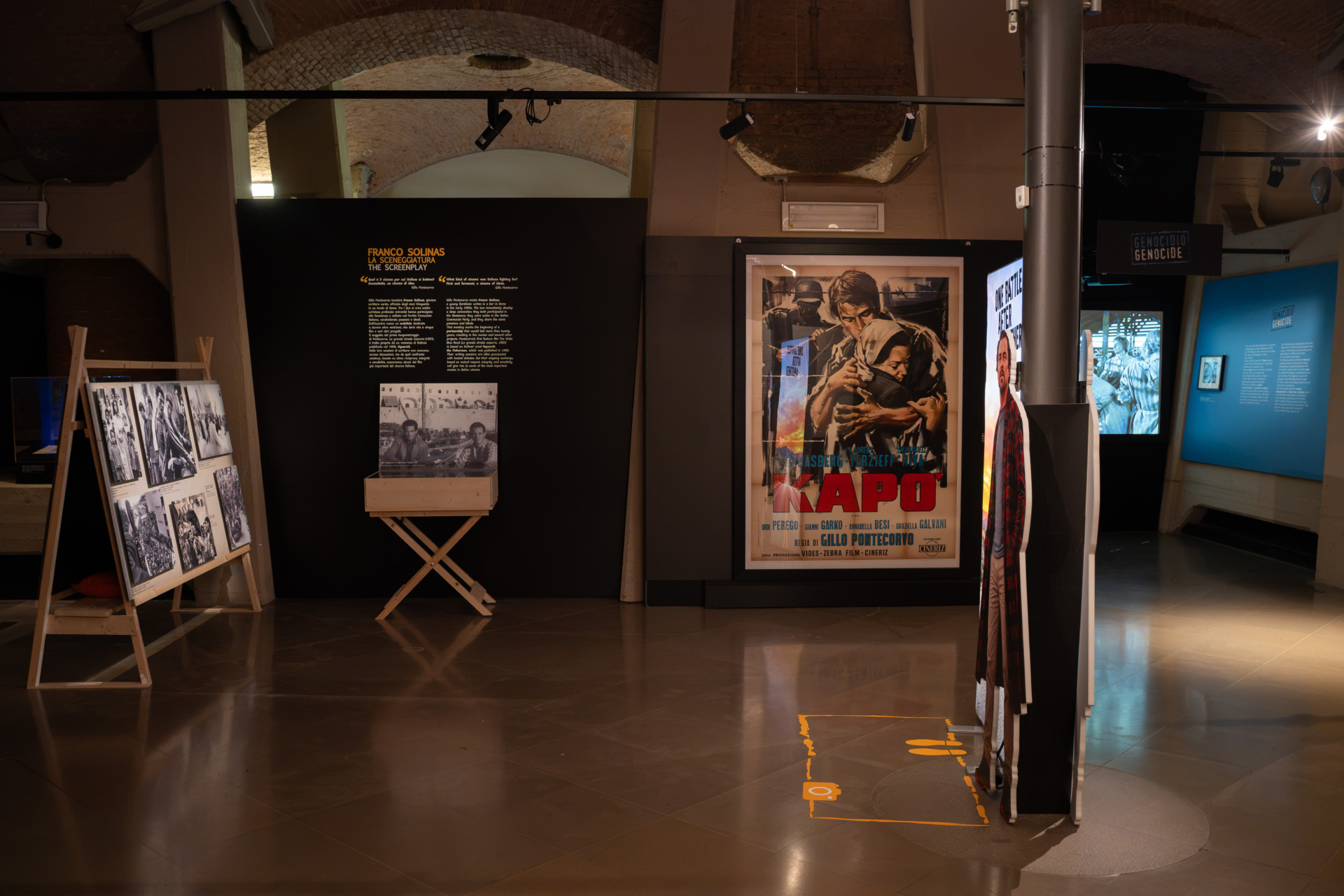
Since 2002 the Mole has been depicted on the Italian 2-cent euro coin.[1][7] The museum alternates major temporary exhibitions. From 16 September 2026 to 5 April 2027 the reception floor hosts "Gillo Pontecorvo. Una battaglia dopo l'altra", curated by Mauro Genovese with Caterina Massignani and built around the director's archive donated by his family.[24] From 19 November 2026 to 31 January 2028 the Temple Hall hosts "T. rex vs. T. rex. Da fossili a icone del cinema", with two authentic Tyrannosaurus skeletons from the United States, about ten metres long and weighing around a tonne each, mounted in fighting stance on a three-metre platform around the panoramic lift.[25][26] It is the first time the Hall has hosted two fossil specimens of the species together; authenticity is certified by the palaeontologist Peter Larson.[26] The exhibition, curated by Gianni Canova and Stefano Boni with Giaime Alonge and produced with Luca Cableri's Theatrum Mundi gallery, traces the dinosaur in cinema from Karel Zeman and Ray Harryhausen to Carlo Rambaldi, all the way to the Jurassic World saga.[27][25]
Chronology
- — The National Cinema Museum at the Mole Antonelliana hosts the exhibition "T. rex vs. T. rex", dedicated to the dinosaur in cinema. TorinoClick la Repubblica Torino
- — The Mole Antonelliana and the Balbis and Isabella bridges light up red in Turin for the launch of Molino di CasaOz, FondazioneOz's new space dedicated to children and families facing illness or hardship. TorinoOggi Prima Torino
Related articles: Alessandro Antonelli, National Museum of Cinema, Novara
Pages linking here
- Alessandro Antonelli
- Artissima
- Caffè Vergnano
- CasaOz
- Chivasso
- Edmondo De Amicis
- Guida Torino
- Installation of a work by Mario Merz at the Istituto Nazionale Oncologico di Candiolo (September 2026)
- Intesa Sanpaolo
- Intesa Sanpaolo Skyscraper
- Monte dei Cappuccini
- Museitorino
- Museo Egizio
- Museo Nazionale del Risorgimento Italiano
- National Automobile Museum
- National Museum of Cinema
- Novara
- Palazzo Carignano
- Porta Palazzo
- Primo Levi
- Red illumination of the Mole and the bridges over the Po for CasaOz's Molino
- San Donato (Turin)
- San Salvario
- T. rex vs. T. rex Exhibition at the Mole Antonelliana
- Teatro Regio
- The Mole Antonelliana Lights Up Red for the Birth of CasaOz's Molino
- Torre Littoria
- Tuttosport
Sources
- MuseoTorino
- Museo Nazionale del Cinema
- Visit Jewish Italy (UCEI)
- Torino Magazine
- Treccani, Dizionario Biografico degli Italiani —
- Touring Club Italiano
- Focus
- La Stampa, 08/11/1910, n. 310, p. 4 — 8 November 1910
- La Stampa, 11/06/1930, n. 138, p. 6 — 11 June 1930
- La Stampa, 18/06/1930, n. 144, p. 6 — 18 June 1930
- La Stampa, 28/06/1930, n. 153, p. 6 — 28 June 1930
- La Stampa, 28/06/1930, n. 153, p. 8 — 28 June 1930
- La Stampa, 25/11/1930, n. 280, p. 6 — 25 November 1930
- La Stampa, 09/11/1933, n. 266, p. 8 — 9 November 1933
- Stampa Sera, 01/01/1936, n. 1, p. 2 — 1 January 1936
- La Stampa, 13/10/1950, n. 243, p. 2 — 13 October 1950
- Mole24 — 23 May 2013
- La Stampa, 24/05/1953, n. 123, p. 1 — 24 May 1953
- La Stampa, 16/03/1955, n. 64, p. 2 — 16 March 1955
- La Stampa, 20/08/1955, n. 197, p. 2 — 20 August 1955
- Stampa Sera, 30/01/1960, n. 26, p. 2 — 30 January 1960
- Stampa Sera, 26/04/1975, n. 91, p. 7 — 26 April 1975
- Museo Nazionale del Cinema
- Prima Torino — 16 September 2026
- ANSA Piemonte — 18 September 2026
- Quotidiano Piemontese — 18 September 2026
- Prima Torino