Monte dei Cappuccini
A hill about 280 metres high on the right bank of the Po, with the Capuchin church and convent and the National Mountain Museum: Turin's belvedere.
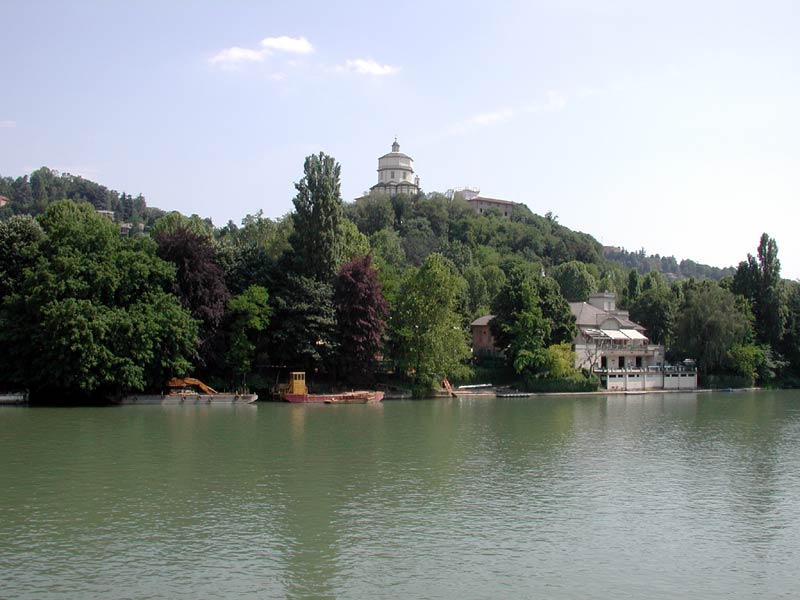
Monte dei Cappuccini is the main high point of Borgo Po, the district of Turin on the right bank of the river: a hill about 280 metres high, a short walk from the Gran Madre di Dio, and one of the city's best-known viewpoints.[1][2] From its terrace the view takes in the city centre, the Mole Antonelliana and the Po; on a clear day almost the whole western Alpine arc can be seen, along with part of the Ligurian Apennines.[1][2] On the summit stand the church of Santa Maria al Monte and the Capuchin friars' convent, which gives the hill its name; part of the complex houses the National Mountain Museum.[1]
From the Bastita to the duke's gift
The site, guarding the bridge over the Po, was put to military use long before the friars arrived. A bastita, a small fortress built in the thirteenth century, once stood on the hill: in November 1248 Thomas II of Savoy, named imperial vicar by Frederick II, gained control of Turin, of the bridge with its tower and of the bastita that had recently been built there.[3] Once its military purpose had lapsed, in 1437 the site became a private farm and passed to the noble Scaravello family.[4] In 1581 Duke Charles Emmanuel I acquired it and set it aside for the Capuchins, as part of his religious policy; in 1583, even before the church was built, a cross was planted on the summit to mark the community's arrival.[5][4]
A church built over half a century
The building of Santa Maria al Monte was long and intermittent. The design was entrusted to the Milanese engineer Giacomo Soldati, who turned the old structures into a church originally dedicated to San Maurizio; work began in 1584 and stopped at cornice height, in 1596 according to MuseoTorino, or as early as 1589 according to Mole24.[5][4] It resumed in 1610 under Ascanio Vitozzi, who raised the drum with the dome and added the sacristy and choir, and passed to Carlo di Castellamonte from 1615.[4] Only in 1621 were the friars authorised to hold services there.[4] The Dizionario Biografico degli Italiani documents, through a deed of 6 December 1623, Castellamonte's work on the chapel of San Francesco, and records a further phase, between 1634 and 1637, promoted by the new sovereign and concluded with the making of the main altar.[6] The church was consecrated in 1656; the last major change came in 1802, when the dome was clad in stone.[5][4]
1640 and the soldier at the altar
In the Piedmontese civil war that pitted the regent Christine of France, allied with France, against her brothers-in-law Thomas and Maurice of Savoy, backed by Spain, the hill was the setting for an episode that lives on in the city's devotion.[7] On 12 May 1640 French troops, having come up the Po as far as what is now Borgo Po, sacked the church; a soldier approached the main altar to carry off the tabernacle holding the Blessed Sacrament.[7] According to popular tradition, "a tongue of fire suddenly shot out from the altar and struck the French soldier."[7] Research by Father Luca Isella, a historian of the Capuchin order, offers another reading: the looter, he suggests, was shot by a Catholic marksman posted behind the tabernacle.[7]
An illustrious burial and a hollowed-out hill
Among those buried at the convent is Filippo San Martino d'Agliè, favourite and adviser of Madama Reale, who died in Turin in 1667: in his will he had asked to rest "in the most humble and lowly spot in the convent."[8] His skeleton resurfaced by chance on 31 July 1989, during earth-moving works in the Monte's vegetable garden.[8]
Eight tunnels run beneath the hill; one leads to the air-raid shelter dug during the Second World War directly beneath the church.[9] In the 1960s, some thirty metres down, a laboratory of the National Institute of Astrophysics was set up there, where the rock shielded measurements of the radioactivity of meteorites and marine sediments; by 2019 its rooms were no longer in use for research.[9]
The house of the mountain
In 1874 the Italian Alpine Club (CAI) opened a lookout post with an observatory on the Monte and, on 9 August that year, the museum, set up in some of the convent's rooms; in 1891 the City granted the CAI's request to open its own headquarters on the hill.[2][4] The air raid of 8 August 1943 badly damaged the complex and the museum, then called the Museo Alpino Italiano.[5] Today the "Duca degli Abruzzi" National Mountain Museum, linked to CAI Torino, is housed in piazzale Monte dei Cappuccini; it holds material on mountaineering, exploration, winter sports and images of the mountains, and also hosts contemporary art exhibitions, such as Stay with Me by Michael Höpfner and Magda Drozd in 2024.[1][10]
From 1885 the summit was linked to the bank of the Po by a funicular designed by Alessandro Ferretti, which closed in 1942.[4] Until around the mid-twentieth century, after the heaviest snowfalls, Turin residents who could not afford a skiing week at the resorts of the Val di Susa would ski down from the terrace in front of the church: a makeshift slope, with no ski lifts or tow ropes.[11]
In literature and in lights
The hill is one of the Turin landscapes of Cesare Pavese. In the diary later published as Il mestiere di vivere ("The Business of Living"), under the date of 1 December 1949, he wrote:[12]
"Walking along the Lungo Po, in front of Monte dei Cappuccini. A misty dusk, the villas disappear, leaving only the dark, shaggy backs of the hills, wild, blurred. What is this beauty for – what, at least, does it mean?"
In winter the church is surrounded by Rebecca Horn's Piccoli spiriti blu ("Little blue spirits"), seventy-two rings of blue neon created in 1999 for the Luci d'Artista festival: originally set around the Gran Madre, they have stood on the Monte since 2000, and in 2022 a restoration remade 40 per cent of their tubes.[13]
Today
The viewpoint and the museum are visited every day by tourists and residents alike. To cut private traffic in a place of historical and scenic interest, in the summer of 2025 the Mobility department of the City of Turin announced an access-control camera for the limited-traffic zone on salita CAI, the road leading up to the terrace.[14]
Pages linking here
- Borgo Po
- CAI Turin Open Day at Monte dei Cappuccini (October 2026)
- Castello del Valentino
- Castello di Agliè
- Cesare Pavese
- Christine of France
- Gran Madre di Dio
- Guida Torino
- Piazza San Carlo
Timeline
- — CAI Torino opens the doors of its historic headquarters at Monte dei Cappuccini for an Open Day devoted to the mountains, on Saturday 17 October. → TorinoToday Il Torinese
Related articles: Castello del Valentino, Castello di Agliè, Cesare Pavese, Christine of France, Parco del Valentino, Piazza Castello
Sources
- Mole24 — 3 August 2026
- Aree protette Po piemontese
- MuseoTorino
- Mole24 — 6 March 2013
- MuseoTorino
- Treccani, Dizionario Biografico degli Italiani
- Mole24 — 14 May 2012
- Mole24 — 3 April 2026
- Mole24 — 21 March 2019
- Mole24 — 7 January 2024
- Mole24 — 30 January 2012
- Torino Oggi — 14 August 2020
- Mole24 — 9 September 2024
- Mole24 — 3 August 2025