Museo Nazionale del Risorgimento Italiano
Italy's oldest museum of national history, founded in 1878 and housed since 1938 in Palazzo Carignano, where it preserves the chamber of the Subalpine Parliament.
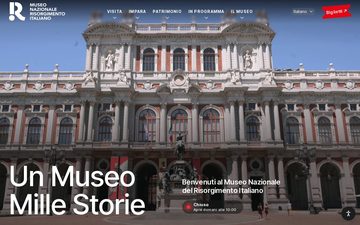
The Museo Nazionale del Risorgimento Italiano is the museum of the history of Italian unification, housed in Torino on the main floor of Palazzo Carignano, the baroque building by Guarino Guarini overlooking piazza Carlo Alberto and a UNESCO heritage site since 1997[1]. Founded in 1878, it is the oldest Italian museum of national history and the only one with the status of a national museum[1][2]. Its route includes the chamber in which the Chamber of Deputies of the Kingdom of Sardinia met from 1848: for this reason it is both a museum and the very site of part of the history it recounts.
From the «Ricordo nazionale» to the Mole
The museum was born in 1878 under the name «Ricordo nazionale di Vittorio Emanuele II»[1][3]. For thirty years it had no permanent home: in 1884 it was set up at the national exhibition in the Valentino, in 1899 it moved into the rooms of the modern art section of the Museo Civico in corso Galileo Ferraris, and only in 1908 was it inaugurated in permanent form inside the Mole Antonelliana, which was its home for the following thirty years[3]. According to the museum, the «Tempio del Risorgimento» set up at the 1884 exhibition was the prelude to the museum's formal establishment, in 1901. [14]
At Palazzo Carignano
In 1938 the collections moved to Palazzo Carignano, where they have occupied the main floor ever since[3][4]. The choice carried strong symbolic weight: the palace, commissioned in the seventeenth century by Emanuele Filiberto of Savoia-Carignano and designed by Guarini from 1679, had seen the birth of Carlo Alberto and Vittorio Emanuele II, and in its courtyard, according to the museum, the Unification of Italy was proclaimed on 17 March 1861[4]. After the Second World War the museum partly reopened in 1948; in 1961, for the centenary of Unification, it hosted a major historical exhibition[3].
The chamber of the Subalpine Parliament
The heart of the visitor route is the chamber of the Subalpine Chamber of Deputies. It was originally the state hall of the princes of Carignano, built by Guarini between 1679 and 1683; after the Statuto granted by Carlo Alberto in March 1848, the Senate was set up at Palazzo Madama and the Chamber in Carignano's large elliptical space[5]. The design was entrusted on 18 March 1848 to the architect Carlo Sada, who in fifty days transformed the hall into a semicircle for 204 deputies; painters such as Francesco Gonin worked on the decoration[5][6]. Alongside Gonin worked Capisani, Moja and Rusca, and it was the minister Vincenzo Ricci who chose the hall for the Chamber. [6] The first sitting was held on 8 May 1848 and Vincenzo Gioberti was elected president of the assembly; in the chamber the democrats sat on the left and the liberals on the right[5][6]. The first elections had been held on 27 April 1848; MuseoTorino dates the deputies' entry into the chamber to 9 May. [6] In the chamber, where according to the museum «the protagonists of the Risorgimento decided the fate of an entire nation»[7], the Chamber met until 1860, when the annexations made the hall too small[5][6]. Declared a national monument in 1898, it is described as «the only parliamentary chamber of 1848 to survive intact in Europe»[5]. According to the museum the last sitting was held on 28 December 1860, a date still shown on the chamber's clock and calendar. [16] Restored in 1988 and in 2011, when a viewing platform was built on a mezzanine, since 2017 the chamber has been opened to the public around 17 March. [15]
The Chamber that never met
To accommodate the deputies of the new Kingdom of Italy, Cavour requested a temporary chamber in the palace courtyard on 27 October 1860: the engineer Amedeo Peyron built it in 113 days, in iron and in neo-medieval style, 24 metres high, with 600 seats and 450 places in the gallery. On 18 February 1861, in the presence of the king and 443 deputies, the first sitting of the Italian Parliament opened there[8]. In 1864 the final design by Domenico Ferri and Giuseppe Bollati was approved, a new wing facing piazza Carlo Alberto with a large parliamentary chamber[8], now included in the museum's route with its painted vaults[9]. But the September Convention of 1864 with France moved the capital to Florence, and Parliament left Torino: «The Torino chamber, however, never came into use», as the MuseoTorino record sums it up[8].
The new 2011 display
Renovation work, begun in 2006, led in 2011, the year of the 150th anniversary of Unification, to an entirely new display in the rooms of Palazzo Carignano[3][9]. In the same months the baroque apartments on the ground floor also reopened, closed for more than half a century, with the staircase leading up to the Subalpine Parliament and the study of the Count of Cavour; today they are managed separately within the circuit of the Savoy residences[10][4]. The museum's route has more than 2,500 objects across thirty rooms — original documents, works of art and testimonies — and recounts the Risorgimento from the great revolutions of the eighteenth century to the eve of the First World War, linking Italian history to that of Europe[7][4][9]. The collections include about 2,000 decorations and medals, 7,000 prints, 1,100 maps, 17,500 photographs — including images of the Crimean War and stereoscopic plates of Gaeta in 1860 — 5,500 postcards and about 6,000 posters. [17]
Library and archives
Alongside the rooms the museum holds a specialised library of about 86,000 documents, with 4,700 periodical titles, 5,900 rare volumes and 730 scores and printed music. It holds newspapers of the period, from the «Gazzetta del Popolo» of 1848 to satirical sheets such as «Il Fischietto», parliamentary records from 1848, the works of Mazzini, Gioberti and Cavour, and collections donated by families and scholars, including the Cesare Alfieri fund and a Garibaldi bibliography of about 1,200 titles[11]. The museum's historical archives bring together documents mainly from the eighteenth and nineteenth centuries, with papers ranging from the thirteenth century to the Second World War and the Resistance[12].
The museum today
The museum's governing board is made up of members appointed by the City of Torino, the Regione Piemonte and the Istituto per la storia del Risorgimento italiano, plus some co-opted members; the museum operates with the support of the Ministry of Culture[2][1]. It is a controlled private-law body, in which the City of Torino holds a 20% share. [18] Since October 2023 it has been chaired by Luisa Papotti, formerly superintendent for archaeology, fine arts and landscape for the Città metropolitana di Torino, who on her appointment described it as «the oldest of our country's museums of national history, and the only one with the status of a national museum»[2]. The general director is Alessandro Bollo, and the scientific director is the historian Silvia Cavicchioli[1].
The permanent rooms alternate with temporary exhibitions that look at the Risorgimento from less familiar angles: in 2021-2022 «Anita e le altre», for the bicentenary of the birth of Anita Garibaldi, told the stories of nineteen women of the Risorgimento, from Cristina Trivulzio di Belgioioso to Giulia di Barolo, and closed with a video by Cavicchioli on Anita's true face[13]; in 2026 the exhibition «In Gioco. Arte e gioco dal Risorgimento a oggi», curated by Ermanno Tedeschi, is open until 4 October, while «A Tavola! Cucina, cibo e gusto nell'Italia del Risorgimento» is in preparation[7]. The Subalpine chamber, meanwhile, is the subject of an extraordinary maintenance campaign supported through the Art Bonus scheme, which has raised 100,000 euros, including from the Compagnia di San Paolo[5]. The entrance is at piazza Carlo Alberto 8; the museum is open from Tuesday to Sunday[1].
Pages linking here
- Alessandro Antonelli
- Camillo Benso di Cavour
- Carlo Alberto
- Città metropolitana di Torino
- Guarino Guarini
- Kingdom of Sardinia
- Massimo d'Azeglio
- Mole Antonelliana
- Museo Egizio
- MuseoTorino
- National Museum of Cinema
- Palazzo Carignano
- Porta Palazzo
- Stazione di Porta Nuova
- Victor Emmanuel II
Related articles: Camillo Benso di Cavour, Carlo Alberto, MuseoTorino, Victor Emmanuel II
Sources
- Museo Nazionale del Risorgimento Italiano
- ANSA — 30 October 2023
- MuseoTorino
- Museo Nazionale del Risorgimento Italiano
- Art Bonus – Ministero della cultura
- MuseoTorino
- Museo Nazionale del Risorgimento Italiano
- MuseoTorino
- Turismo Torino e Provincia
- Ministero della cultura — 11 March 2011
- Museo Nazionale del Risorgimento Italiano
- Archivio di Stato di Torino
- ANSA — 19 November 2021
- Museo Nazionale del Risorgimento Italiano — 21 October 2024
- TorinoToday — 14 March 2022
- Museo Nazionale del Risorgimento Italiano
- Museo Nazionale del Risorgimento Italiano
- Città di Torino