National Automobile Museum
The Turin museum of automobile history, founded in 1933 by Carlo Biscaretti di Ruffia, in its Corso Unità d'Italia premises since 1960 and renovated in 2011.
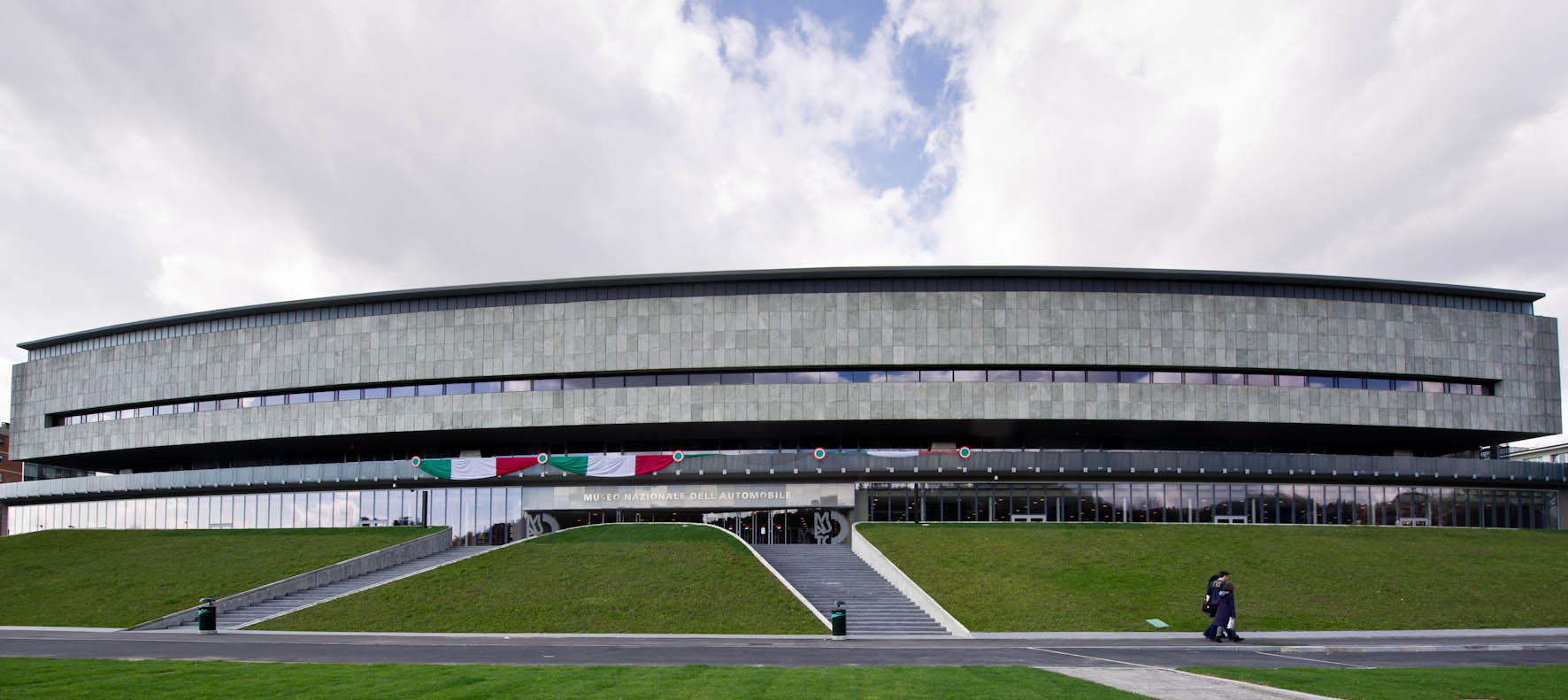
The National Automobile Museum (MAUTO) is Turin's museum dedicated to the history of the automobile, located at corso Unità d'Italia 40, along the Po. Founded in 1933 and opened in its present building in the autumn of 1960, it is among the oldest museums of its kind and, through the evolution of the automobile, tells the story of society's great turning points[1]; the collection numbers more than two hundred original cars from eighty different makes[2]. For the city that saw the birth of FIAT, Lancia and the great coachbuilders, it is the visible archive of its own industrial identity.
Carlo Biscaretti di Ruffia, the founder
The idea for the museum is bound up with one name: Carlo Biscaretti di Ruffia, a Turin nobleman born in 1879. His father, Count Roberto, was among the founders of FIAT; as a young man Carlo watched Italy's first car race, the Turin-Asti-Turin, in 1901 took part in the first Giro d'Italia by car alongside the mechanic Felice Nazzaro, and in 1902 was among the very first people in Italy to obtain a driving licence[3]. A talented draughtsman, he worked as a technical and advertising illustrator for FIAT, Lancia, Olivetti, Ansaldo and Michelin, and from 1916 to 1930 ran Itala's press and advertising office[3].
The first core of the collection was a retrospective exhibition of historic vehicles devised in 1933 by two pioneers of motoring, Cesare Goria Gatti and Roberto Biscaretti di Ruffia[1]; Carlo was called in to organise it, on behalf of the management of the Salone dell'Automobile, which in those years was held in Milan. On 19 July 1933, by a decree of the podestà, the City of Turin set up the body "Museo dell'Automobile" and entrusted Carlo Biscaretti with the task of organising it[3].
From the stadium to corso Unità d'Italia
After some temporary arrangements, in 1938 the collection found a home at the Stadio Comunale, today's Stadio Olimpico Grande Torino. In 1939 the museum was inaugurated by Mussolini during his second visit to the city and opened to the public in July: admission cost one lira, plus another lira to enter the stadium. The collection numbered 181 pieces dated from 1854 to 1939, including 55 complete cars, 62 engines (some of them aircraft engines) and 30 chassis[3][2]; for lack of space only 73 of them could be put on display[2].
The turning point came in July 1955, when ANFIA, the manufacturers' association, decided to tackle the problem of a new home; in July 1956 the City granted the land and in 1957 the body was re-founded by decree of the President of the Republic[3]. The design was entrusted to the architect Amedeo Albertini, who between 1958 and 1960 built a building with a long convex façade, 114 metres long, facing the river[4]. When the museum opened, in the autumn of 1960, the collection had grown to 106 cars from fifty makes[2].
Biscaretti did not live to see the opening. In the summer of 1959, from his retreat in Tuscany, he was drawing a series of large panels for the new premises, showing the cars of the pioneers from Daimler and Benz down to the first FIAT. In a letter to a friend dated 31 August he explained their purpose:
"…always with the aim of simplifying, so as to satisfy the visitor of our times: superficial, busy, hurried… and forgetful"
He died a week later, at his Tuscan retreat in Ripafratta, while finishing the very panel devoted to the 1899 FIAT. That October the board of directors, on a motion by the vice-president Giovanni Agnelli, named the museum after its founder; the name remained until 2011, when it reverted to Giovanni Agnelli's own name[3].
The 2011 rebirth
In 2005 the Milan studio of Cino Zucchi won the competition for the restoration and extension of the building[4]. The museum remained closed for four years; it was inaugurated by the President of the Republic, Giorgio Napolitano, on 19 March 2011, as part of the celebrations for the 150th anniversary of Italian Unification, and reopened to the public the following day[5][1]. According to the museum's own statement, the total investment was 33 million euros, 22 for the building and 11 for the exhibition design, and the floor area grew from 11,000 to about 19,000 square metres[5]; the trade press put the cost of the building works at 23 million[4]. On via Richelmy, Zucchi added a new exhibition wing, a large open space that can be set up in different ways, and he roofed over the inner courtyard[4].
The exhibition design was by the set designer François Confino, who had already designed that of the National Cinema Museum in the Mole Antonelliana[5]. The cars were "staged" in settings that tell the story of their eras and customs. Presenting the project, Confino explained: "The phenomenon of the 'automobile' appears as one of the most significant expressions of our civilisation," and added: "The car is culture, in the true anthropological sense of the word"[5]. Two years later the Times included the museum among the fifty most beautiful in the world[1].
The collection
The route unfolds over three floors and runs through the history of the car from its steam-powered ancestors to prototypes, with sections by era (Ancêtre up to 1904, Veteran up to 1918, Vintage up to 1930) and for sports and special cars[6][2]. About 150 vehicles are on display; several dozen more are kept in the Open Garage, an underground store that can be visited by appointment, and the museum also has a documentation centre, an educational centre and a restoration centre[1][6].
Among the best-known pieces is the 1909 Itala 35/45 HP known as "Palombella" ("little dove"), which belonged to Queen Margherita of the House of Savoy, who gave it its nickname: bodied in Milan by Cesare Sala, it has a chassis identical to that of the Itala that won the 1907 Peking-Paris race, and it entered the collection in 1934[7]. Another is the 1952 Alfa Romeo "Disco Volante" ("flying saucer"), donated by the Milanese carmaker in 1956: originally built with a two-litre engine, it was later fitted with the 3,495 cm³ six-cylinder engine from the 6C 3000[8].
The museum today
From 2018 to 2023 the museum was directed by Mariella Mengozzi, the first woman at the helm of MAUTO, who came from Ferrari's marketing department; in 2022 the museum had 240,000 visitors, beyond the record set at the 2011 reopening[9]. Under president Benedetto Camerana and director Lorenza Bravetta the museum has opened up to contemporary art: in the autumn of 2025 an exhibition centred on the DeLorean DMC-12 designed by Giorgetto Giugiaro, and the "Convergenze" programme was launched in partnership with the Fondazione Sandretto Re Rebaudengo[10]. In November 2025 a two-thousand-square-metre Design Space was added, created in partnership with the Triennale di Milano and opened with an exhibition on Ferrari design[11]. That same year the displays and exhibits were renewed, bringing works of modern and contemporary art into the permanent route[2].
The museum's two leaders have summed up its approach: "We do not want to be a contemporary art centre"[12]. According to the same source, visitor numbers have tripled compared with the years before the pandemic[12]. In the 2026 programme the Project Room is hosting, among others, works by Alain Bublex, Mimmo Frassineti, Aldo Brovarone and Gerald Laing[12].
Pages linking here
- Alberto Cirio
- Aldo Brovarone
- Car tax exemption from 2027 for 1.6 million Piedmontese
- Fondazione Sandretto Re Rebaudengo
- Giorgetto Giugiaro
- Lancia
- Mostra «Aldo Brovarone, la matita di Pininfarina» (ottobre 2026)
- Nizza Millefonti
Related articles: Giorgetto Giugiaro
Timeline
- — The National Automobile Museum in Turin opens the exhibition "Aldo Brovarone, la matita di Pininfarina" ("Aldo Brovarone, Pininfarina's pencil"), dedicated to the designer from Biella on the centenary of his birth. TorinoToday TorinoOggi
Sources
- MAUTO – Museo Nazionale dell'Automobile
- MAUTO – Museo Nazionale dell'Automobile
- MAUTO – Museo Nazionale dell'Automobile
- Archiproducts (già Archiportale) — 11 March 2011
- Museo Nazionale dell'Automobile (comunicato stampa) — 8 March 2011
- MAUTO – Museo Nazionale dell'Automobile
- MAUTO – Museo Nazionale dell'Automobile
- MAUTO – Museo Nazionale dell'Automobile
- Artribune — 31 May 2023
- Artribune — 11 October 2025
- Artribune — 12 November 2025
- Artribune — 23 January 2026