Stadio Olimpico Grande Torino
The municipal stadium of Turin, inaugurated in 1933 as the Stadio Mussolini, later the Comunale and the Olimpico, today home to Torino FC.
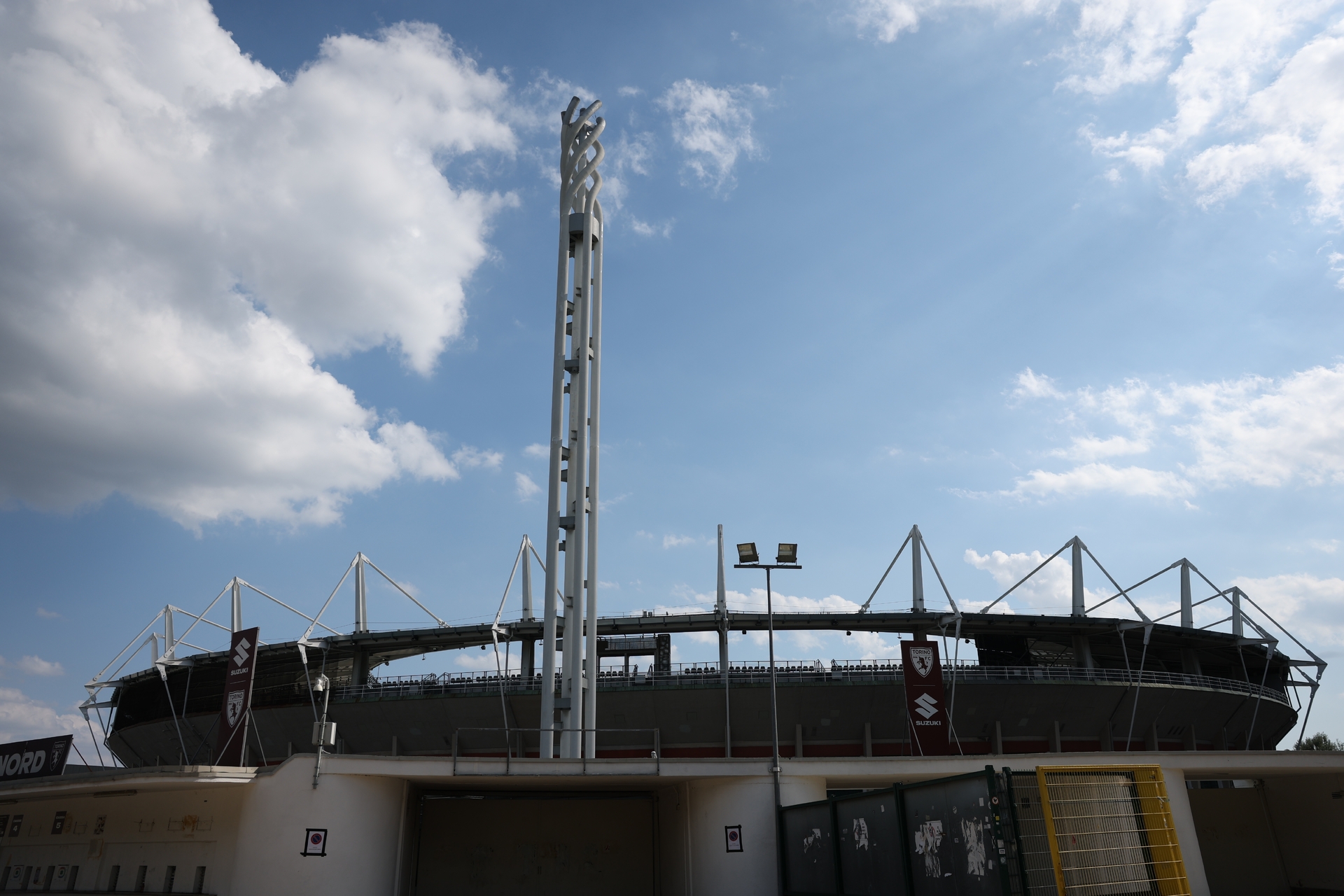
The Stadio Olimpico Grande Torino is the large municipal stadium of Turin, in the southern part of the city, between via Filadelfia, corso Sebastopoli and corso Quattro Novembre, in the Santa Rita district, next to piazza d'Armi[1][2][3]. Inaugurated in 1933 as the Stadio Mussolini, later the Comunale and the Olimpico, it has changed name four times in ninety years and has been home to both of the city's clubs: today Torino plays there[1][3].
The sports citadel of 1933
In the early 1930s Turin was looking for a facility to replace the Stadium, built for the 1911 International Exposition and by then poorly suited to its purpose. The new complex was meant to serve sport as mass spectacle and, above all, to host the regime's gymnastic displays, the Littoriali della Gioventù and the international university championships planned for the city in 1933. The area chosen was that between the new piazza d'Armi and the Ospizio di Carità, then in the midst of urbanisation, the same area where hospitals, wholesale markets and the FIAT plants stood[1].
The City Council issued a design-and-build tender and split the work among several firms: the Rome-based Saverio Parisi built the stands and terraces, the Vannacci e Lucherini firm the athletics track, the Marathon Tower and the ticket offices, and engineer Faletti's company the indoor swimming pool. Construction began in the last days of September 1932 and the complex was inaugurated on 14 May 1933 by Achille Starace, secretary of the National Fascist Party, to open the Littoriali: less than a year's work[1]. In the MuseoTorino catalogue, the ensemble of stadium, athletics track and swimming pool is described this way:
"This is a sports citadel that celebrates the invention of the age of leisure time."
Its official name was the Stadio Municipale "Benito Mussolini"; once the regime fell, the stadium simply became the Comunale[1].
Architecture
The stadium is the work of the architect Raffaello Fagnoni and the engineers Dagoberto Ortensi and Enrico Bianchini. It is an elliptical ring built entirely of reinforced concrete, about 640 metres in perimeter, on a base of white granite with a red plinth, closed at the top by a cantilever that projects more than three metres at a 45-degree angle. Entry was through 27 openings; the main one, between two full-height granite pillars, led to a hall in cipollino marble in front of the tribune of honour. The football pitch measures 70 by 105 metres and is surrounded by a six-lane track. The design followed purely functional criteria, cutting-edge for its time[1].
The athletics track and the Marathon Tower, which conceals the complex's water tank, are the work of the architect Brenno Del Giudice and the engineer Gustavo Colonnetti, a professor of structural engineering at the Politecnico; the indoor swimming pool, with its art déco façade and rationalist interiors, is by Contardo Bonicelli and Antonio Villanova[1]. The tower, ticket offices and fencing are protected under the municipal catalogue as an "ensemble of architecture of environmental and documentary value, unitarily characterising the layout of the sporting architecture"[2].
The Comunale of Juventus and Torino
Juventus played its first league season at the Comunale in 1934-1935; Torino, which during the years of the Grande Torino had its home at the Stadio Filadelfia, played its first season there only in 1963-1964[4]. From then on the Comunale was the stadium of both of the city's clubs, with an original standing capacity of 65,000[1].
The 1975-1976 season gives a sense of its scale. On 16 May 1976 Gigi Radice's Torino drew 1-1 with Cesena, while Juventus lost in Perugia, and won the scudetto: there were about 65,000 Torino fans on the terraces and another 15,000 waiting outside the gates without tickets. Radice, at the end of the match, was annoyed about the draw: "you can't draw like that"[5]. A few months later, on 15 September 1976, more than 65,000 spectators watched Torino's debut in the European Cup, a 2-1 win over Malmö with goals from Mozzini and Graziani[6].
For the 1990 World Cup the city built a new, large stadium, the Stadio delle Alpi[7]. The Comunale, meanwhile, had also been named after Vittorio Pozzo[8], the Turin-born national team manager, born in 1886, who led the national team to the 1934 and 1938 World Cup titles and also wrote about football for La Stampa[9].
The Olympic stadium of 2006
For the 2006 Winter Olympics the stadium was renovated to a design by the Giovanni Cenna Architetto studio and Arteco, both from Verona, respecting the protected parts. A third tier of seating on a steel structure was added, with 44 boxes, and all seats became covered and seated, as required by the so-called Pisanu decree on stadium safety[10]. Capacity fell, according to MuseoTorino, to 27,168 seats[10], or, according to the stadium's entry in the same catalogue, to just over 26,000[1]. The works were supposed to be paid for by Torino, the stadium's intended occupant, but after the club's failure to be enrolled in the league in August 2005 it was the City Council that took the project back over and financed it; the renovated stadium was unveiled on 29 November 2005[10]. The area also saw the construction of the Palaolimpico, today the Inalpi Arena, and the stretch of corso Sebastopoli in front of the stadium was closed to cars and merged with the park[1].
With temporary structures that brought capacity to around 35,000 people[10], the stadium hosted the opening ceremony on 10 February 2006, in which the skier Giorgio Rocca took the athletes' oath and Luciano Pavarotti sang, and the closing ceremony on 26 February, with the medal presentation for the 50-kilometre cross-country race won by Giorgio Di Centa, whose medal was presented to him by his sister Manuela[8].
The name of the Grande Torino
After the Games the stadium went back to football. Juventus had moved to its own stadium, the Juventus Stadium, inaugurated on 8 September 2011 on the site of the Delle Alpi[7], and in 2016 the Stadio Olimpico took on its current name, dedicated to the Torino team lost in the Superga air disaster[1]. Today it is Torino's stadium, reachable from the city centre, about seven kilometres away, by several public transport lines[3].
Pages linking here
- Andrea Agnelli
- Grande Torino
- Inalpi Arena
- Juventus Stadium
- National Automobile Museum
- Olimpiadi invernali di Torino 2006
- Santa Rita (Turin)
- Sauze d'Oulx
- Stadio delle Alpi
- Stadio Filadelfia
- Superga air disaster
- Torino Football Club
- Turin surpasses 1.28 million meals saved with Too Good To Go
Related articles: Andrea Agnelli, Bardonecchia, Grande Torino, Inalpi Arena, Juventus Football Club, Torino Football Club