Superga air disaster
On 4 May 1949 the plane carrying Grande Torino back from Lisbon crashed into the Basilica of Superga: 31 dead, including the entire team.
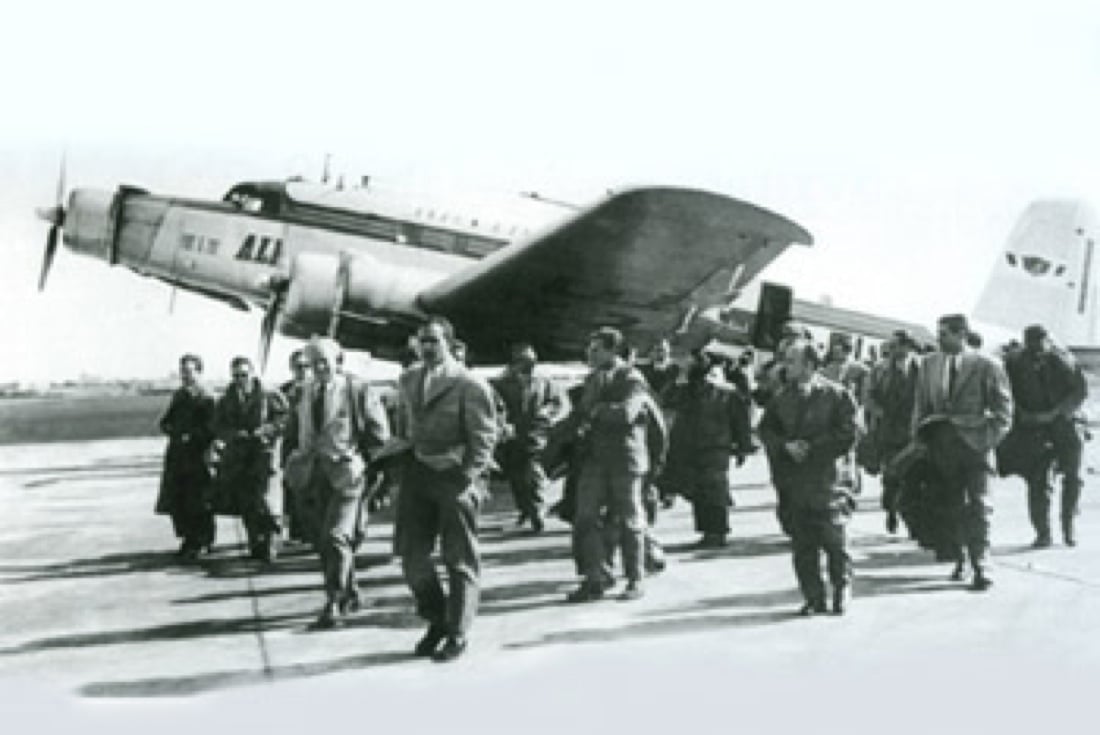
The Superga air disaster was the plane crash of 4 May 1949 in which every Grande Torino player on board died, along with coaches, club officials, three journalists and the crew: thirty-one people in all[1]. The three-engined aircraft bringing the team home from Lisbon crashed, shortly after five in the afternoon, into the retaining wall of the Basilica of Superga, on the hill above Turin[2]. That team was a symbol of the country's postwar recovery, and its end caused national mourning[2].
The Lisbon friendly
The Torino had travelled to Portugal for a friendly against Benfica, organised in honour of the Portuguese captain Francisco Ferreira: it was played on 3 May 1949 at Lisbon's Estádio Nacional and ended 4-3 for the home side[3]. On the pitch for the granata were Bacigalupo, Aldo Ballarin, Martelli, Grezar, Rigamonti, Castigliano, Menti, Loik, Gabetto, Valentino Mazzola and Ossola[3]. The team had already won four consecutive league titles and was about to clinch a fifth; two years earlier national coach Vittorio Pozzo had fielded as many as ten Torino players for Italy in the same match, a record never equalled since[3].
The flight of 4 May
The aircraft was a Fiat G.212 registered I-ELCE, built in 1947 and belonging to Avio Linee Italiane, a company controlled by FIAT; at the controls was Pierluigi Meroni, a veteran of the Regia Aeronautica[1]. The three-engined plane took off from Lisbon at 9:52, stopped in Barcelona to refuel and set off again in the early afternoon for Turin's Aeritalia airport[1]. Weather over Piedmont was poor. The bulletin transmitted by the tower at 16:55 reported continuous rain and, at Superga, visibility of only 40 metres: "Low clouds 8/8, stratus and fractostratus, ceiling 480 metres"[1].
Navigating by the radio beacons of Novi and Savona, the crew descended to 2,000 metres; at 17:02 came the last radio contact, confirming the approach angle, then silence[1]. A few minutes later the aircraft, at an estimated speed of about 180 km/h, struck the embankment on the eastern side of the basilica with its left wing, caught fire, and the fuselage disintegrated against the boundary wall; the tail remained almost intact[1]. Sources give the time of impact as 17:03[2] or 17:05[1]. The first to arrive was the basilica's chaplain, Don Tancredi Ricca, alerted by a shout from below: "A plane has come down!"[1].
The victims
Eighteen players died: Valerio Bacigalupo, Aldo and Dino Ballarin, Émile Bongiorni, Eusebio Castigliano, Rubens Fadini, Guglielmo Gabetto, Ruggero Grava, Giuseppe Grezar, Ezio Loik, Virgilio Maroso, Danilo Martelli, captain Valentino Mazzola, Romeo Menti, Piero Operto, Franco Ossola, Mario Rigamonti and Julius Schubert[4]. Also killed were coaches Ernest Egri Erbstein and Leslie Lievesley, masseur Ottavio Cortina, club officials Arnaldo Agnisetta, Andrea Bonaiuti and Ippolito Civalleri, and the four crew members, Meroni, D'Incà, Biancardi and Pangrazi[4].
Among the victims were three leading figures of Turin sports journalism. Luigi Cavallero ran the sports desk of La Stampa, where he had worked since 1929; Renato Casalbore, for thirty years at the Gazzetta del Popolo, had founded and edited Tuttosport; Renato Tosatti had written for the Gazzetta del Popolo since 1946[5]. Some survived by chance: club president Ferruccio Novo, who had stayed in Turin with bronchopneumonia, defender Sauro Tomà, out with a knee injury, back-up goalkeeper Renato Gandolfi, whose seat on the plane went to Dino Ballarin, and radio commentator Nicolò Carosio, kept back by his son's confirmation[6]. Tomà, the last surviving member of Grande Torino, died on 10 April 2018[6].
Identification and funeral
It fell to Vittorio Pozzo, the national team's coach, to identify the bodies[6]. The funeral was held on 6 May 1949 at Palazzo Madama, attended by delegations from every Italian club and some foreign ones[6]. Estimates of the crowd vary: around half a million people according to some journalistic accounts[6], almost a million according to the Treccani encyclopaedia[2]. The same day, Indro Montanelli wrote on the front page of the Corriere della Sera[7]:
"Heroes are always immortal in the eyes of those who believe in them. And so the boys will believe that Torino has not died: it is only away from home"[8]
The Football Federation awarded the 1948-49 championship to Torino: the club played its last four matches with its youth team, and the opposing clubs in turn fielded their own youth sides; Torino won all four, securing a fifth consecutive title[3].
The causes
No cause has ever been established with certainty. Journalistic reconstructions have ruled out crew inexperience, since Meroni was certified for blind flying, and a simultaneous failure of the three independent altimeters; the most widely accepted theory is a small error of course and altitude, a matter of seconds or a few dozen metres, caused by the approximation of instrument navigation at the time, poorly standardised communication between tower and aircraft, and a strong south-westerly wind, with no radio altimeter or radar on board[1]. Other accounts also consider a possible altimeter fault, which might have shown an altitude of 2,000 metres when the plane was in fact much lower[9]. In his book Il comandante restò sulla collina ("The captain stayed on the hill"), Luigi Troiani disputes the human-error theory, notes that seven of the twelve G.212s built were destroyed in service, and argues that the final report on Superga cannot be found in the aviation archives[10].
Remembrance
Every 4 May, fans and the team make a pilgrimage up to the basilica: after Mass, Torino's captain reads out the names of the dead in front of the monument commemorating them. In 2026 around two thousand fans attended, and captain Duván Zapata read the names for the second year running[11]. In Grugliasco, in the Villa Claretta Assandri on via La Salle, the Museo del Grande Torino e della Leggenda Granata has been housed since 2008, set up by the Associazione Memoria Storica Grande Granata: among the 1,000-1,500 items on display are a wheel and a propeller from the crashed aircraft and a section of the wooden stand from the Stadio Filadelfia[12]. The museum had originally opened in smaller premises right at Superga[12]. The name of the lost team also lives on in the city's stadium, the Stadio Olimpico Grande Torino.
Pages linking here
- Aeroporto di Torino-Caselle
- Basilica di Superga
- Giampiero Boniperti
- Gigi Meroni
- Grande Torino
- Grugliasco
- Palazzo Madama
- Stadio Filadelfia
- Stadio Olimpico Grande Torino
- Torino Football Club
- Tuttosport
- Valentino Mazzola
Related articles: Basilica di Superga, Grande Torino, Stazione di Porta Nuova, Torino Football Club, Tuttosport, Valentino Mazzola
Sources
- Panorama — 4 May 2024
- Treccani
- Sky Sport — 4 May 2023
- Toro.it
- Il Catenaccio — 4 May 2026
- Sky TG24 — 4 May 2024
- Associazione Nazionale Case della Memoria
- Torino Oggi — 4 May 2026
- Geopop — 3 May 2025
- FIRSTonline
- Toro News — 4 May 2026
- Comune di Grugliasco