Grande Torino
The Torino team that won five consecutive Italian championships in the 1940s, wiped out in the Superga air disaster of 4 May 1949.
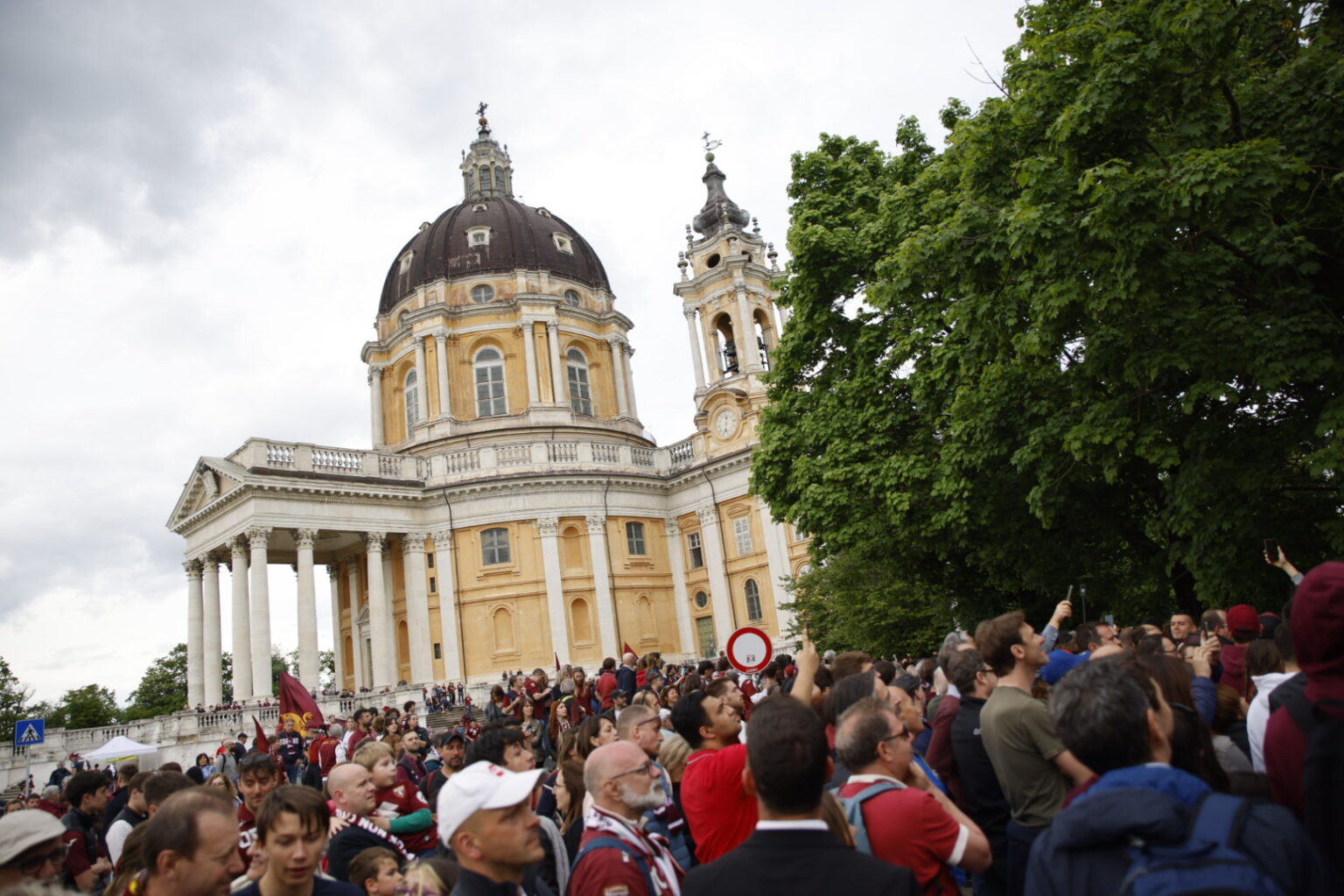
«Grande Torino» is the name by which the Torino team is remembered, which in the 1940s won five consecutive Italian championships, from 1942-43 to 1948-49, with a gap for the tournaments suspended during the war[1]. Built by president Ferruccio Novo around captain Valentino Mazzola, it supplied almost the entire post-war national team and was wiped out on 4 May 1949 by the Superga air disaster, when the aircraft bringing it back from Lisbon crashed into the hill below the basilica[2]. For the city of Turin it became a civic myth as much as a sporting one: the «Invincibili» ("the Invincibles")[3].
Ferruccio Novo and the building of the team
Novo became president of the granata club in 1939 and concentrated every decision in his own hands[1]. Around him worked a staff unusual for the time: the Hungarian coach Ernesto Egri Erbstein, who introduced pre-match warm-ups, dietary control and psychological preparation; national-team manager Vittorio Pozzo as a consultant, for comparison with English football; fitness coach Leslie Lievesley, who also ran the youth sector; and board member Roberto Copernico[1]. At the start of the 1942-43 season Novo imposed the switch from the «metodo» to the «sistema», the British-derived scheme based on dynamic, attacking play and physical pressure on the opponent[1].
The decisive move was signing Mazzola and Ezio Loik from Venezia. According to the Dizionario Biografico degli Italiani the fee was 1,200,000 lire[1]; according to the Enciclopedia dello Sport, Novo paid 1,250,000 lire, getting there just ahead of Juventus, who were also interested in both players[4]. By 1945 the core line-up was complete: Bacigalupo in goal, Ballarin and Maroso in defence, Grezar, Rigamonti and Castigliano in midfield, and Loik, Menti, Ossola, Mazzola and Gabetto in attack[1].
Five titles and the records
The first season with the new team, 1942-43, ended with the Italian title and the Coppa Italia: it was the first «double» in Italian football[5]. After the years of civil war, Torino won all four championships from 1945-46 to 1948-49[1]. In the 1947-48 season the team scored 125 goals, a record; at home it had not lost since 1943 and put together 88 consecutive matches without defeat[3].
The symbol of that strength was the «quarto d'ora granata» ("the granata quarter of an hour"): the moment when captain Mazzola rolled up his sleeves and the team accelerated until it overwhelmed its opponent[5]. The story, tied to the Filadelfia, has it that the signal was given by Oreste Bolmida, a railwayman and stationmaster at Porta Nuova, with a horn from the Ferrovie dello Stato[5]. Of Mazzola, who scored 97 goals in 170 games for the granata and earned twice as much as his team-mates, Gigi Garanzini wrote in the Enciclopedia dello Sport[4]:
«Valentino wasn't simply a forward: he was the Grande Torino.»
The national team's squad
Almost all the granata players also wore the Azzurri's shirt[6]. In the spring of 1947 national-team manager Pozzo fielded nine Torino players against Switzerland and ten against Hungary, a record never repeated since[5]. It would fall to Pozzo himself, two years later, to identify the bodies at Superga[7].
The last trip
At the start of May 1949 Torino, by then close to a fifth title, travelled to Portugal for a friendly against Benfica, played on 3 May in Lisbon and lost 4-3[8]. The next day the Fiat G.212 three-engined aircraft of Avio Linee Italiane, flown by captain Pierluigi Meroni, took off at 9:52, made a stopover in Barcelona and approached the final leg to Aeritalia airport in rain and low cloud; at 17:05 it struck the retaining wall of the basilica of Superga[9]. All 31 people on board died: eighteen players, coaches, officials, three journalists and the crew[6]. Novo, who was not on the flight, survived, but was marked by it for the rest of his life[1].
The disaster caused a wave of national grief: the team was seen as a symbol of the country's rebirth[2]. At the funeral on 6 May, with the coffins laid out at Palazzo Madama, about 500,000 people attended according to Sky Sport[5], almost a million according to Treccani[2]. On the same day Indro Montanelli wrote, on the "terza pagina" — the newspaper's culture page — of the Corriere della Sera[10]:
«Heroes are always immortal in the eyes of those who believe in them. And so the boys will believe that Torino is not dead: it is only away from home».
The 1948-49 championship was completed by the youth team, which won the four remaining matches against the youth sides that opposing clubs fielded out of respect, and the title was awarded to Torino[6][3].
Remembrance
Every 4 May, fans climb up to Superga. In 2026 there were about two thousand: mass in the basilica was celebrated around 17:03 and the team's captain read out the names of the dead in front of the Invincibili's memorial plaque[11]. Since 2015 the date has also been marked as a world football day in memory of the Grande Torino[3].
The team's name was given to the Stadio Olimpico Grande Torino. The old Filadelfia, closed in September 1994 and demolished from 1997, was rebuilt and reopened on 25 May 2017: it hosts the first team's training sessions and carries the names of the Grande Torino's players, together with those of Giorgio Ferrini, Gigi Meroni and the champion sides of 1927-28 and 1975-76[12]. In Grugliasco, in the seventeenth-century Villa Claretta Assandri, the Museo del Grande Torino e della Leggenda Granata, opened in May 2008 and run by the Associazione Memoria Storica Grande Granata, holds among other things a wheel and a propeller from the aircraft that crashed at Superga[13].
Pages linking here
- Alberto Cirio
- Basilica di Superga
- Giampiero Boniperti
- Gigi Meroni
- Grande Torino Museum
- Grugliasco
- Moncalieri
- Monumental Cemetery of Turin
- Palazzo Madama
- Presentation of the Museo del Grande Torino Project at the Filadelfia (October 2026)
- Sandro Mazzola
- Stadio delle Alpi
- Stadio Filadelfia
- Stadio Olimpico Grande Torino
- Stazione di Porta Nuova
- Superga air disaster
- Torino Football Club
- Tuttosport
- Valentino Mazzola
Related articles: Basilica di Superga, Stadio Filadelfia, Stadio Olimpico Grande Torino, Superga air disaster, Torino Football Club, Valentino Mazzola