Stadio Filadelfia
Torino's home ground from 1926 to 1963 and the house of the Grande Torino: demolished in 1997-98, rebuilt as the club's granata training centre and reopened in 2017.
The Stadio Filadelfia, known to fans simply as «il Fila», is the sports ground at via Filadelfia 36, on the corner of via Giordano Bruno, in Turin.[1] Built in 1926, it was the home ground of Torino until 1963 and the stage for the triumphs of the Grande Torino; abandoned and largely demolished in the late 1990s, it was rebuilt on the same site and reopened on 25 May 2017 as the first team's training centre.[1][2]
The construction (1926)
The ground was built on the initiative of Count Enrico Marone di Cinzano, president of Torino, who set up the Società Civile Campo Torino to buy the land. The application for planning permission is dated 24 March 1926; the design was entrusted to the engineer Miro Gamba of the Politecnico and the reinforced-concrete works to the firm of Commendator Riccardo Filippa. The site work took five months and cost 2.5 million lire.[2]
The inauguration was held on 17 October 1926 before around 15,000 spectators, in the presence of the crown prince Umberto and Princess Maria Adelaide; the ground was blessed by Archbishop Giuseppe Gamba.[2] In the inaugural friendly Torino beat Fortitudo Roma 4-0, and during the ceremony the Juventus players came down from the stands to pay tribute to the granata.[3] At the Filadelfia Torino immediately won its first league title, that of the 1926-27 season, later revoked.[4]
The original design called for 15,000 seats: 1,300 in the main stand, 9,500 on the terraces and 4,000 in the paddock, around a grass pitch of 110 by 70 metres fitted with drainage, enclosed by a perimeter wall two and a half metres high; the facade was in red brick, with columns and large windows. Under the stands were the caretaker's lodgings and fourteen rooms used by the players and the referee, the infirmary, the management offices and a refreshment room. A ticket office was added in 1928 and in 1932 the terraces were enlarged, taking capacity to 30,000.[2] MuseoTorino cites it as an example of architecture functional to sport, akin to the contemporary Motovelodromo on corso Casale.[1]
The home of the Grande Torino
On the pitch in via Filadelfia Torino won six of its seven league titles. Ferruccio Novo's team went unbeaten there for 100 consecutive matches, from 17 January 1943 until the Superga air disaster of 4 May 1949; it was also there that Torino inflicted a 10-0 defeat on Alessandria, still today the record victory by the largest margin in Serie A.[2]
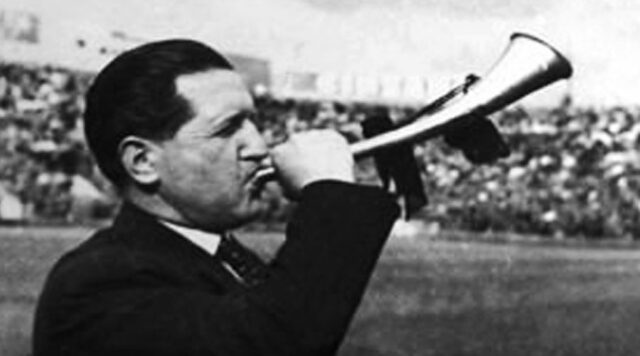
The Filadelfia is also home to the ritual of the «quarto d'ora granata» (the granata's quarter of an hour). Oreste Bolmida, a stationmaster at Porta Nuova, used to bring his railway horn to the stadium and sound it from the stands to call for the team's reaction in the difficult moments of a match.[5]
War and decline
On 13 July 1943 a bombing raid struck the pitch and the terraces on via Giordano Bruno; the steel girders were removed and replaced with wooden structures, and the stadium became unusable, so that the team had to play first at the Motovelodromo Umberto I and then at the Stadio Mussolini, the future Comunale.[2] On 29 March 1944 a United States air raid using «carpet bombing» caused the collapse of the building's first floor.[1] After the war the reconstruction was again overseen by Novo.[2]
In the 1958-59 season Torino, then called Talmone for sponsorship reasons, moved to the Comunale, today's Stadio Olimpico Grande Torino, and was relegated to Serie B; the following year it returned to the Filadelfia for luck. The first team's last official match was Torino-Napoli 1-1 on 19 May 1963, after which the move to the Comunale became permanent.[2] A renovation project wanted in 1970 by president Orfeo Pianelli was shelved in 1973, because the 1959 town plan had designated the area as public green space, a restriction that at the same time prevented housing from being built there.[2]
The youth teams kept playing there until 1993.[6] Accounts differ on when training actually stopped: according to the Fondazione Stadio Filadelfia the team moved to Orbassano in 1989, according to MuseoTorino in 1994.[2][1] Left without maintenance, the ground suffered partial collapses, and demolition, authorised by the heritage authority, began in 1997 and finished in 1998: what remained were the corners of the curves on via Filadelfia and via Spano and the core of the main stand.[1]
The long reconstruction
As early as 1994 the former mayor Diego Novelli had set up a foundation to safeguard the stadium.[1] After the bankruptcy of the old Torino Calcio, on 25 May 2006 the City bought back the site from the bankruptcy receiver. The current Fondazione Stadio Filadelfia, established on 28 March 2011, brings together the City, the Piedmont Region, Torino FC and seven supporters' associations.[2]
The foundation stone of the new ground was laid on 17 October 2015, exactly eighty-nine years after the original inauguration.[4] The preliminary design is by the firms Martinetto and Box Architetti Associati; the funding came from the Region (3.5 million euros), the City (3.5 million), the Fondazione Mamma Cairo (one million) and a fundraiser among private citizens.[7] At the inauguration the names of the 2,372 supporters who had contributed donations to the works appeared in the square dedicated to the backers.[8]
The new Filadelfia
The inauguration on 25 May 2017 opened with a blessing from don Riccardo Robella, in the presence of mayor Chiara Appendino, the president of the Region Sergio Chiamparino, Torino president Urbano Cairo and the whole squad; the Foundation, which owns the ground, leases it to the club.[9] From the centre of the pitch Cairo said:[10]
«Everyone deserves this ground, from the fans to the champions of Superga. Here we won 6 league titles, maybe 7»
The facility has two heated pitches separated by a covered stand with 2,010 seats; counting all the stands, there are 4,529 seats. Under the stand are the changing rooms for the first team, the Primavera youth side, visiting teams and referees, a gym, facilities for the coaching staff, first-aid rooms and an underground garage.[7] Two sections of terracing and the ticket-office building were salvaged from the old stadium.[8] The Filadelfia hosts the first team's training sessions and some of the Primavera's home matches.[6]
The museum and the current state
The project was divided into lots. In January 2020 the Foundation estimated the cost of completing the guest quarters and refreshment area at around 600-700 thousand euros, the restoration of the two historic curves at 500 thousand euros, and the museum planned on via Giordano Bruno at around 6 million euros.[11] In August 2026 the City approved the agreement with the Foundation for the Museo del Grande Torino e della Leggenda Granata: a two-storey building on the open area of about 2,500 square metres between the south-east stand and via Giordano Bruno, with rooms for temporary exhibitions and a library open to the public.[12] The city councillor for Sport, Domenico Carretta, spoke of a step that restores to the place «its role as guardian of the granata's memory».[12]
Pages linking here
- Grande Torino
- Grande Torino Museum
- Grugliasco
- Pro Vercelli
- Stadio Olimpico Grande Torino
- Stazione di Porta Nuova
- Superga air disaster
- Torino Football Club
- Valentino Mazzola
Related articles: Grande Torino, Torino Football Club
Sources
- MuseoTorino
- Fondazione Stadio Filadelfia
- Mole24 — 23 October 2020
- Toro.it
- Toro News
- Toro News — 25 May 2025
- Sport&Impianti
- Calcio e Finanza — 25 May 2017
- Corriere dello Sport — 25 May 2017
- Toro News — 25 May 2017
- Toro News — 15 January 2020
- Città di Torino — 19 August 2026