Orbassano
A municipality in the inner south-west ring of Turin: a textile village turned car-industry town, home to the San Luigi hospital, the Fiat Research Centre and the freight hub.
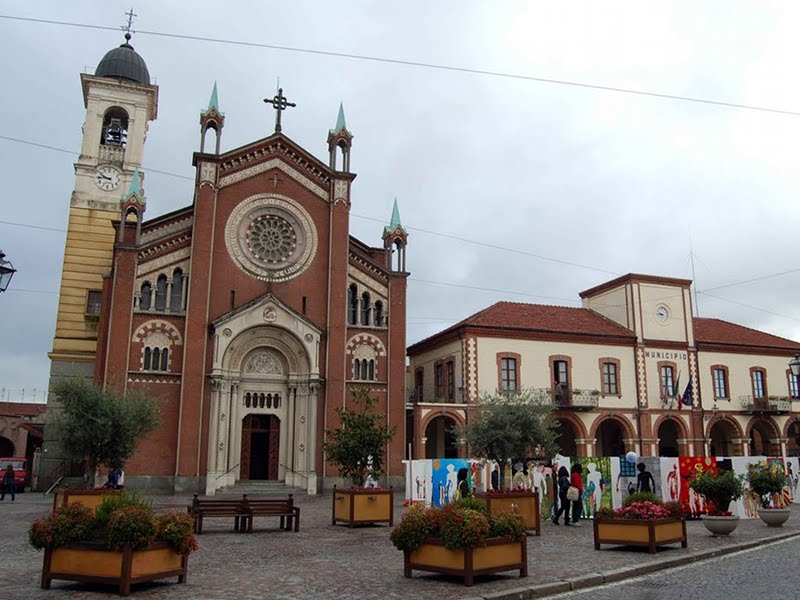
Orbassano is a municipality of the metropolitan city of Turin, in the inner ring south-west of the provincial capital. It borders Turin, Rivoli, Rivalta di Torino, Beinasco, Nichelino, Volvera, Candiolo and None; the territory is crossed by the 45th parallel and divided in two by the Sangone stream, with the built-up centre to the south and, to the north, a more open strip occupied by the hospital and freight yards.[1] It has about 22,600 inhabitants.[2] A farming and textile village until the decades after the Second World War, it has become one of the towns of the Turin car industry and today hosts three facilities of metropolitan importance: the San Luigi Gonzaga university hospital, the historic Fiat Research Centre, and the main freight railway hub for the Turin area.
The name and its origins
The Municipality explains the name through the motto on its coat of arms, Orbis sanus, "a healthy place"; other scholars trace it to a Roman legionary named Urbicius. Attested forms range from Vicus Urbanicum to Orbacianum, in use around the year 1000, and to Orbazan between the 16th and 17th centuries.[3] The countryside in the area was cleared of woodland and divided into lots as early as Roman times: in the 19th century stones concerning land ownership were found there.[2]
From Susa to the Orsini of Rivalta
In the Middle Ages the territory belonged to the marquises of Susa: in 1029 Olderico Manfredi ceded it to the abbey of San Giusto of Susa, and after 1035 half of the land passed to the diocese of Turin. In the 12th century the place came under the orbit of the lords of Rivalta, the Orsini, whose disputes with the bishops of Turin were settled by the agreement of 1253. In 1327 Orbassano was granted as a fief to the House of Savoy, who entrusted it once again to the lords of Rivalta; on the death of Risbaldo Orsini in 1341 the family split into two branches. The lords’ power declined from the 16th century and died out in the mid-18th century, when the inheritance passed to Isabella, wife of the marquis Palavicini; between the 16th and 18th centuries the villas Gaj di Quarti and Palma Nota were built.[2] Full municipal autonomy came in 1789.[3]
Marsaglia and 1706
On 4 October 1693, during the War of the League of Augsburg, the French army of Marshal Nicolas de Catinat met that of Victor Amadeus II on the plain between Volvera and Orbassano. A few days earlier the French had burned the royal palace of Venaria (30 September) and the castle of Rivoli (2 October); the clash lasted about four hours and left more than 13,000 casualties on the field.[4] The Municipality recalls the Battle of Marsaglia on the page devoted to its own history,[3] while the entry for the Parco naturale di Stupinigi notes that the fighting did not actually touch Orbassano’s own territory but the surrounding countryside.[2] The re-enactment, held since 1997, is organised each year by the Municipality of Volvera.[4] Thirteen years later, during the 1706 siege of Turin, the town was set ablaze by French troops.[1]
Churches and memorials
On piazza Umberto I stand the two main religious buildings. The church of the Confraternity of the Holy Spirit, built between 1739 and 1749 and consecrated in 1750, is an example of Piedmontese Baroque on a Greek-cross plan, with a dome, a high altar in polychrome marble and canvases by Casella, Brambilla and Milocco. The parish church of San Giovanni Battista was instead rebuilt in 1896–97 in Neo-Romanesque style, with three naves and a bell tower from 1892; it holds a Way of the Cross by Giovanni Stura and an 18th-century Deposition of Christ. In the Parco della Rimembranza, the monument to the fallen of the Great War, inaugurated in 1925 and signed by the Trieste sculptor O. Brunner, in Alzo granite and bronze, shows a fallen soldier held up by two comrades; in the same place stands an altar containing earth brought from Russia.[5]
From textile village to suburban town
In the 19th century mayor Leandro Quenda, who held office for more than twenty years, backed the creation of the San Giuseppe hospital, the Don Giordano school, and rail links to Giaveno and Pinerolo.[2] In the 1930s the Enciclopedia Italiana described Orbassano as a centre of the plain and noted: "It is linked by tramway to Turin (16 km), to Pinerolo (22 km) and to Giaveno (17 km)." The municipality had 3,865 inhabitants in 1931, and the 1927 census counted 544 industrial workers there, 381 of them in textiles.[6] The first notable firm was indeed a weaving mill, the Depetris.[2]
The turning point came with the car industry. In 1969 FIAT opened its plant at Rivalta, at Tetti Francesi, right on the border; in the 1970s Orbassano’s population rose from about 6,000 to 16,000 inhabitants.[2] In a few decades the rural village became a medium-sized town.[3]
The San Luigi Gonzaga hospital
The hospital now located in the Gonzole area has a Turin history spanning two centuries. Work on the first premises, intended for patients with lung disease, began on 26 March 1818 in Valdocco, to a design by Giuseppe Maria Talucchi; in 1909 the institute moved to corso Orbassano, to the area now occupied by the Mirafiori plant, with a thousand beds.[7] That pavilion-style sanatorium was badly damaged in the air raid of 18 November 1942.[8] In 1970 the hospital moved to Orbassano, keeping the pavilion layout with wide sun terraces; in the early 1990s the University of Turin established itself there, and since 1 January 2008 it has been a university hospital trust.[7]
Research, freight and railways
The Fiat Research Centre was set up in 1976 as a joint-stock consortium company;[9] its Orbassano site, on strada Torino, dates from 1979.[10] With about a thousand researchers and more than three thousand patents, the centre has tied its name to the Unijet and Multijet diesel engines and to the common-rail system; after the creation of Stellantis, according to the trade press, it has lost autonomy and much of its staff.[9]
Within the municipal territory lies the SITO freight hub, held jointly by Finpiemonte, Socotras and Mercitalia Logistics: 300 hectares, an eight-hectare intermodal terminal, eight kilometres of track and 90 hectares of warehouses. In 2021 the Ministry of Infrastructure allocated 1.5 million euros there to lengthen the tracks to 750 metres to the European standard; the terminal then handled no more than 600 trains a year.[11] Alongside it operates the State Railways’ freight yard, run by Terminali Italia, with 50,000 square metres of yard space, five tracks and four rubber-tyred gantry cranes, also licensed for dangerous goods.[12] From Orbassano runs the 24-kilometre link towards Avigliana planned under the Turin–Lyon line, with a 17-kilometre tunnel under the Avigliana hill: the special commissioner Calogero Mauceri puts the end of the works between 2033 and 2034, while several municipalities along the route oppose the project.[13]
For passengers, Orbassano will be the terminus of line 5 of the metropolitan rail service, running to Torino Stura via Borgata Quaglia–Le Gru in Grugliasco and San Paolo. The Orbassano-San Luigi stop has accumulated about five years of delay; in September 2026 councillor Gian Luca Vignale explained that "the closure of the Sp 174 is expected by the end of 2026, while completion of the works and the opening of the stop are now expected in the second half of 2027."[14]
Pages that link here
- Attack by two dogs on their owners at Borgaretto di Beinasco
- Banche del Tempo della provincia di Torino
- Borgaretto
- Metropolitan City of Turin
- Istituto Europa
- Turin Metro
- Mirafiori
- Changes to the Gtt network between Orbassano and Nichelino (October 2026)
- Monica Canalis
- Nichelino
- Ospedale San Luigi Gonzaga
- Pinerolo-Torino (linea ferroviaria)
- Mock trial of an artificial intelligence system at the San Luigi hospital in Orbassano
- Santa Rita (Torino)
- Servizio ferroviario metropolitano di Torino
- Stadio Filadelfia
- Turin Ring Road
- Torino-Lione
- Tram di Torino
- Unione Artigiana di Torino e Provincia
Related articles: Servizio ferroviario metropolitano di Torino
Timeline
- — At the San Luigi hospital in Orbassano an artificial intelligence system is put through a mock trial and comes out of it acquitted with reservations. → La Stampa
- — In Orbassano and Nichelino, construction sites and works on the Gtt network change, from 5 October, the routes of several bus lines, with temporary diversions and termini until January 2027. → CronacaQui Torino
Sources
- Mole24 — 11 December 2025
- Parks.it – Parco naturale di Stupinigi
- Comune di Orbassano
- Ministero della Cultura – Rievocazioni storiche
- Mole24 — 10 December 2025
- Treccani – Enciclopedia Italiana —
- AOU San Luigi Gonzaga
- MuseoTorino
- ClubAlfa.it — 26 April 2024
- UGAF – Unione Gruppi Anziani Fiat
- TrasportoEuropa — 17 February 2021
- Terminali Italia (Gruppo FS)
- TrasportoEuropa — 10 September 2026
- Quotidiano Piemontese — 23 September 2026