Avigliana
A municipality at the entrance to the Susa Valley, residence of the counts of Savoy, with two protected glacial lakes and the former Nobel Dynamite Factory.
Avigliana is a municipality in the Metropolitan City of Turin, located at the entrance to the Susa Valley, among the last rocky spurs of Mount Pirchiriano, on whose summit stands the Sacra di San Michele[1]. The municipal area covers about 23 square kilometres and had 11,984 inhabitants in 2007; between the 13th and 15th centuries it was one of the favourite residences of the counts of Savoy[2]. About 25 kilometres from Turin, along the old road to France, the town combines a medieval quarter, two glacial lakes protected by a nature park, and the memory of the Dynamite Factory founded by Alfred Nobel[3].
The castle and the House of Savoy
According to the tradition reconstructed by the local press, the castle on the hill was built in 924 by Margrave Arduin III, known as the Glabrous, and passed into Savoyard hands in 1045, through the marriage of Adelaide of Susa and Oddone of Savoy[4]. The castle was the birthplace in 1136 of Umberto, later count and venerated as Blessed Umberto III, and in 1449 of Bona of Savoy, future wife of the Duke of Milan Galeazzo Maria Sforza[4]. In 1368 Filippo of Savoy-Acaia was imprisoned there, awaiting a death sentence by drowning in the lake[4].
The figure most closely tied to Avigliana is Amadeus VII, the «Red Count», born on 24 February 1360. The 1930 Enciclopedia Italiana and local tradition both say he was born in Avigliana's castle[1][4]; the Dizionario Biografico degli Italiani, however, gives the castle of Chambéry as his birthplace[5]. The nickname, according to the Dizionario, dates back to 1383: at the siege of Bourbourg, in Flanders, on hearing of the birth of his son the count set aside his mourning for his father and dressed in red[5]. In 1388 he gained Nice, the House of Savoy's first outlet to the sea, and died in 1391, at the age of thirty-one, from the effects of a wound suffered while hunting[5].
After 1418, having lost its role as a residence, the castle became a defensive fortress[4]. In May 1691, during the war against Louis XIV's France, Marshal Catinat blew it up with mines, and it was never rebuilt[4]; the Enciclopedia Italiana instead dates the destruction to 1698[1]. Today only the elliptical outline of the outer walls and a few stretches of the watchtowers' walkways survive[4].
The medieval quarter
Below the ruins lies Piazza Conte Rosso, with arcaded buildings and a 14th-century well; nearby stands the octagonal clock tower, dating from the 13th-14th centuries, said by local tradition to house the first public clock in Piedmont[6]. At the top of a flight of steps, in the quarter of San Pietro, stands the Romanesque-Gothic church of San Pietro, possibly of Benedictine foundation[6], which the Enciclopedia Italiana dates to the 12th century[1]. In the church of San Giovanni Battista, whose interior was remodelled in the early 19th century, triptychs and panels by the Piedmontese Renaissance painter Defendente Ferrari and his school are preserved[1]:
«a veritable small museum of the art of Defendente de' Ferrari»
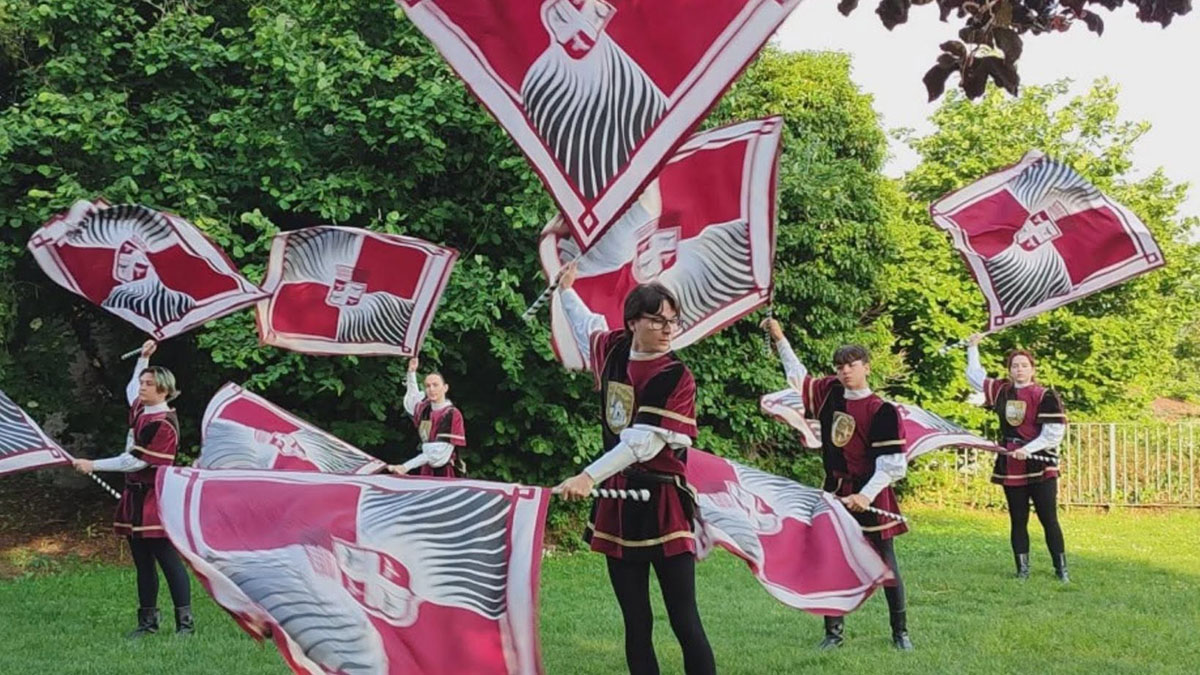
Every June the town re-enacts its Savoyard past with the Palio dei Borghi, which in 2026 reached its forty-third edition: the festival recalls the celebrations of 1389 for the passage of Valentina Visconti and pits seven districts against each other, from Borgo Vecchio to Drubiaglio[7][8].
The lakes and the park
South of the town are two intermorainic lakes, formed by the morainic amphitheatre left behind by the glacier of the Dora Riparia valley: Lago Grande, covering 0.84 square kilometres and up to 26 metres deep, and Lago Piccolo, covering 0.58 square kilometres and at most 12 metres deep[2]. They are the only survivors among the lakes formed in the Susa Valley by the last two great glaciations of the Pleistocene[9]. Together with the Mareschi marsh and the morainic hills they form the Avigliana Lakes Nature Park, about 400 hectares, managed since 2012 by the Ente di gestione delle Aree protette delle Alpi Cozie and recognized as a site of Community interest[9]. Coots, little grebes, great crested grebes, grey herons, black kites and the rare bittern nest or stop over there; the waters are home to pike, perch and carp[9].
The countryside of the Drubiaglio and Grangia hamlets preserves an ancient crop: the flat golden onion, grown locally «from seed to seed» and now a Slow Food Presidium[10].
The Nobel Dynamite Factory
In 1872, on the initiative of Alfred Nobel and Parisian bankers, a dynamite factory was founded in Avigliana; in December 1873 the first Italian nitroglycerine plant came into operation, producing the substance discovered by the Turin chemist Ascanio Sobrero[3]. Avigliana's explosives served the great Alpine tunnelling projects, from the Fréjus to the Gotthard, and the site grew from an initial five hectares to more than 130 by 1938[3]. Adriano Galinié, director from 1880 to 1893, received honorary citizenship in 1890 with a scroll signed by representatives of more than 300 families; he is remembered as «a father to the workers, a courteous superior to the clerks, and a generous philanthropist to the population»[11].
In 1925 the factory passed to Montecatini. During the Second World War it achieved the world record for the production of T4, the explosive also known as RDX, and was hit by bombing raids and partisan actions; alongside wartime production, a line of Duco paints was also started[3]. It was at the Duco-Montecatini plant in Avigliana that Primo Levi worked as a chemist between 1946 and 1947, in the very months when he was writing If This Is a Man[12]. The plant closed in the 1960s[3].
Avigliana today
Of the factory buildings, now surrounded by vegetation, part has been restored as a museum, open for guided visits run by the Amici di Avigliana association; in 2025 the association and the municipality offered five themed tours, the first of which, in March, was devoted to the working conditions of female workers from the second half of the 19th century to the postwar period[13]. In November 2025 the Piedmont Region approved funding of 840,000 euros, from European ERDF funds, to turn an initial lot of about 17,000 square metres into an immersive museum and cultural hub linked to the Via Francigena cycle route[14]. In August 2026 the executive project was approved, with 536,000 euros of works and a «explosive science and living history room»[15]. The town's public library is named after Primo Levi[16].
The redevelopment of the factory is part of the area urban strategy for the Susa and Sangone Valleys, which brings together 22 municipalities[14]. In 2024 Avigliana was among the five municipalities of the province of Turin awarded the Orange Flag of the Touring Club Italiano[17].
Pages that link here
- Bricherasio
- Chamber of Commerce of Turin
- Dora Riparia
- Giulio Einaudi
- No TAV March Sant'Ambrogio-Avigliana, 3 October 2026
- March «Let's Stop the Avigliana-Orbassano Together», 3 October 2026
- Marrone della Valle di Susa
- No TAV Movement
- Orbassano
- Piero Fassino
- Primo Levi
- Sacra di San Michele
- Saluzzo
- Servizi di Informatica e Internet
- Susa
- Turin-Lyon
- Unione Montana Valle Susa
- University of Turin
- Susa Valley
Timeline
- — The Unione Montana Valle Susa calls a public march for Saturday 3 October, «Let's Stop the Avigliana-Orbassano Together», against the planned Avigliana-Orbassano railway line, from Piazza XXV Aprile in Sant'Ambrogio di Torino to Piazza del Popolo in Avigliana. → TorinoOggi TorinoToday
Related articles: Giulio Einaudi, Primo Levi, Settimo Torinese, Università degli Studi di Torino
Sources
- Treccani – Enciclopedia Italiana (1930) — 1 January 1930
- Treccani
- L'Agenda News — 2 January 2026
- L'Agenda News — 18 April 2022
- Treccani – Dizionario Biografico degli Italiani
- Touring Club Italiano – Bandiere Arancioni
- L'Agenda News — 16 June 2026
- L'Agenda News — 17 June 2026
- Comune di Avigliana
- Comune di Avigliana
- L'Agenda News — 16 April 2025
- Centro Internazionale di Studi Primo Levi
- L'Agenda News — 11 March 2025
- L'Agenda News — 7 November 2025
- L'Agenda News — 8 August 2026
- Comune di Avigliana
- ANSA — 4 February 2024