Sacra di San Michele
Fortified abbey on Mount Pirchiriano, at the mouth of Val di Susa, founded at the end of the 10th century and symbol-monument of Piedmont since 1994.
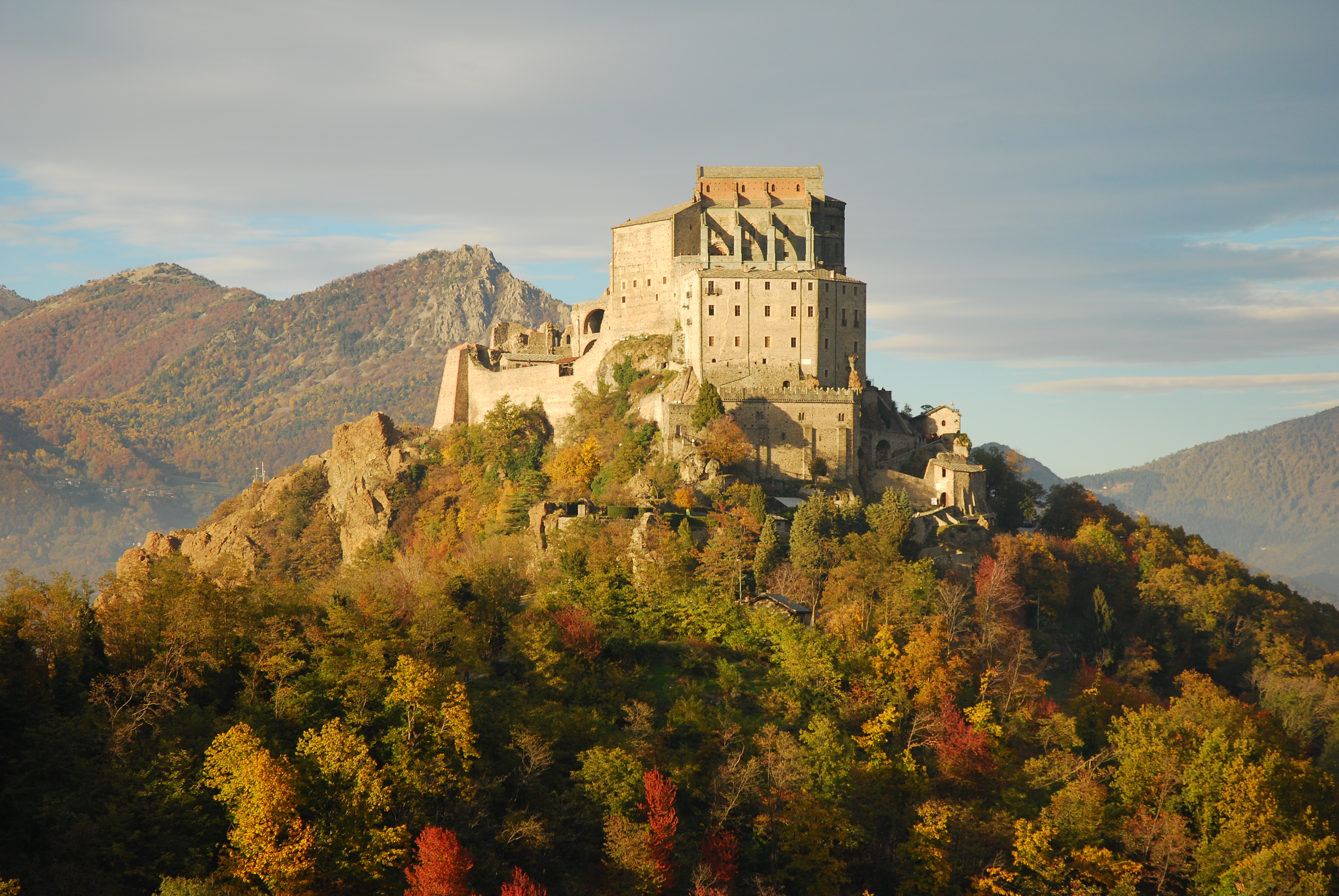
The Sacra di San Michele is an abbey complex built on the summit of Mount Pirchiriano, at 962 metres, at the mouth of Val di Susa, some forty kilometres west of Turin[1]. Founded as a fortified Benedictine monastery at the end of the 10th century, it was one of the most important Benedictine monastic centres in Europe[2] and, thanks to its position along the Via Francigena, a major pilgrimage destination[3]. In 1994 the regional council proclaimed it by law a symbol-monument of Piedmont[1].
Origins on the Pirchiriano
A small temple dedicated to the Archangel Michael already existed on the summit, built by the Lombards, which in the 10th century was rebuilt by Bishop Giovanni Vincenzo[4]. The founding of the monastery proper dates to between 983 and 987[3][2]. Several figures contributed to the birth of the community: the marquis, the bishop of Turin, a group of noble pilgrims from the Auvergne led by Hugh of Montboissier, Giovanni Vincenzo himself, and the hermits of the nearby Mount Caprasio[2]. The preface to a volume published by the Piedmont Region in 1995 sums it up thus: "At the time the Sacra was built, Piedmont was a place of transit and a borderland"[1].
The Benedictine abbey and its possessions
The abbey flourished until the 12th century[4]. Known in medieval sources as San Michele della Chiusa, it accumulated properties and dependencies well beyond the Alps: around 1090 the counts of Geneva granted it the valley of Chamonix, at the start of the 12th century it received the priory of Port-Valais, and from 1163 to 1536 the priory of Burier, on Lake Geneva, was among its dependencies[3].
Decline began in the 14th century, when the abbey lost its autonomy and was reduced to a commendam: according to Treccani in 1379[4], according to the Historical Dictionary of Switzerland in 1381, when the antipope Clement VII entrusted it to Amadeus VI of Savoy[3]. From then on the commendatory abbots were often prelates linked to the Savoy court, such as Guillaume de Challant (abbot from 1390) and Guillaume de Varax (from 1446), both later bishops of Lausanne[3]. The Benedictines left the monastery in 1622[2], and a few years later, in 1629, the complex was nearly destroyed by the French[4]. Formal suppression came at the start of the 19th century: in 1803 by decision of Pope Pius VII according to the Historical Dictionary of Switzerland[3], in 1802 by an act of the French government according to the Città e Cattedrali entry[2].
Carlo Alberto, the Rosminians and the Savoy tombs
After three decades of abandonment, in 1836 King Carlo Alberto entrusted the Sacra to the Rosminian Fathers, the Institute of Charity founded by Antonio Rosmini, who still look after it today[1][2]. The king also wanted the abbey to hold the remains of some members of the House of Savoy: the stone sarcophagi, moved there in those years, are lined up along the sides of the church[2][1]. In the 19th century the Sacra thus also became a dynastic burial site[4]. The church was damaged by an earthquake in 1885 and restored in 1937[4].
The Stairway of the Dead and the Zodiac Portal
The climb to the monastery is itself an architectural journey. First comes the Monks' Sepulchre, a small Greek-cross building with four circular niches dating from the early 11th century, then the Iron Gate, a low tower once reached by a drawbridge[2]. From here begins the Stairway of the Dead: 243 steps cut into the rock[1], along which side niches once held the skeletons of monks[2]. At the top opens the Zodiac Portal, carved between 1128 and 1130 and signed by Master Nicolao, with the collaboration of Pietro da Lione[2]. The façade rising from below reaches a height of 41 metres[1].
The church, built in two phases from the 12th century onward, combines Romanesque and Gothic elements with clustered piers[2]; it has three apses, the central one trilobed with an external gallery of small arches, and a crypt with three chapels[4]. Among the works preserved are the Deposition, frescoed in 1505 by Secondo del Bosco, the triptych of the Virgin by Defendente Ferrari, and the canvas of Saint Michael painted by Antonio Maria Viani in 1633[2]. The apse is oriented so as to catch the dawn light on 29 September, the feast day of Saint Michael[2].
Legends and literature
The mountain has its own legend, that of "Bell'Alda", told by Massimo d'Azeglio: a young woman, fleeing soldiers, is said to have thrown herself from the highest tower invoking the Madonna and to have been saved by angels; attempting the leap a second time, she died on the rocks below[1]. Alessandro Manzoni also drew on these places for a canto of his Adelchi[1]. In the 20th century the Sacra was named among the models for the abbey in The Name of the Rose, the novel by Umberto Eco published in 1980 and adapted for film in 1986 with Sean Connery[1].
From John Paul II to the 2018 fire
On 14 July 1991 Pope John Paul II climbed the Pirchiriano during his visit to the diocese of Susa. In the address he gave at the abbey, he said:
"Our restless world, often caught up in haste and deafened by noise, needs privileged places like this one"
The text of the address is published by the Holy See[5].
On the evening of 24 January 2018 a fire broke out in the roof of the convent, where restoration work was under way; several fire brigade teams responded, along with the Red Cross and the carabinieri of Avigliana, and firefighters pointed to a short circuit as the initial hypothesis[6]. The flames affected around 180 square metres of roofing; the three Rosminian fathers present were unharmed, and the convent was closed to the public pending a stability check[7]. "Some documents, including the Sacra's diary and financial records, were probably lost," explained Father Camillo Modesto Temon the following day[7]. At the time the abbey was receiving around one hundred thousand visitors a year[6].
Symbol of the Region
Regional law no. 68 of 21 December 1994 recognised the Sacra as a "symbol-monument of Piedmont"[1]. In 2020, the fiftieth anniversary of the Piedmont Region, the regional council dedicated a publication to it; its president Stefano Allasia wrote that a symbol of this kind "can become — in the year of the 50th anniversary of the founding of the Piedmont Region — a means to feel more united"[1]. The complex lies within the territory of the Metropolitan City of Turin and remains in the care of the Rosminians, who look after its worship and visits[1].
Call to suspend the light beam over risk to nocturnal animals (September 2026)
In September 2026 Elena Patriarca, an expert at the Piedmont Theriological Station of Turin's Museo Civico, formally asked for the suspension of the high-intensity light beam projected five kilometres into the night sky above the Sacra di San Michele, in Val di Susa, installed as a symbolic reference to the Archangel Michael's sword. According to the report, the beam of light risks attracting and disorienting moths and nocturnal migratory birds, with a risk of death for the animals.
Appeal by the Piedmont Theriological Station against the light beam (September 2026)
The Theriological Station did not provide quantitative data or direct measurements of the installation's impact, and no response from the monument's managing body has so far been reported.1
Chronology
- — The Piedmont Theriological Station calls for the suspension of the light beam installed at the Sacra di San Michele, warning of the risk of attracting and killing moths and nocturnal migratory birds. → CronacaQui Torino
Related articles: Appeal Against the Light Beam at Sacra di San Michele, Elena Patriarca, Piedmontese Theriological Station, Request to Suspend the Light Beam at the Sacra di San Michele, Val di Susa
Pages linking here
- Appeal Against the Light Beam at Sacra di San Michele
- Avigliana
- Elena Patriarca
- Inaugurazione dell'ascensore della Sacra di San Michele
- Nuovo ascensore accessibile alla Sacra di San Michele (settembre 2026)
- Piedmontese Theriological Station
- Request to Suspend the Light Beam at the Sacra di San Michele
- Val di Susa
Sources
- Consiglio regionale del Piemonte —
- Città e Cattedrali (Regione Piemonte - Conferenza Episcopale Piemontese)
- Dizionario storico della Svizzera (DSS)
- Istituto dell'Enciclopedia Italiana Treccani
- Santa Sede — 14 July 1991
- ANSA — 24 January 2018
- AGI — 25 January 2018
- CronacaQui Torino — 19 September 2026