Umberto Eco
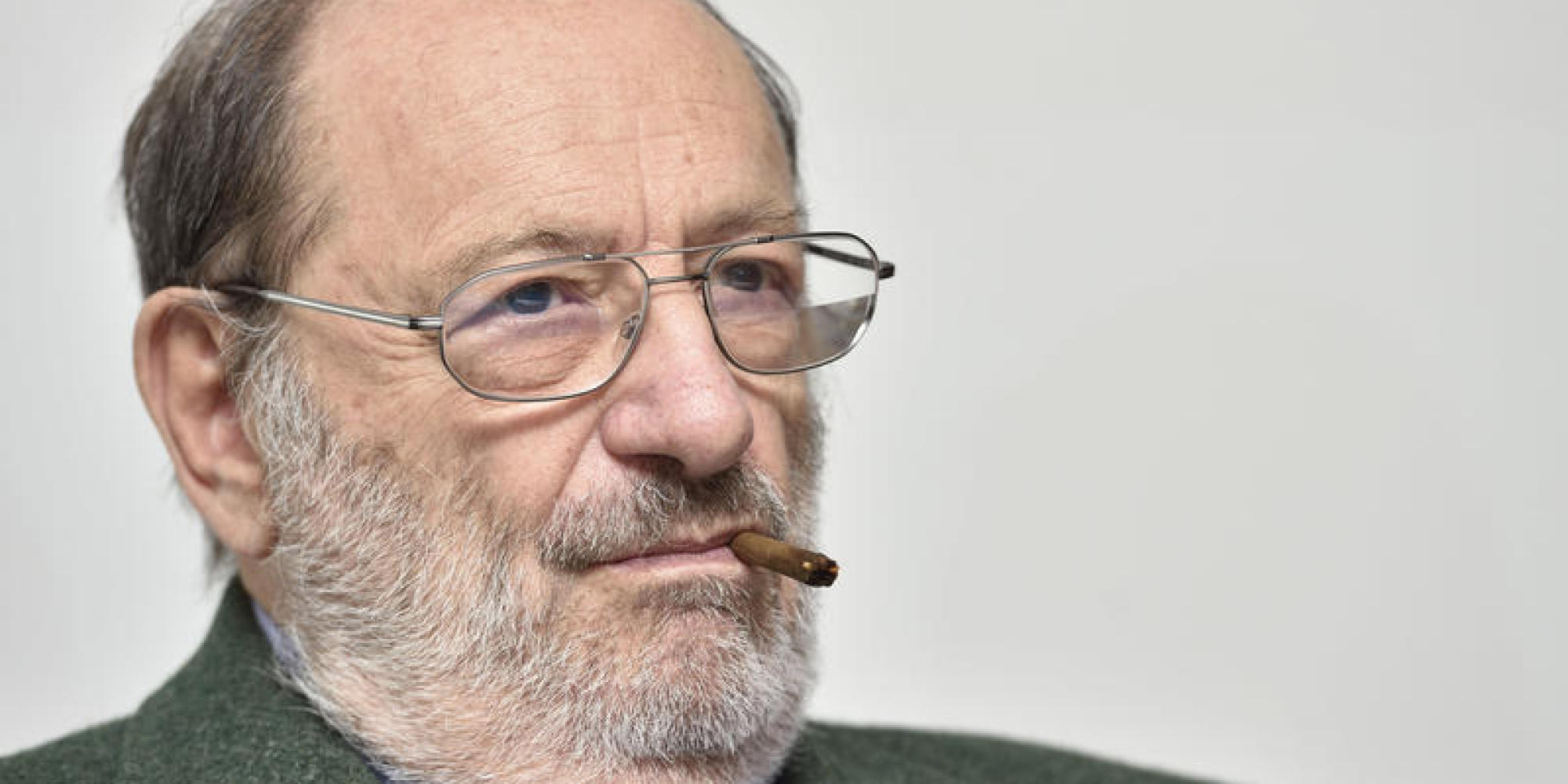
Umberto Eco (Alessandria, 5 January 1932 – Milan, 19 February 2016) was one of the leading Italian intellectuals of the twentieth century: a semiologist, philosopher, essayist, publisher and world-famous novelist, author of The Name of the Rose. A Piedmontese by birth, he did his university studies in Turin, which shaped the course of his career: at the University he graduated in aesthetics under Luigi Pareyson.[1][2]
From Alessandria to Turin
He was born in Alessandria, where his father worked in a hardware shop.[3] At the local high school he had a teacher, Giacomo Marino, who passed on to him very broad interests, from history to music to psychoanalysis.[2] From his years at the Liceo Plana also survive some youthful drawings, unpublished until 2016, when they were exhibited in Turin as part of the Portici di Carta festival.[4]
At the University of Turin he studied under teachers such as Augusto Guzzo, Nicola Abbagnano, Norberto Bobbio and Carlo Mazzantini.[2] He lived in the Valentino section of the Collegio universitario Einaudi, at via Galliari 30, a rationalist building constructed in 1936 to a design by Ferruccio Grassi, one of the first in Italy conceived specifically as student housing; the college's list of notable alumni remembers him alongside Claudio Magris.[5] In the city's memory he is associated with the so-called «ragazzi di via Po» («boys of via Po»), the generation of students and writers who grew up among the arcades of the city centre.[4]
The young Catholic and the thesis on St Thomas
In the early 1950s he was a leader of Catholic student youth and a member of Giac, the Gioventù italiana di Azione cattolica. Gianni Vattimo, who knew him in those circles, recalled his ideas at the time as follows:[6]
«he clearly maintained that God can only be of the left, because creation itself is of the left, against the inertia of repetition and conservation.»
In 1954 he left Catholic Action in protest against Pius XII's support for its president Luigi Gedda, who was pushing the organization to the right.[2] That same year he graduated in philosophy under Pareyson, professor of aesthetics, with a thesis on the aesthetic problem in Thomas Aquinas, published as a book in 1956.[1][2] It was precisely his study of St Thomas, he later recounted, that helped him free himself from religious faith.[6]
Rai, Bompiani and the avant-garde
At the end of 1954 he moved to Milan to work on cultural programming for the newly founded television network; he frequented the Studio di fonologia musicale of Luciano Berio and Bruno Maderna.[2] From the late 1950s he worked at the publishing house Bompiani, where he was co-director until 1975, and he contributed to the founding of Gruppo 63, the literary neo-avant-garde.[3][7] There followed the essays that made him famous: Opera aperta (1962), the Fenomenologia di Mike Bongiorno and Diario minimo (1963), and Apocalittici e integrati (1964).[7] His method excluded nothing: in 2002 he said that «Mickey Mouse can be perfect, in the sense that a Japanese haiku is perfect».[1]
Some entries he wrote in the early 1980s for the Encyclopedia published by Einaudi, the Turin-based publishing house, were later collected in Semiotica e filosofia del linguaggio (1984).[2]
Bologna and semiotics
In 1971 he joined the new DAMS degree programme at the University of Bologna, and in 1975 he won the chair of semiotics; in 2000 he founded and chaired the Scuola superiore di studi umanistici, left teaching in 2007 and became professor emeritus in 2008.[8] In 1975 he also published his Trattato di semiotica generale (Treatise on General Semiotics), which introduced the concept of the encyclopedia and favoured the theories of Charles S. Peirce.[2] He gave a now-famous definition of his discipline: «the discipline that studies everything that can be used to lie».[9] He received around forty honorary degrees.[8]
The novels and Piedmont
The Name of the Rose (1980), a philosophical mystery set in a medieval abbey, was translated into more than forty languages.[2] It was followed by Foucault's Pendulum (1988), a novel about esoteric conspiracy theories that closes in Piedmont, at the house of the uncle of the character Belbo, in a never-named location.[10]
Piedmont returns in Baudolino (2000): the protagonist spends his youth in the countryside near Marengo, roughly where Alessandria would arise in 1168, and is adopted by Frederick Barbarossa.[11] And Turin is the home city of Simone Simonini, the forger of The Prague Cemetery (2010), son of a Turinese father, who earns his law degree in Turin itself and learns to forge documents in a notary's office there.[12] His last novel, Numero zero, came out in 2015.[2]
Final years and legacy
In October 2015 he was among the founders of the publishing house La nave di Teseo.[3] He died at his home in Milan during the night of 19 February 2016, at the age of 84, and was honoured with a civil funeral rite.[1][3] In his will he asked that no conferences be held about him for ten years.[9] In 2021 his personal library of about 44,000 volumes and his archive passed to the University of Bologna.[8]
Turin remembered him in October 2016 with the tenth edition of Portici di Carta, which dedicated to him the programme «Umberto Eco, gli anni torinesi» («Umberto Eco, the Turin years»): readings, walks through the places of his youth, and meetings with friends and witnesses such as Furio Colombo and Gianni Vattimo.[4]
Pages linking here
- Adriano Olivetti
- Alessandria
- Biblioteca civica centrale
- Bicerin
- Gianni Vattimo
- Norberto Bobbio
- Presentation of the Vale Project in Turin
- Sacra di San Michele
- Stefano Lo Russo
- Università degli Studi di Torino
- VALE
Sources
- Radio Popolare — 20 February 2016
- Fondazione Umberto Eco
- Il Post — 20 February 2016
- Gravità Zero —
- FAI – Fondo per l'Ambiente Italiano
- MicroMega — 22 February 2016
- Treccani
- Università di Bologna
- Il Post — 19 February 2026
- Letture.org
- La nave di Teseo
- ThrillerMagazine — 10 November 2010