Alessandro Baricco
Alessandro Baricco is a writer, essayist and man of theatre born in Turin in 1958, author of novels translated into many languages such as Ocean Sea, Silk and City, and of the monologue Novecento.[1][2] In his home city he founded the Scuola Holden in 1994, a school dedicated to the art of storytelling, of which he is still dean; since 2024 the school has belonged entirely to Feltrinelli, but Baricco remains its dean and a lifetime member of its board.[3]
Education and music criticism
A philosophy graduate with a thesis in aesthetics, Baricco made his debut as an essayist in 1988 with a book on Gioachino Rossini.[2] In those same years he worked as a music critic for la Repubblica, before moving to La Stampa as a cultural columnist; alongside his writing, he devised radio and television programmes on music and literature.[1] On television he appeared in cultural programmes such as L'amore è un dardo, about opera, and Pickwick, devoted to books.[2]
The novels
His first novel, Castelli di rabbia, came out in 1991; it was followed by Ocean Sea (1993), Silk (1996), City (1999), Without Blood (2002), This Story (2005) and Emmaus (2009), and later Mr Gwyn (2011), Three Times at Dawn (2012), Smith & Wesson (2014) and Abel (2023).[1] The first novel, published by Rizzoli, won the Premio Selezione Campiello and the Prix Médicis Étranger; his later books, all translated abroad, were reviewed by outlets such as the Guardian, the New York Times, Libération and Le Monde.[2] His recognisable, evocative prose has given him a rare balance between literary quality and wide popular success.[1] With Abel, published by Feltrinelli, Baricco returned to the stage as a reader: in the show Abel Concerto he brought pages from the book to Italian theatres with three musicians, Cesare Picco, Roberto Tarasco and Nicola Tescari, divided into four parts called "songs".[4]
Novecento and the theatre
Novecento was written in 1994 for the actor Eugenio Allegri, who brought it to the stage under the direction of Gabriele Vacis and performed it for decades.[5] Giuseppe Tornatore drew the film The Legend of 1900 from the monologue about the pianist born on an ocean liner.[2] When Allegri died suddenly in May 2022, Baricco remembered him in a piece published by Il Post:
"I write these lines with immense difficulty because, among many other things, Eugenio was also the actor for whom I wrote Novecento"
In the same piece he wrote that Allegri performed Novecento so many times that no one knew that story as well as he did.[5] Baricco has also worked in theatre as author, director and performer, with the readings of Totem and a rewriting of the Iliad.[2]
The Scuola Holden
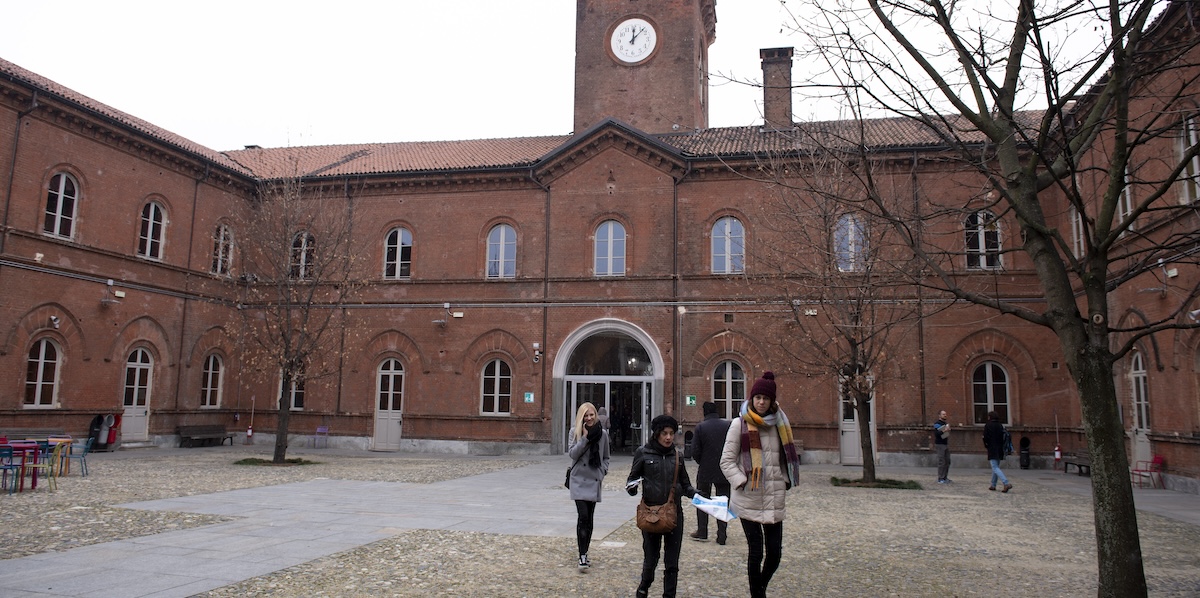
The Scuola Holden was founded in 1994 by a group of five friends in their thirties, at a time when the teaching of writing was not taken seriously in Italy; its name comes from Holden Caulfield, the protagonist of Salinger's The Catcher in the Rye.[6] For twenty years the school occupied a small Art Nouveau building near the Po, no bigger than a couple of tennis courts, where more than three hundred students graduated. In 2013 it moved to the Manica degli Obici, a former munitions factory granted by the City at Piazza Borgo Dora 49, right by Porta Palazzo: the new campus was inaugurated on 14 September 2013 with an evening lecture by the architect Renzo Piano and fireworks.[6]
The idea behind the school is that all forms of storytelling share a common root:[7]
"We believe that a novelist, a screenwriter, a journalist or a video game designer are, first and foremost, storytellers."
For this reason teaching has no traditional lecterns or exams, but is organised into thematic colleges, from film to reportage to serial fiction, and students of one narrative form also attend the others.[7] Feltrinelli, which joined the company with a 25.1 percent stake, rose to 51.5 percent in 2019, the year in which the Holden also became a university institution, with a writing course equivalent to a bachelor's degree in Arts, Music and Performance Disciplines; in February 2024 the publisher took over 100 percent of the shares.[3]
The essayist of mutation
Since the 2000s Baricco has paired his novels with essays on cultural change: The Barbarians: An Essay on the Mutation of Culture, Una certa idea di mondo, the Palladium Lectures and The Game, devoted to the digital revolution.[8] In The Game (2018) he argues that much of the protest against the digital revolution expresses a need to be outraged stronger than the arguments supporting it, summing it up as: "Your urge to be angry is far greater than the arguments you have for being so."[9] In January 2019, a long article of his in la Repubblica about the breakdown of the pact between elites and ordinary people, which also called into question the internet and social networks, sparked wide debate.[10] In 2005 he became a partner in Fandango Libri.[2]
Turin and the Toro
Baricco lives in Turin, and the long podcast interview Wild Baricco was recorded in the living room of his Turin home in 2023, made with Matteo Caccia for Il Post and Feltrinelli; among the passions he talks about there is his love for "Toro".[11] A supporter of Torino, on 21 September 2025 he posted on social media a photo of himself wearing the maroon shirt and holding a flag reading "Cairo vattene" ("Cairo, go away"), taken at the fans' march protesting against chairman Urbano Cairo before the Torino-Atalanta match.[12]
Awards
In 2020 he received the Premio Campiello for lifetime achievement, and in 2024 the Premio speciale Lattes Grinzane.[1] In 2008 he directed his first film, Lezione ventuno, and took part in the Mondi al limite project on the work of Médecins Sans Frontières.[1]
Pages linking here
Sources
- Treccani
- Feltrinelli Editore
- Il Post — 9 February 2024
- Il Post — 12 December 2024
- Il Post — 8 May 2022
- Scuola Holden
- Feltrinelli Editore
- Feltrinelli Editore
- Il Post — 21 October 2018
- Il Post — 15 January 2019
- Il Post — 8 December 2023
- Il Post — 21 September 2025