Beppe Fenoglio
Writer from Alba (1922–1963), partisan in the Langhe, author of «I ventitre giorni della città di Alba» and the posthumous «Il partigiano Johnny»; he died in Turin.
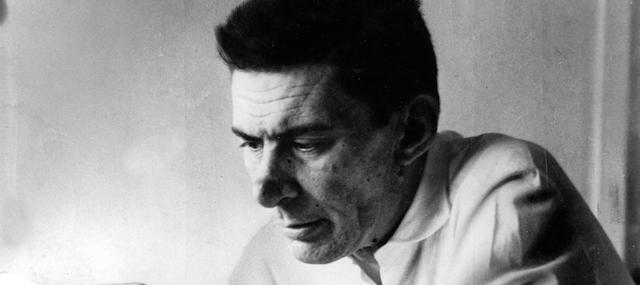
Beppe Fenoglio (Giuseppe Fenoglio; Alba, 1 March 1922 – Turin, 18 February 1963) was an Italian writer, author of the rawest and least rhetorical novels and stories about the Resistance in the Langhe. He lived almost his whole life in Alba, but his literary destiny passed through Turin: he was a literature student at the Turin university, made his debut with the publishing house Einaudi, and died at the Molinette hospital, a few years before the works published posthumously, starting with Il partigiano Johnny, made him one of the classics of twentieth-century literature.[1][2]
Alba and the discovery of English
Son of the butcher Amilcare Fenoglio and of Margherita Faccenda, he grew up in Alba and spent summers with relatives in San Benedetto Belbo and Murazzano, in the upper Langa that would become the landscape of his books.[1][2] At middle school the teacher Maria Lucia Marchiaro introduced him to the study of English; at high school his teachers included the philosopher Pietro Chiodi and Leonardo Cocito, a teacher of Italian and anti-fascist, and he formed a lasting friendship with don Natale Bussi.[2] His passion for English poets and prose writers became for him a way of looking elsewhere: Anglo-Saxon civilization, according to his publisher's profile, was an antidote to the meanness of provincial fascism.[3]
In 1940 he enrolled in the faculty of letters at the University of Turin, but attended irregularly and sat few exams; in 1943 the war interrupted his studies.[1][2] Called up in January 1943, he attended the officer cadet course first at Ceva and then at Pietralata, in Rome, the experience he would later recount in Primavera di bellezza.[1][3]
Partisan in the Langhe
After 8 September 1943 he returned to Alba and chose guerrilla warfare. He took part in the assault on the Alba carabinieri barracks in December 1943 and joined a communist brigade active between Murazzano and Mombarcaro; after the defeat at Carrù, in March 1944, he returned to the city and in September resumed the fight with the “azzurri”, the autonomous formations of Badoglian orientation in the southern Langhe.[1][2] On 10 October 1944 he was among the partisans who liberated Alba, held for twenty-three days until it was retaken by the Italian Social Republic on 2 November.[1][4] Between March and May 1945 he served as liaison officer with the British mission in the Monferrato, the Vercelli area and the Lomellina.[2]
From that brief season came the most famous opening of Resistance literature, the first sentence of I ventitre giorni della città di Alba:[4]
«Alba was taken by two thousand men on 10 October and lost by two hundred on 2 November of the year 1944»
The clerk who wrote
From 1947 he worked for the Alba wine company Figli di Antonio Marenco, where he handled correspondence with foreign clients and rose to the role of clerk: an undemanding job that left him time to write.[1][2][3] He made his debut in November 1949 with the short story Il trucco, published in “Pesci rossi”, Bompiani's publishing bulletin, under the pseudonym Giovanni Federico Biamonti.[1]
In Turin his manuscripts reached the desks of Einaudi's readers: Italo Calvino and Natalia Ginzburg judged them favourably, while Elio Vittorini did not support the publication of the novel La paga del sabato.[1] It was Vittorini, however, who in 1952 welcomed into the “I gettoni” series I ventitre giorni della città di Alba, twelve stories about the partisans that marked his true debut; in 1954 came the short novel La malora, a story of peasant poverty in the Langhe.[1][5] In 1958, thanks to his contacts with Livio Garzanti, he moved to the Milanese publisher, who the following year published Primavera di bellezza, awarded the Premio Prato in 1960; in 1962 the story Il mio amore è Paco won the Premio Alpi Apuane.[1]
Critics have compared him to Cesare Pavese, to Hemingway and to Dos Passos.[5] Compared to the optimistic chronicle of neorealism, his Resistance is made of sharp contrasts, of a life reduced to the essential, and his reading of the partisan war is disenchanted.[6]
Illness and death in Turin
In March 1960 he married Luciana Bombardi.[2] Two years later he fell ill with bronchial cancer and was admitted to the Molinette hospital in Turin, where he died during the night between 17 and 18 February 1963, at the age of forty.[1][7] In the notebook with which he communicated with his family he left precise instructions for the funeral: a “civil funeral, of the lowest degree, Sunday morning, without stops, flowers or speeches”.[1] His publisher recalls that he faced the illness with firm composure.[3]
The posthumous books
The best-known part of his work appeared after his death. In 1963 Garzanti published Un giorno di fuoco, which also contained the short novel Una questione privata: the story of the partisan Milton who, in the midst of war, seeks the truth about the relationship between the girl he loves, Fulvia, and his friend Giorgio.[1][7] Italo Calvino, in his 1964 preface to the new edition of Il sentiero dei nidi di ragno, wrote that in that book “there is the Resistance just as it was, from inside and outside, true as it had never been written before”.[1]
In 1968 Einaudi published in Turin Il partigiano Johnny, edited by Lorenzo Mondo, which remained unfinished: it is his best-known book.[1][3][5] There followed La paga del sabato (1969), Un Fenoglio alla prima guerra mondiale (1973), the Racconti partigiani (1976) and, in 1978, the three-volume critical edition of the Opere directed by Maria Corti, with many unpublished texts; the Appunti partigiani 1944-1945 appeared in 1994.[1][6] Since then Einaudi has kept novels, stories and letters in its catalogue.[3]
The memory in Alba
In Alba, at piazza Rossetti 2, is the seat of the Centro Studi Beppe Fenoglio, which preserves a library of over 1,400 volumes and the archive dedicated to the writer, organizes programmes for schools on the theme “Fenoglio and the Resistance” and collaborates with the municipality on the celebrations of the city's Liberation.[8][9] The opening of I ventitre giorni has also entered music: it is echoed in the first line of the song Linea Gotica by CSI.[4]
Pages linking here
Related articles: Alba, Langhe