Molinette Hospital
The largest hospital in Turin, on corso Bramante: opened in 1935, heir to the Ospedale maggiore di San Giovanni, founded in the Middle Ages next to the Duomo.
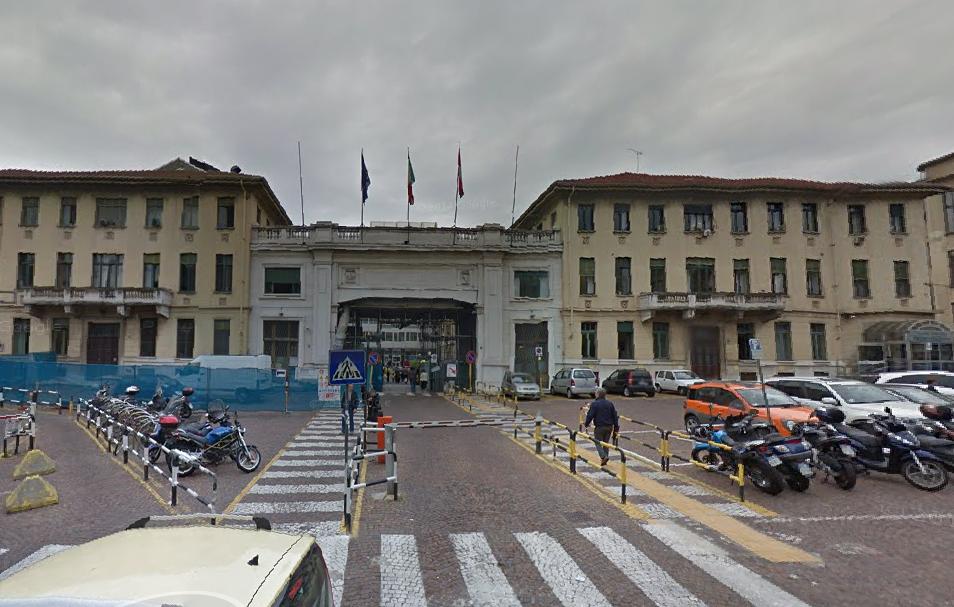
The Molinette Hospital, officially the Ospedale San Giovanni Battista, is the main hospital in Turin: a pavilion complex opened in 1935 on corso Bramante, on the left bank of the Po. It is the direct heir of the Ospedale maggiore di San Giovanni Battista e della Città di Torino, founded in the Middle Ages next to the Duomo, and today it is part of the university hospital trust Città della Salute e della Scienza di Torino.[1] Piedmont's organ transplant programme began in its operating theatres.
From the Duomo's bell tower to via Giolitti
According to tradition, a canon of the cathedral picked up a dying man from the street and had him taken into a room in the bell tower of the church of San Giovanni: from that act, it is said, the city's first hospital was born.[1] A document dated 13 March 1228 refers to it as «Hospitale del Domo»; in 1306 the site was moved toward the towers of the Porta Palatina, and from 1460 the institution has been known as the Ospedale di San Giovanni.[2] In 1540-41 the Municipality joined the Chapter of canons, donating to the hospital the assets of twelve confraternities and more than a hundred houses; on 12 January 1578 the institution took the official name Ospedale maggiore di San Giovanni Battista e della Città di Torino, which it still retains.[2] Management remained for a long time with the canons of the Duomo, under the authority of the bishop; the plague of 1630 put the institution into crisis and forced the Chapter to ask the City for help.[1]
In 1680 Count Amedeo di Castellamonte designed the new building on what is now via Giolitti: a Greek-cross plan on two floors, with the altar visible from every ward and four porticoed courtyards. The work took eight years and cost one million lire.[1] In 1832 King Carlo Alberto signed the hospital's regulations; from 1836 care was entrusted to the Daughters of Charity of St Vincent de Paul, who served there for more than 130 years.[1] The seventeenth-century building, today "San Giovanni Antica Sede", preserves its original structure.[1]
The "new Policlinico"
Already at the start of the twentieth century the old site was no longer adequate. The project for a new hospital was discussed in the city council from 1903.[3] In 1914 mayor Teofilo Rossi di Montelera, in the report on his term of office, placed it in the southern part of the city, near the future Politecnico:[4]
«Near the future Politecnico, the new Hospitals planned will rise on the north side of Corso Spezia, with their eastern front laid out along Corso Galileo Galilei, between the aforementioned Corso Spezia and Corso Piemonte»
On 21 July 1928 the agreement was signed for the new "Hospital City" along the Po, in the area of the old mills: the popular name Molinette comes from a small mill called la Mulinetta.[1] The project was signed by engineers Eugenio Mollino (1873-1953) and Michele Bongioanni: nineteen pavilions from two to four storeys high, linked by glazed galleries on two levels, with load-bearing masonry and reinforced-concrete floors, over an area of about 139,000 square metres.[3]
The 1935 inauguration
King Vittorio Emanuele III inaugurated the hospital on 9 November 1935; the blessing was given by Cardinal Maurilio Fossati.[2] The Fondazione Ricerca Molinette instead places the ceremony on 13 November, and notes that Mussolini declined the invitation.[5] The project had cost 71 million lire: 35 from the Municipality, 21 from the government, 10 from the Abegg family and 5 from the hospital for furnishings and equipment.[1] On opening it had 1,600 beds, four medical divisions and four surgical divisions, the university clinics, an institute of pathological anatomy, radiology, a church, a boarding school for nurses, the kitchens and a thermoelectric power plant; the complex also housed the San Lazzaro hospital with its dermatology clinic.[1]
The bombs of the Second World War
The proximity to the FIAT plants at Lingotto, to RIV, and to the railway line, all targets for bombers, proved costly.[1] The Molinette was struck five times: on 13 and 17 August 1943 by night raids of the RAF with large-calibre bombs, and on 8 November and 1 December 1943 and 3 January 1944 by daytime carpet bombing by the United States air force, which partly destroyed the pavilions and badly damaged roofs and systems.[3] The hospital remained only half usable, and an air-raid shelter was dug under the courtyard on corso Bramante.[1] Among those remembered as victims of the bombing is Sister Santina, of the Daughters of Charity, who refused to abandon a patient.[6]
The transplant era
Piedmont's transplant programme began at the Molinette with the first kidney transplant, on 7 November 1981; the first heart transplant was on 3 April 1990, the first liver transplant on 10 October of the same year, followed by the lung (5 September 1993) and the pancreas (18 August 1999).[7] The liver transplant centre, directed by Mauro Salizzoni, passed 3,000 operations on 17 July 2017.[8] On that occasion the rector of the University of Turin, Gianmaria Ajani, commented: "The number is certainly significant, and reaching the milestone of three thousand transplants has its own symbolic meaning, but the most important aspect is quality, which is achieved and maintained only through continuous support for research".[8] In November 2023 the centre, founded by Salizzoni, who led it for 28 years, and directed since 2018 by Renato Romagnoli, reached 4,000 transplants, a record in Italy and in Europe.[9]
Today and the Parco della Salute
In 2012 the Azienda ospedaliero-universitaria Città della Salute e della Scienza was formed,[10] bringing together the Molinette (with the San Lazzaro Dermatology hospital and the San Giovanni Antica Sede), the CTO, the Regina Margherita Children's Hospital and the Sant'Anna.[11] In 2021 they had 1,481 ordinary beds and 161 day-hospital places.[6] Their future, however, lies elsewhere: in April 2025 the contract was signed with the grouping formed by Consorzio Sis and Abp Nocivelli for the Parco della Salute, which will rise between corso Settembrini and corso Spezia and will house the Molinette and the CTO. The total cost is 610.9 million euros, covered by the State, the Piedmont Region and the concession holder; construction is expected to start in 2026, with delivery set for 2031.[12]
Pages linking here
- Beppe Fenoglio
- Carlo Mollino
- Città della Salute e della Scienza di Torino
- Compagnia di San Paolo
- European Caregiver Day 2026 in Piedmont: Initiatives of the Oncology Network
- Nursing Up
- Oncology Network of Piedmont and Aosta Valley
- Robot-assisted Urological Surgery at Molinette (September 2026)
- ThyssenKrupp fire
- Trams of Turin
- Turin Prosecutor's Office Investigation into the Death of Raffaele Miele After a Heart Transplant (October 2026)
Related articles: Città della Salute e della Scienza di Torino, Robot-assisted Urological Surgery at Molinette (September 2026)
Robotic surgery in urology
In September 2026 the hospital performs about 250 urological procedures a year with the support of a surgical robot, in order to reduce waiting lists.[1]
Timeline
- — The Turin public prosecutor's office opens an investigation for manslaughter into the death of Raffaele Miele, 36, who died on 1 October at the Molinette after a heart transplant, and orders an autopsy as a non-repeatable technical assessment at the family's request. → la Repubblica Torino ANSA Piemonte
Sources
- A.O.U. Città della Salute e della Scienza di Torino
- La Voce e il Tempo
- MuseoTorino
- Piemonteis — 7 April 2020
- Fondazione Ricerca Molinette
- Mole24 — 17 August 2021
- Quotidiano Sanità
- Torino Oggi — 17 July 2017
- insalutenews.it — 24 November 2023
- Quotidiano Piemontese
- A.O.U. Città della Salute e della Scienza di Torino
- Torino Free — 26 April 2025
- La Stampa — 27 September 2026