Turin Cathedral
The cathedral of St John the Baptist, a Tuscan Renaissance building project of 1491–1505 commissioned by Domenico Della Rovere, today home to the Shroud of Turin.
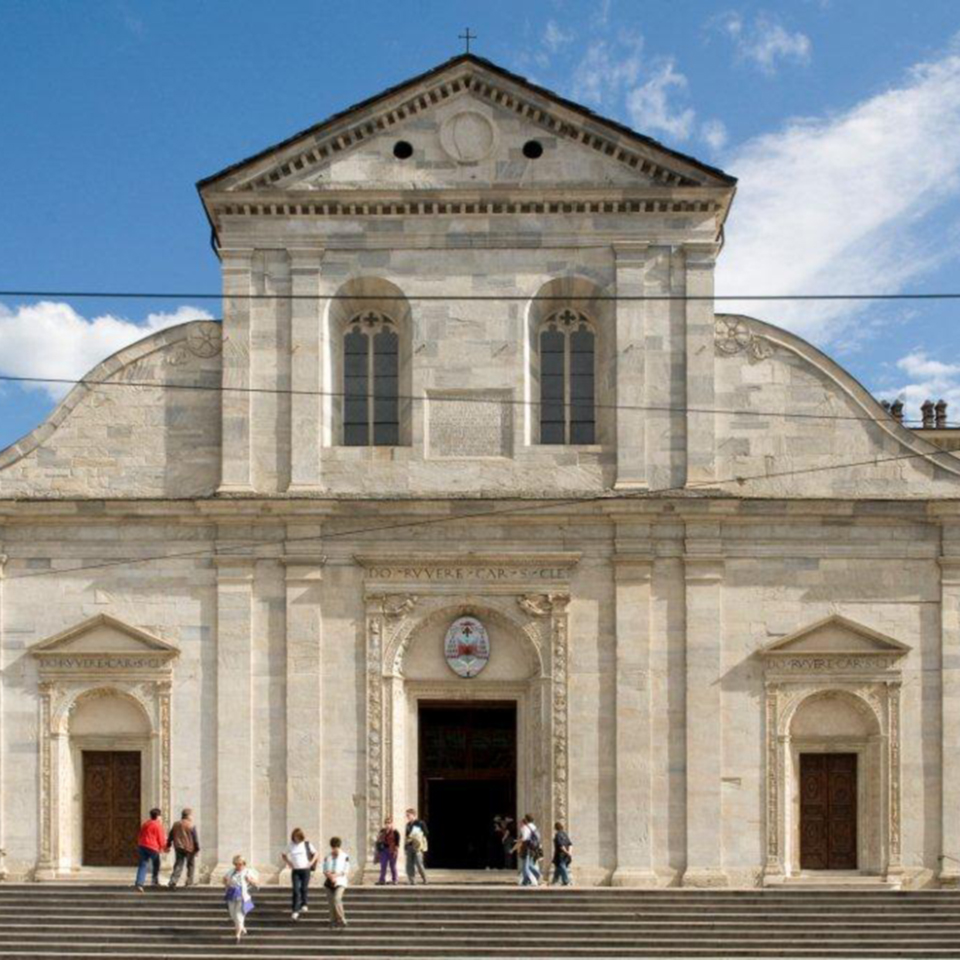
Turin Cathedral, the metropolitan cathedral dedicated to St John the Baptist, is the mother church of the Archdiocese of Turin. It stands between the Royal Palace and Guarino Guarini’s Chapel of the Holy Shroud, and is the building that most clearly tells the story of the Renaissance’s arrival in Piedmont: it was built in Tuscan style at the end of the fifteenth century at the behest of Cardinal Domenico Della Rovere, on the site of three early Christian basilicas[1]. Since 1993 it has housed the Shroud of Turin, which survived the 1997 fire right here, in the choir[2].
The three basilicas
The site has been sacred for long before the present church. The episcopal complex arose at the end of the 4th century, in the time of Bishop Maximus, and comprised three basilicas standing side by side: San Salvatore, Santa Maria and San Giovanni Battista[3]. The three medieval churches survived until 1490, when Domenico Della Rovere, cardinal and bishop of Turin, decided to replace them with a single new building[3]. Of the older complex, the bell tower still stands, dedicated to St Andrew and erected between 1468 and 1470[3].
Della Rovere’s building project
For the project the cardinal called in a Tuscan, Amedeo da Settignano, known as Meo del Caprina; the first stone was laid in 1491 by Bianca of Montferrat[3]. Construction took place between 1491 and 1498[1]. In the Dizionario Biografico degli Italiani, Isa Belli Barsali considers it very likely that Della Rovere entrusted him not only with directing the works but also with the design, and cites the wording by which a 1492 payment describes him:[4]
“magistro Amedeo de Septignano fiorentino architectori et magistro fabricae Ecclesiae Taurinensis”
Documents from 15 November 1492, 11 April 1493 and 12 August 1494 name him as the cathedral’s architect[4]. The church was consecrated on 21 September 1505[3]. According to the council for Piedmontese ecclesiastical heritage, it was with this work that Amedeo brought the new forms of the Renaissance to Piedmont[3].
Façade, portals, interior
The façade is an exception in a city of brick: it is faced with white marble from Foresto[1]. The design is restrained, with paired pilasters and a triangular pediment joined by volutes in the Albertian taste[4]. Along the undersides of the three portal arches run reliefs by Meo del Caprina and his workshop: the Saviour on the right-hand portal, St John on the central one, and God the Father on the left[1].
The interior has a Latin-cross plan with three naves, and the floor is raised above street level because a large crypt opens up below[1]. Tall, slender piers support barrel vaults, and above the church rises a polygonal dome that Belli Barsali compares to that of Santa Maria del Calcinaio in Cortona[4]. Along the naves, semicircular and rectangular chapels alternate, remodelled from the late sixteenth century onward to house devotional altars[1].
The Shroud and the House of Savoy
When Emanuele Filiberto made Turin the capital of the Savoy domains in 1563, the city also became home to the dynasty’s most precious relic: the Shroud arrived there in 1578[3]. To give it a fitting setting, the chapel designed by Guarino Guarini was built behind the presbytery: work began in 1668, and the dome was closed in 1694, twenty-eight years later[3]. The circular chapel stands about six metres higher than the church and acts as a hinge between the cathedral and the royal palace[1]. In the following century Filippo Juvarra worked on the fifteenth-century bell tower, adding a Baroque spire to it between 1720 and 1723[1].
The twentieth century brought restorations directed by Bertea, between 1926 and 1928, which erased much of the nineteenth-century work[1].
The night of 11 April 1997
On 24 February 1993, for works on Guarini’s chapel, the Shroud had been moved to the cathedral’s choir, inside a crystal case[2]. At 10:50 pm on Friday 11 April 1997 fire broke out and spread through the Chapel, the Royal Palace and the Cathedral; the alarm did not reach the fire brigade until 11:45 pm[2]. About 150 firefighters responded, from Piedmont, from Caselle and from Milan[5]. At 1:20 am team 21, led by Mario Trematore, reached the choir, and the team leader broke open the case with a four-kilogram sledgehammer[2]. His account, as reported by the diocesan weekly:[2]
“I struck with all my strength. I took the casket in my arms.”
Guarini’s chapel emerged devastated; the church did not. In his statement, Archbishop Giovanni Saldarini was able to write: “Thanking the Lord, the Shroud’s case was not involved. The Cathedral was spared.”[2] The Chapel of the Holy Shroud reopened in September 2018, after a restoration that lasted twenty-one years and cost 30 million euros, funded by the Ministry with the support of foundations and companies in the city, including the Compagnia di San Paolo[6]. The relic, however, did not return there: it remains in the Cathedral, where, Archbishop Cesare Nosiglia said, it had found “its safe and stable place.”[6] The chapel was reopened on Thursday 27 September; the following day Nosiglia celebrated a mass of thanksgiving in the cathedral for the completion of the works[7].
The Cathedral today
After works that began in 1996–97, in 2004 the presbytery was refurbished with furnishings entrusted to the sculptor Mario Rudelli[1]. Pier Giorgio Frassati is buried in the cathedral: on 4 July 2024 a packed Duomo opened the year of preparation for the centenary of his death, with prayer at his tomb[8]. It is also the church of civic and dynastic ceremonies: on 10 February 2024 the funeral of Vittorio Emanuele di Savoia, son of Umberto II, was held there, before he was buried privately in the royal crypt of the Basilica of Superga[9].
Pages linking here
- Archdiocese of Turin
- Basilica di Superga
- Cappella della Sindone
- Chiesetta di San Ferreolo
- Cinema Statuto fire
- Filippo Juvarra
- Gianni Agnelli
- Guarino Guarini
- House of Savoy
- Molinette Hospital
- Palazzo Reale
- Pier Giorgio Frassati
- Primo sito del Comune di Torino
- Real Chiesa di San Lorenzo
- Santuario della Consolata
- Sergio Chiamparino
- Shroud of Turin
- Torino
- Umberto II
- Vigili del Fuoco Torino - Comando Provinciale
Related articles: Basilica di Superga, Cappella della Sindone, Guarino Guarini, House of Savoy, Palazzo Reale, Real Chiesa di San Lorenzo
Sources
- BeWeB – Beni ecclesiastici in web (CEI)
- La Voce e il Tempo — 11 April 2022
- Città e Cattedrali (Consulta regionale per i beni culturali ecclesiastici del Piemonte)
- Treccani – Dizionario Biografico degli Italiani —
- La Voce e il Tempo — 27 September 2018
- ANSA — 27 September 2018
- La Voce e il Tempo — 18 September 2018
- La Voce e il Tempo — 5 July 2024
- Sky TG24 — 4 February 2024