Cappella della Sindone
Baroque chapel by Guarino Guarini next to the Cathedral of Turin, built for the Shroud, devastated by fire in 1997 and reopened in 2018.
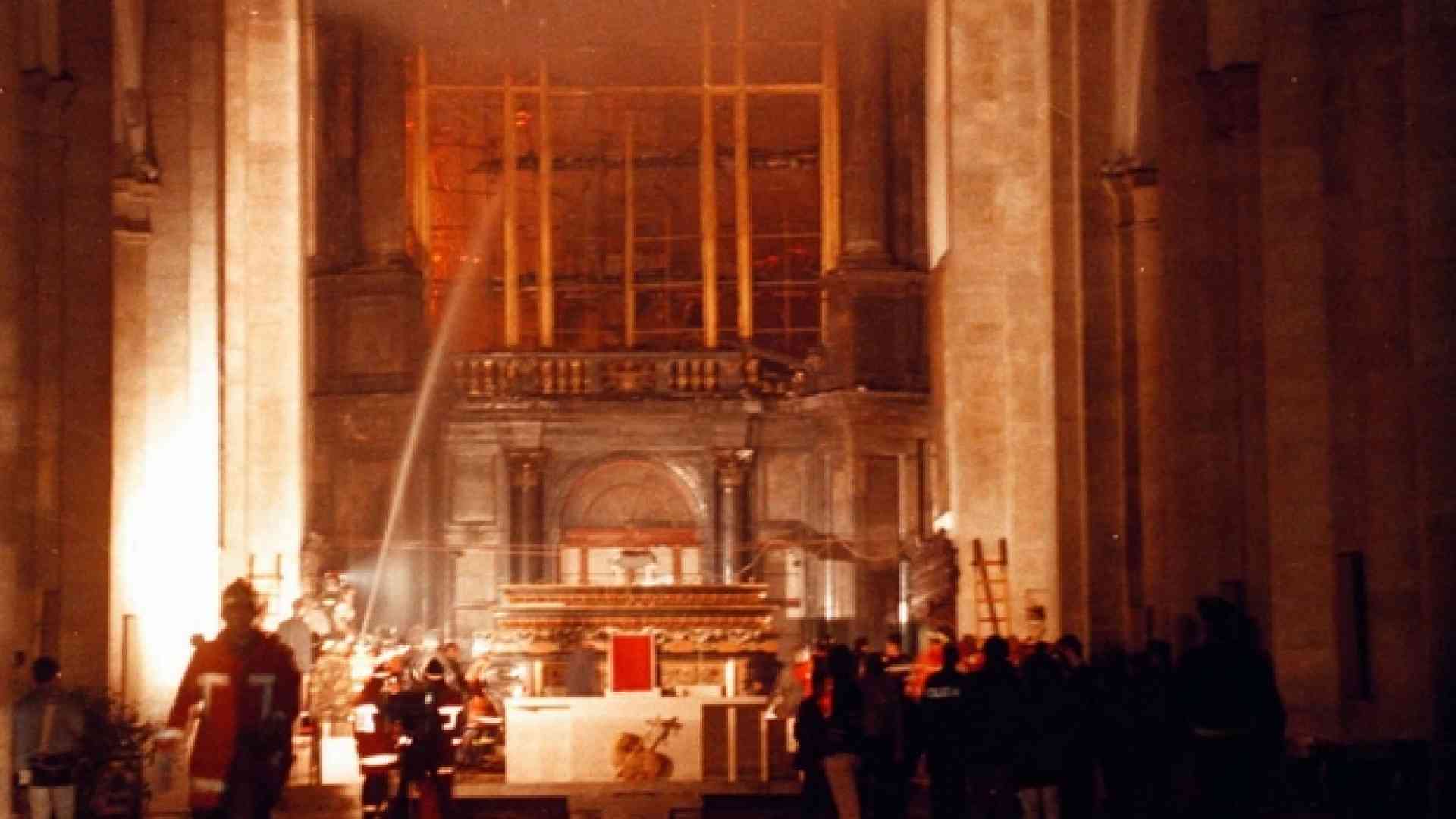
The Cappella della Sindone (Chapel of the Shroud) is the Baroque chapel built in the seventeenth century next to the Cathedral of Turin to give a worthy home to the Shroud, the relic that arrived in Turin in 1578, capital of the duchy of the House of Savoy since 1563.[1] The definitive design is owed to the Theatine Guarino Guarini, to whom the chapel was entrusted in 1668.[2] Devastated by a fire during the night between 11 and 12 April 1997, it became visitable again in September 2018 as part of the Royal Museums, after twenty-one years of works.[3]
A chapel between the church and the royal palace
The idea of a freestanding chapel for the relic took shape in the mid-seventeenth century: in 1649 Bernardino Quadri, who had arrived in Turin at the court of Carlo Emanuele II, was consulted, but his first design was not accepted.[1] Between 1655 and 1656 Cardinal Maurizio di Savoia and the architect Amedeo di Castellamonte discussed the realization of the work with the duke, formally approved on 5 June 1657.[4] That day Carlo Emanuele II ordered that it proceed according to Quadri's design; the building site, previously begun under the direction of Carlo di Castellamonte, was at a standstill with the foundations laid and the walls only partly built.[5]
The solution chosen was at once religious and political. The new structure was inserted into the presbytery of the cathedral, raised above the faithful, so as to display the relic while at the same time isolating it; a direct access from the Royal Palace visibly linked the sacredness of the cloth to that of the power that guarded it.[4]
Guarini's arrival
Guarino Guarini, born in Modena in 1624, had entered the Theatine order in 1639 and had done his novitiate in Rome.[2] A document in the State Archive dated 30 April 1666 records a new design for the chapel “made by father Guerino, Theatine”; on 18 April 1668 Guarini is recorded as paid as engineer of the works, and from then on Quadri and Castellamonte disappear from the records.[5] In that same year, 1668, Carlo Emanuele II appointed him his engineer and mathematician, with the preliminary task of building the chapel for the relic, annexed to the Cathedral.[2][6]
Guarini thus found a building site already under way. The architectural historian Mario Labò, in the entry dedicated to the architect in the Enciclopedia Italiana in 1933, described its covering thus:[6]
«its dome, built as always of superimposed drums, which here, grown greatly in number, largely made polygonal, and reduced in height, follow a gradual progression, so as to form a cusp of an almost continuous profile»
Guarini died in Milan in 1683 without seeing the work finished.[2] The dome was completed in 1694, after twenty-eight years of work.[1] Antonio Bertola, “architect of the Holy Shroud”, then worked in the chapel, where he erected the central altar on which the relic was placed in 1694.[7]
The night of 11 April 1997
In February 1993, to allow restoration work on the chapel, the Shroud had been moved with its case to the centre of the cathedral's choir, behind the main altar.[8] The fire broke out at 10:50 p.m. on Friday 11 April 1997; the alarm reached the fire brigade at 11:45 p.m. and around 150 men rushed to the scene from Piedmont, from Caselle and from Milan.[9] Temperatures in the chapel exceeded a thousand degrees; the flames also reached the north-west tower of the palace, where several dozen paintings were destroyed, and were brought under control only at dawn.[8]
Around 1:20 a.m. fire chief Mario Trematore reached the choir and, with his colleagues, broke open with blows of a sledgehammer the armoured glass protecting the relic: a four-kilogram tool according to the diocesan weekly La Voce e il Tempo, five according to Avvenire, which also recalls that Trematore was not on duty that evening: it was his wife who saw the column of smoke from the balcony, and he, on learning that the Cathedral was burning, joined his colleagues.[9][10] His account: “I strike with all my strength. I take the casket in my arms. Running towards the exit I find Monsignor Giacomo Maria Martinacci, chancellor of the Curia.”[9] On 14 April an inspection with Cardinal Giovanni Saldarini confirmed that the cloth was intact.[8]
Twenty-one years of restoration
The chapel, however, had been reduced to a heap of rubble: the water from the hydrants on the red-hot stone had caused thermal shock and the calcification of the structures, worsened by the chimney effect created by the opening of the doors.[9] The restoration replaced over 1,400 marble elements and consolidated around 4,000 more;[11] for the lost parts, black marble from Frabosa was used.[1]
The work, which cost around 30 million euros, was supported by the Ministry of Cultural Heritage, by the Compagnia di San Paolo, by the La Stampa Foundation – Specchio dei Tempi, by the Consulta per la valorizzazione dei beni artistici e culturali di Torino, by Performance in Lighting and by Iren.[3] The inauguration was held on 27 September 2018 with a ceremony at the Teatro Regio and the ribbon-cutting at the Royal Palace; in the following days admission cost three euros, then it was included in the Royal Museums ticket.[12] The mayor Chiara Appendino said she belonged to the generation that remembered the flames and had never been able to visit the chapel; the president of the Region Sergio Chiamparino spoke of work carried out “stone by stone”.[3] The director of the Royal Museums, Enrica Pagella, commented:[3]
«The restoration was a great challenge of technique and imagination. Today we want to celebrate the rebirth of an astonishing and unique work.»
For the occasion Palazzo Madama hosted the exhibition “La Sindone e la sua immagine” (The Shroud and its image), with around 80 works from the castle of Racconigi and the Umberto II Foundation.[12] Bertola's altar remained to be restored:[3] work on the whole complex was completed on 30 March 2021.[11]
Today
The chapel is visited as part of the Royal Museums route and has also become a place of prayer again, as Archbishop Cesare Nosiglia requested at the inauguration.[3] The Shroud, however, has not returned there: it is kept in the cathedral, in the last chapel of the left aisle beneath the Royal Gallery, in a conservation case itself enclosed in a large metal crate, and is shown only during expositions.[13] The relic belongs to the Pope: Umberto II of Savoy left it to the Holy See in his will.[13]
Pages linking here
- Castello del Valentino
- Christine of France
- Guarino Guarini
- House of Savoy
- La Venaria Reale
- Palazzo Carignano
- Palazzo Reale
- Real Chiesa di San Lorenzo
- Santuario della Consolata
- Sergio Chiamparino
- Shroud of Turin
- Turin Cathedral
- Venaria Reale
Related articles: Castello del Valentino, Guarino Guarini, Palazzo Reale, Real Chiesa di San Lorenzo, Shroud of Turin, Turin Cathedral
Sources
- Città e Cattedrali – Consulta regionale per i beni culturali ecclesiastici del Piemonte
- Treccani
- ANSA — 27 September 2018
- Treccani – Dizionario Biografico degli Italiani
- Treccani – Dizionario Biografico degli Italiani
- Treccani – Enciclopedia Italiana (1933) —
- Treccani – Dizionario Biografico degli Italiani
- Santa Sindone – Arcidiocesi di Torino
- La Voce e il Tempo
- Avvenire
- La Voce e il Tempo — 11 April 2022
- La Voce e il Tempo — 18 September 2018
- Santa Sindone – Arcidiocesi di Torino