Teatro Regio
Turin's opera house on piazza Castello: opened by the Savoys in 1740, destroyed by fire in 1936, rebuilt by Carlo Mollino and reopened in 1973.
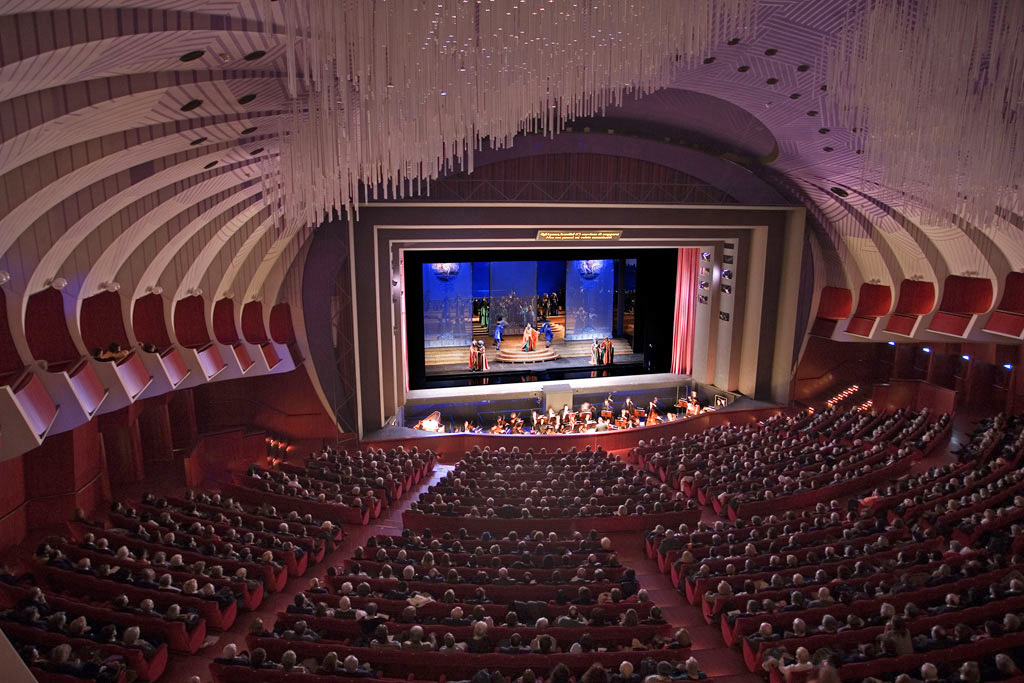
The Teatro Regio is the opera house of Turin and one of Italy's lyric-symphonic foundations. It stands on piazza Castello, at number 215, on the spot where in 1740 the Savoy court opened its great court theatre. Of that eighteenth-century building, destroyed by fire in 1936, only the façade on the square survives; behind it is the hall rebuilt by Carlo Mollino and opened in 1973, the last work of its designer.[1]
The court theatre (1740-1792)
The idea of a new royal theatre goes back to Vittorio Amedeo II, who asked Filippo Juvarra for a design.[1] It was Carlo Emanuele III, however, who in 1736 entrusted Benedetto Alfieri with completing the construction, begun on Juvarra's drawings.[2] The building work lasted about two years: the theatre opened on 26 December 1740 with Francesco Feo's Arsace, with sets by Giuseppe Galli Bibiena. The elliptical hall held about 2,500 seats between the stalls and five tiers of boxes (152 in all, decorated in crimson and gold), under a vault painted by Sebastiano Galeotti.[1] In 1741 the court had a volume printed with plates of the building, Il nuovo Regio Teatro di Torino apertosi nell'anno MDCCXL, credited as a design by Count Alfieri, "first Architect to His Majesty"; the preparatory drawings are held at the Archivio di Stato di Torino.[2]
The theatre was part of the Palazzo Reale complex, to which it was linked by the Beaumont gallery, today the Royal Armoury. The season began every 26 December and ended with Carnival, with two new serious operas: Galuppi, Jommelli, Cimarosa, Paisiello, Gluck and Hasse all wrote for the Regio. For decades the sets were signed by the Galliari brothers. In January 1771 the young Mozart, together with his father Leopold, attended Paisiello's Annibale in Torino there, and the English traveller Charles Burney described it as "the great opera house which is considered one of the finest in Europe".[1]
From the French to the city council (1792-1870)
After five years of closure, during the years of French rule the theatre changed its name three times: Teatro Nazionale in 1798, Grand Théâtre des Arts in 1801, Théâtre Impérial in 1804. The republican period abolished the royal box and banned castrati singers; the Empire restored the box, reserved for Napoleon, who attended performances there three times.[1]
With the Restoration the Regio returned to the House of Savoy. Under Carlo Alberto the hall was given a neoclassical look by Ernesto Melano and Pelagio Palagi, and in 1846 the ballet school was reorganised. Saverio Mercadante gave numerous world premieres there, from Didone abbandonata (1823) to Il reggente (1843); in 1842 the Italian premiere of Giselle was staged there. In 1861 Angelo Moja remade the hall in neo-Baroque style.[1]
Puccini, Toscanini and the fire (1870-1936)
In 1870 ownership passed to the city council (today the Città di Torino), and under Carlo Pedrotti the repertoire came to include Wagner and Massenet. The Regio was the theatre of the world premieres of two Puccini operas: Manon Lescaut in 1893 and La bohème on 1 February 1896, conducted by Arturo Toscanini with the Turin-born Cesira Ferrani as Mimì. The reception was mixed: the Milanese press praised the composer, while the Turin press was cooler.[1] Toscanini, who had made his Regio debut opening the 1895-96 season with the Italian premiere of Götterdämmerung, opened the hall renovated by Ferdinando Cocito on 26 December 1905 with Siegfried; in 1906 Richard Strauss conducted the Italian premiere of Salome there, and in 1914 Zandonai's Francesca da Rimini, on a libretto by D'Annunzio, was the old theatre's last great premiere. Before Cocito's renovation, the hall had also been restored by Randoni and Pregliasco. [8][1]
On the night of 8-9 February 1936 a fire, "sudden and extremely violent", starting beneath the stage, destroyed the building. On the bill was Mulè's "Liolà", and the fire spread through wooden beams and scaffolding crossed by electric cables. [9][1]
Mollino's reconstruction (1937-1973)
The competition held in 1937 was won by Aldo Morbelli and Robaldo Morozzo della Rocca, but their design was never built. MuseoTorino dates the competition to 1936 itself; the project, halted by the war, was resubmitted in revised form in 1955. [8] Only in 1965 did the city council give the commission to the architect Carlo Mollino and the engineer Marcello Zavelani Rossi; work began in September 1967 and finished at the start of 1973.[1] For the Dizionario Biografico degli Italiani the Regio is the culminating work of Mollino's career, with an "ambiguous and polymorphous" syntax that sums up his whole search for "an architecture free of normative and conventional schemes"; it features a multi-level foyer, cantilevered ramps, aerial walkways and escalators. The volume of the hall is detached from the eighteenth-century wing and linked to it by two raised passages; the sinuous side walls have a star-shaped brick pattern recalling Palazzo Carignano. [8][3]
"The stylistic constant that, more than any other, characterises the external and internal appearance of every part of the new Teatro Regio — every smallest detail of which, moreover, Mollino designed himself, from the door handles to the lights, from the staircases to the reinforced-concrete structures — is precisely the curved line."
The hyperbolic shell roof was calculated by the engineer Felice Bertone; the building extends over eight floors, four of them underground, from 12.50 metres below street level to a height of 32 metres. The hall has an ellipsoidal plan, 1,398 seats and 31 boxes for 194 people, and is lit by a chandelier of 1,762 slender aluminium tubes; the stage is described as "among the largest and most mechanised in Europe". Next to it is the Piccolo Regio, with 380 seats.[1] Mollino, born in Turin in 1905, died on 27 August 1973, a few months after the opening.[3]
The new Regio (from 1973)
The theatre reopened on 10 April 1973 with Verdi's I vespri siciliani, conducted by Fulvio Vernizzi, with sets and costumes by Aligi Sassu and choreography by Serge Lifar.[1] The staging was directed by Maria Callas and Giuseppe Di Stefano: it was the only stage direction of Callas's life.[4]
In 1990 the Regio celebrated its 250th anniversary, and Umberto Mastroianni's bronze gate Odissea musicale was placed in front of the entrance. In 1996, for the centenary of La bohème, Mirella Freni and Luciano Pavarotti sang under the direction of Daniel Oren in a performance broadcast live on Rai Due and watched by more than three million viewers; the Piccolo Regio was named after Giacomo Puccini. That same summer the hall underwent an acoustic restoration, designed by the German firm Müller BBM together with the Gabetti & Isola studio.[1]
In 1998, like all Italy's opera houses, the Regio became by law a private-law foundation.[5] Walter Vergnano was its general manager for almost twenty years; during the 2006 Winter Olympics the theatre hosted a wide-ranging cultural programme, and from 2007 to 2018 its music director was Gianandrea Noseda, who led tours in Asia, America and Europe. In April 2018 Noseda announced his departure after a tour of the United States was cancelled; shortly before, Vergnano had resigned, and on 24 April William Graziosi was appointed general manager. [10][1]
Today
The foundation is chaired by the mayor of Turin, Stefano Lo Russo; the general manager is Mathieu Jouvin, the artistic director Cristiano Sandri and the music director Andrea Battistoni. Jouvin, previously deputy director of the Théâtre des Champs-Élysées, had been appointed in April 2022, closing a period under special administration. [11][5] On 10 April 2023, for the fiftieth anniversary of the new theatre, the logo created for the occasion was projected onto the Mole Antonelliana; at the end of the year the words "Teatro Regio Torino" appeared in neon on the entrance glass front, taken from Mollino's own handwriting.[6] Presenting the celebrations in April 2023, Lo Russo had said that in fifty years the Regio had become "a theatre recognised nationally and internationally and much loved by the people of Turin". In February and March 2026 Riccardo Muti conducted "Macbeth" there, directed by Chiara Muti, his fourth appearance at the Regio in five years. [13] The fiftieth-anniversary season opened with "I vespri siciliani" in concert form, conducted by Riccardo Frizza. [12][4]
The 2026/27 season opens with a Festival Verismo from 15 October to 22 November, and in September subscriptions were up 10 per cent. Presenting it, Jouvin defended the choice of less familiar titles: "We can't always stage the same operas: how boring would that be!".[7]
The 2026/27 season, titled «Fatale», comprises 15 titles and 92 performances; the previous season recorded an average hall occupancy of 92 per cent. [14]
Pages linking here
- Borgo Medievale
- Cappella della Sindone
- Carlo Mollino
- Club to Club
- Corriere Torino
- Filippo Juvarra
- Francesco Gonin
- Fred Buscaglione
- Guida Torino
- Lancia
- Mattarella Opens Terra Madre Salone del Gusto at Teatro Regio (September 2026)
- Opening of the 2026/2027 Opera and Ballet Season at Teatro Regio di Torino
- Palazzo Reale
- Pelagio Palagi
- Piazza Castello
- Residenze sabaude
- Stresa
- Teatro Carignano
- Terra Madre Salone del Gusto
- Torino Film Festival
- Turin State Archive
Chronology
- — President of the Republic Sergio Mattarella opens the sixteenth edition of Terra Madre Salone del Gusto at the Teatro Regio, the first without its founder Carlo Petrini. → CronacaQui Torino
- — The Teatro Regio di Torino announces that its 2026/2027 Opera and Ballet season, titled «Fatale», opens on 15 October with the Festival Verismo: Cavalleria rusticana and Pagliacci, followed by La bohème and Iris, for 22 performances until 22 November conducted by Andrea Battistoni. → TorinoClick Prima Torino
Related articles: Carlo Mollino, Piazza Castello
Sources
- Fondazione Teatro Regio di Torino
- Treccani, Dizionario Biografico degli Italiani
- Treccani, Dizionario Biografico degli Italiani
- TorinoClick — 7 April 2023
- Fondazione Teatro Regio di Torino
- TorinoClick — 19 December 2023
- Il Giornale della Musica — 25 September 2026
- MuseoTorino
- Teatro Regio Torino
- Il Post — 27 April 2018
- ANSA — 1 April 2022
- ANSA — 6 July 2023
- ANSA — 19 February 2026
- ANSA Piemonte — 7 May 2026