Real Chiesa di San Lorenzo
Baroque church on piazza Castello, born from a vow of Emanuele Filiberto and completed by Guarino Guarini, author of the famous interlaced-rib dome.
The Real Chiesa di San Lorenzo stands at the corner of piazza Castello, at via Palazzo di Città 4, a short walk from the Palazzo Reale. Born from a military vow of Emanuele Filiberto and brought to completion by the Theatine Guarino Guarini, who celebrated the inaugural mass there in 1680, under the regency of Maria Giovanna Battista di Savoia-Nemours.[1]
A vow on the battlefield of Saint-Quentin
On 10 August 1557, the feast day of Saint Lawrence, the Duke of Savoy Emanuele Filiberto, commanding the troops of Philip II of Spain, defeated the French army at Saint-Quentin, in Picardy.[1] The duke promised to honour the saint of the day with a sacred building; the church on piazza Castello would be built only by his successors.[2] Philip II too fulfilled the same vow, in his own way: from that promise came the monastery of San Lorenzo de El Escorial.[1]
Once the capital had moved to Turin in 1563, Emanuele Filiberto provisionally dedicated to Saint Lawrence a small church already standing in the area of the palaces of power. That old ducal chapel played a leading role: from 1572 it was the first seat of the Order of Saints Maurice and Lazarus, and in 1578 it received the Shroud, brought from Chambéry.[1] The cloth arrived on 9 September at the Lucento castle and was then placed in the chapel, where the Archbishop of Milan Carlo Borromeo, who had come on foot as a pilgrim, was able to venerate it; the relic was shown to the faithful for three days.[3] For decades it was believed that this chapel coincided with today's Oratorio dell'Addolorata, at the church's entrance; according to studies begun in 1999 it was instead, in all likelihood, an old small church adjoining the city walls.[4]
Half a century of building works
On 6 June 1634 the first stone of the new church was laid, on an area of piazza Castello that Vittorio Amedeo I had assigned to the Theatine fathers; the design was by Carlo di Castellamonte.[1] The works site, however, was soon left unfinished.[5] Work resumed in 1664 on a design by Amedeo di Castellamonte, Carlo's son, but the turning point came with Guarini.[1]
A Theatine priest born in Modena in 1624, Guarini arrived in Turin in 1666 and took over the San Lorenzo building site; two years later Carlo Emanuele II appointed him his engineer and mathematician and entrusted him with the Chapel of the Shroud.[6] In 1670 the foundations were opened according to his design, on 27 October 1679 the dome was completed, and on 12 May 1680 Guarini himself celebrated the inaugural mass.[1] Altars and chapels were arranged between 1680 and 1682; the decoration and consecration of the high altar came only in 1696, thirteen years after the architect's death, which occurred in Milan in 1683.[1][6]
The dome
From the nave the dome rises to 55 metres. Eight pairs of crossing arches trace a great eight-pointed star, at whose centre opens the regular octagon of the lantern; the light, broken by the interlacing of the arches, produces an optical effect of unreality.[7] The visible structure rests on eight slender marble columns, but what actually bears the weight stays hidden: four outer walls with as many large round arches, four skewed intersecting arches, and another four, with tie-rods, above the diagonal chapels.[7] Guarini himself spoke of the wonder, indeed the "awe of the human soul," that architecture was meant to arouse.[7]
In the interlacing of the arches one recognises echoes of the ribbed vaulting of the Mosque of Córdoba and of Saragossa Cathedral.[7] As early as 1933 the Enciclopedia Italiana identified in Guarini's art "Gothic remnants, mixed with Hispano-Moorish contributions," from which his pierced domes derive, and on San Lorenzo it gave a clear-cut verdict:[5]
"Here G. brought his type of dome to perfection, achieving here its most sober and harmonious embodiment; and the central plan is a marvel of geometric virtuosity."
The art historian Giulio Carlo Argan read into it "the instant in which mathematical calculation coincides with the course of an imagination reaching toward God."[7] Guarini also designed the dome of the Chapel of the Shroud, which after the fire of 11 April 1997 reopened in 2018 at the end of a restoration that lasted twenty-one years and cost 30 million euros.[8]
Altars and chapels
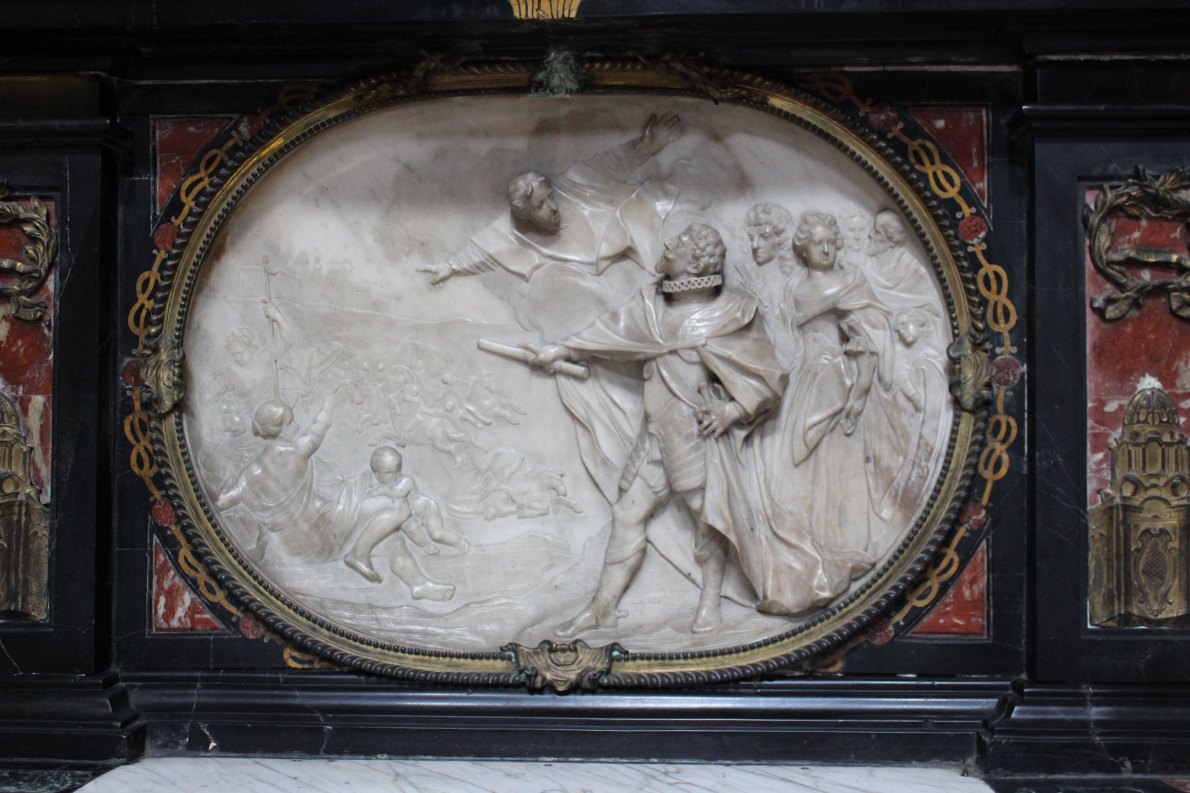
The high altar too is a design by Guarini, conceived detached from the back wall: marbles and coloured stones arranged in interlaced geometric figures, curved inlaid panels, twisted columns, and a tabernacle in marble and gilt bronze set with agates, jaspers and lapis lazuli.[9] The altarpiece with Saint Lawrence is by Antonio Franceschini (late seventeenth century); the antependium depicts the very vow of Emanuele Filiberto and is the work of Carlo Antonio Tantardini, from the early eighteenth century.[9]
The vestibule facing the square, the Oratorio dell'Addolorata, comes from the enclosing of a seventeenth-century three-arched portico. In the mid-eighteenth century Bernardo Antonio Vittone built the altar there and a Holy Stairs of twelve steps; the final arrangement is owed to Alfonso Dupuy in 1846. It holds frescoes devoted to the Shroud and the wooden group of the Addolorata carved by Giovanni Tamone in 1870.[4][1]
Restorations and the present
The choir stalls were made in 1730. After the damage of the French occupation, King Carlo Felice had the church restored between 1823 and 1828 under the direction of Carlo Randoni, and from 1829 Pietro Fea decorated the dome and chapels.[1] The damage from the 1943 bombing was repaired in 1956-57; in 2022-23 the high altar and the presbytery were restored.[1]
The church is still used for worship and remains tied to the history of the House of Savoy and of the Shroud: next to the sacristy a copy of the cloth is on display, explained by volunteer guides, while the original is kept in the Cathedral.[10][8]
Related articles: Cappella della Sindone, Emmanuel Philibert, Guarino Guarini, House of Savoy, Palazzo Reale, Turin Cathedral
Pages linking here
- Cappella della Sindone
- Guarino Guarini
- House of Savoy
- Living institutions, dead addresses
- Palazzo Reale
- Piazza Castello
- Santuario della Consolata
- Shroud of Turin
- Turin Cathedral