Lingotto
Former FIAT plant on via Nizza with its rooftop test track, operating from the 1920s to 1982 and converted by Renzo Piano into a hub of trade fairs, culture and offices.
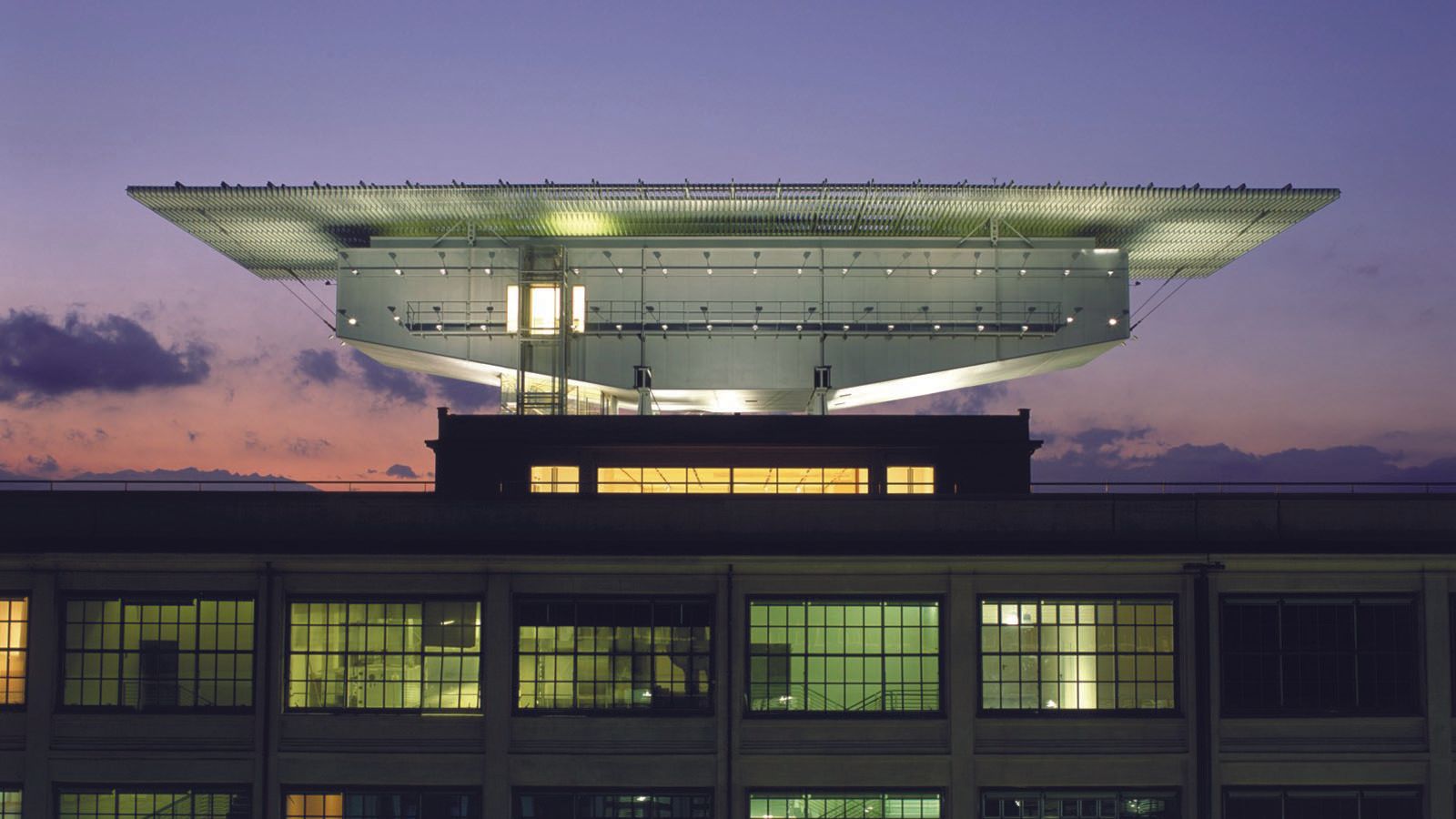
The Lingotto is the large industrial complex built by FIAT in the Nizza Millefonti district, south of the centre of Turin. It was a car plant from the 1920s to 1982, and today, after the conversion designed by Renzo Piano, it houses an auditorium, a conference centre, hotels, offices, shops, a multiplex cinema and the exhibition centre where the Turin Book Fair, the Salone del Gusto and Torino Comics are held; it has become one of the city's recognisable symbols.[1] The test track on the roof, reached by cars via helical ramps, made it an icon of modern architecture; the plant's historic address was via Nizza 250.[2]
The American model and the design
The reference model was Ford's Highland Park plant in Michigan, opened in 1910 and visited by a FIAT delegation made up of Giovanni Agnelli, Bernardino Maraini and Ugo Gobbato.[3] The design was begun in 1915 by engineer Giacomo Mattè Trucco (1869-1934); the structural calculations were by engineer Giovanni Antonio Porcheddu. In 1916 work started with the dispatch workshop, followed by the Nuove Officine ("New Workshops"), built over five floors.[2]
The underlying principle was that of a vertical factory: the assembly line started on the ground floor and rose from floor to floor up to the top one, from which the finished cars emerged for testing on the roof.[4] The main building, 507 metres long, is made up of four multi-storey modular blocks with a reinforced-concrete structure repeating a 6-by-6-metre module.[3][2] Construction proceeded in two phases, between 1915 and 1922 and between 1924 and 1926, and the official opening took place on 15 May 1923 in the presence of King Vittorio Emanuele III.[3] The two helical ramps at either end were completed later: the northern one in 1926, followed by the southern one.[2]
The rooftop track
On the roof ran a banked oval track,[4] about a kilometre and a half long and designed to test up to fifty cars at once.[2] In 1932 the passage of trucks heavier than expected opened cracks in it, and Mattè Trucco was called in to solve the problem.[3] According to the American magazine Hagerty, every car that left the factory — more than a million in all — took its test lap up there; the track also featured in the final chase of the original version of the film The Italian Job, starring Michael Caine.[4]
The building soon drew the attention of architects. Le Corbusier wrote about it in Vers une architecture, published in Paris in 1924:[2]
"one of the most impressive sights that industry has ever offered"
In 1928 the young architects of the Rome Exhibition of Rational Architecture included it among the reference works, and in February 1934 it was presented at the Exhibition of Italian Architecture in Buenos Aires.[3]
War and the end of production
The Lingotto was one of the main targets of the Allied air offensive: between 1940 and June 1944 it was hit repeatedly, with very serious damage and the partial destruction of some buildings.[2] In 1982 the Lingotto closed as a factory;[5][1] according to Hagerty, however, production had already ceased there in 1979, once the multi-storey structure had proved inefficient compared with the new, larger plant at Mirafiori.[4]
Renzo Piano's conversion
In 1984 FIAT held an ideas competition on the building's future; in 1985 the commission went to the Renzo Piano Building Workshop, which turned the factory into a district of mixed functions. The work proceeded in stages: the exhibition centre opened in 1992, the conference centre with the auditorium in 1994, the first hotel in 1995, offices and shops in 2002, and the second hotel in 2003.[5] The auditorium named after Gianni Agnelli seats two thousand and has a ceiling of movable wooden panels that adjust the acoustics; on the roof Piano placed the "Bubble" ("Bolla"), a transparent 14-metre-diameter meeting room, and a helicopter landing area.[5][1]
In 1997 the group's top management also left corso Marconi and moved to the Lingotto, which became FIAT's head office.[1][6] Gianni Agnelli recalled his return to the offices he had known as a young man in these words:[6]
"This is where I used to come to see my grandfather: the telephone wires hung from the ceiling and the walls were covered with maps. I brought along my furniture and the ficus plant"
After his death on 24 January 2003, his body lay in state at the Lingotto itself, and a long line of Turinese, many of them former workers with their families, queued to pay their respects.[6]
The Scrigno and the Pista 500
On 20 September 2002 the Giovanni and Marella Agnelli Picture Gallery opened, laid out over several levels and topped by the "Scrigno" ("Casket"), a hall of about 450 square metres for the permanent collection, with a system of movable aluminium louvres that regulates natural light.[5] It displays twenty-five masterpieces that belonged to the Agnelli couple, while the lower floors host temporary exhibitions, educational workshops and a reading room on art collecting.[7]
The old test track has become a roof garden, the Pista 500, run by the Picture Gallery as a panoramic art trail.[8] The planting scheme, designed by architect Benedetto Camerana with Il Giardino Segreto, covers a total area of 27,000 square metres and includes around 40,000 plants of more than three hundred species, arranged in twenty-eight green areas; the track's parabolic curves have been preserved, and the loop can be ridden by bicycles, scooters and electric vehicles, in a private space opened up to the public.[9]
Trade fairs, politics and the metro
Lingotto Fiere, run by GL events Italia, covers more than 100,000 square metres, 68,000 of them indoors. Hall 2, built on the old press-shop area, has kept its industrial look; the Oval, built in 2005 for speed skating at the 2006 Winter Olympics, was later incorporated into the exhibition centre, adding 20,000 square metres on a single level.[10] Today it hosts the Turin International Book Fair[11] and, in the Oval, the contemporary art fair Artissima.[12]
The Lingotto has also entered the vocabulary of Italian politics. On 27 June 2007 Walter Veltroni launched his bid to lead the newly founded Democratic Party, born from the merger of the Democrats of the Left and La Margherita:[13]
"To build a new Italy. That is the reason, the mission, the meaning of the Democratic Party."
Matteo Renzi returned to the same place to launch his campaign for the party's primary election on 10 March 2017.[14]
On 6 March 2011, the year of the 150th anniversary of Italian unification, metro line 1 reached the Lingotto with the stretch from Porta Nuova;[15] on 23 April 2021 the extension to piazza Bengasi opened, with the new Italia 61-Regione Piemonte and Bengasi stops.[16]
Casàlia, a new home and lifestyle fair (October 2026)
From 8 to 11 October 2026 the Oval Lingotto Fiere hosts Casàlia, a new fair devoted to the home and lifestyle, with more than 150 brands and more than 50 workshops, free to attend.
Chronology
- — Artissima, Turin's contemporary art fair, returns for its 33rd edition from 30 October to 1 November at the Lingotto Oval with 183 galleries from 35 countries. → ANSA Piemonte TorinoClick
- — Casàlia, a new fair devoted to the home and lifestyle, is launched at the Oval Lingotto Fiere in Turin, running from 8 to 11 October with more than 150 brands and more than 50 workshops, free to attend. → TorinoOggi
- — An event at the Lingotto and a gala dinner at the Venaria Palace for the conferral of dynastic honours, with donations of up to 30,000 euros, causes a public rift within the House of Savoy between Aimone of Savoy and Emanuele Filiberto. → CronacaQui Torino CronacaQui Torino
Related articles: Bardonecchia, Casàlia, home and lifestyle show at the Oval Lingotto (2026), Collegno, FIAT, Gianni Agnelli, Olimpiadi invernali di Torino 2006
Pages linking here
- 15th Edition of Bike Pride in Turin (September 2026)
- 33ª edizione di Artissima (2026)
- Accident between Via Biscaretti di Ruffia and Via Buriasco on 24 September 2026
- Artissima
- Bardonecchia
- Borgo Po
- Casàlia, home and lifestyle show at the Oval Lingotto (2026)
- Cesare Pavese
- Città di Torino
- Club to Club
- Collegno
- Districts of Turin
- Eataly
- FIAT
- Galleria Sabauda
- Gianni Agnelli
- Giovanni Agnelli (1866–1945)
- Grattacielo Piemonte
- Gruppo Torinese Trasporti
- Intesa Sanpaolo Skyscraper
- Italia '61
- John Elkann
- Kappa FuturFestival
- La Pista - Cultura del gusto - Torino
- Maurizio Marrone
- Metropolitana di Torino
- Mirafiori
- Molinette Hospital
- Monica Canalis
- Nizza Millefonti
- Olimpiadi invernali di Torino 2006
- Pinacoteca Agnelli
- Pinerolo-Turin (railway line)
- Porta Susa station
- Rift in the Savoy Royal Family over the Dynastic Honours Scandal (October 2026)
- Sauze d'Oulx
- Sergio Marchionne
- Sestriere
- Stabilimento di Mirafiori
- Stazione di Porta Nuova
Sources
- Treccani, Enciclopedia
- MuseoTorino
- Treccani, Dizionario Biografico degli Italiani
- Hagerty
- Renzo Piano Building Workshop
- La Voce e il Tempo — 25 January 2023
- MuseoTorino
- Pinacoteca Agnelli
- European Garden Heritage Network
- Lingotto Fiere
- Il Post — 28 March 2024
- Lingotto Fiere
- Il Post — 9 November 2010
- Il Post — 10 March 2017
- MuseoTorino
- ANSA — 17 April 2021
- TorinoOggi — 30 September 2026