Collegno
A municipality on the western outskirts of Turin on the Dora: the Royal Charterhouse and its asylum, the "amnesiac," Leumann Village, and the western terminus of the metro.
Collegno is a municipality of the Metropolitan City of Turin, eight kilometres from the provincial capital, on the plain on the right bank of the Dora Riparia, at an elevation of 302 metres over a little more than 18 square kilometres; a 2021 estimate puts its population at 49,099, and its patron saint is Saint Lawrence, celebrated on 10 August.[1] For people from Turin, its name evokes above all the Charterhouse turned into an asylum, the case of the "amnesiac," and the western terminus of the metro.
From the Roman mansio to the Provana
The name recalls a Roman staging post, the Collegium ad quintum milium, founded five miles from Augusta Taurinorum on the road to the Moncenisio pass towards Gaul; the finds from that period are kept in the Museo di Antichità in Turin.[2] Excavations have also uncovered a small Gothic necropolis, with a monumental tomb at its centre and female burials with jewellery and gold-brocade garments, and a Lombard necropolis of 157 graves arranged by family group: burials of rank had gold crosses sewn onto the funeral veils, and a sacrificed horse was buried beside a community leader. The cemetery's final phase, from the 8th century, marks, according to Mole24, the community's transformation "from warriors into farmers."[2] A Lombard fara (clan settlement) also came to light during work on the metro in the early 2000s.[3]
In the Middle Ages the place, by then called Collegium, passed from the marquises of Susa to the counts of Turin and finally to the House of Savoy, who in 1599 granted it as a fief to the Provana family.[1] The family remained its feudal lords until the end of the feudal system.[3] Of the medieval castle a square tower survives, attached to the 17th-century Palazzo Provana, while the church of San Massimo, dating from the 11th century, preserves two Romanesque apses.[1]
The Royal Charterhouse and the asylum
The Carthusian monastery, founded according to Mole24 in the 14th century, was raised in 1641 to the rank of "Royal" by Christine of France, regent of the duchy of Savoy; its architecture blends Gothic and Baroque elements.[2] The Sapere encyclopedia instead links the Charterhouse to the wishes of Maria Cristina in 1641, and notes there a 17th-century Annunciation by Orazio Gentileschi.[1]
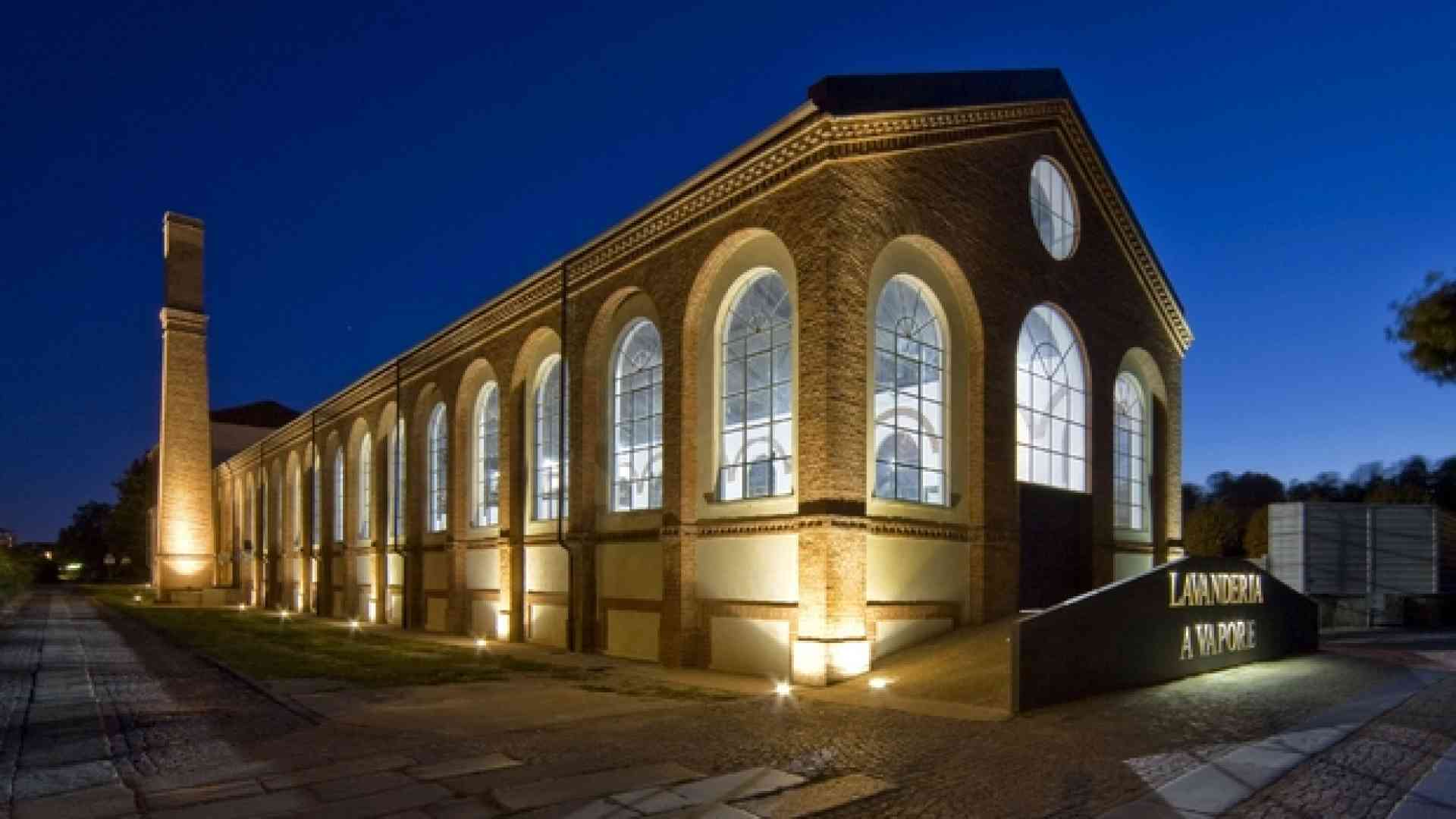
1853 changed the fate of both the monastery and the town: the Royal Asylum of Turin was transferred there, and the same year the railway station opened, the first after Turin on the line to Susa.[3] New pavilions, laid out in a comb pattern, were built around the complex.[2] The walls of the psychiatric hospital were torn down in 1977, a symbolic gesture,[3] on the eve of the 1978 Basaglia Law, which decreed the closure of psychiatric hospitals.[2] The building put up in 1875 to wash the hospital's linen, restored by the Municipality and the Region, became in 2008 the Lavanderia a Vapore ("Steam Laundry"), a centre devoted to dance.[4] Today it is the only dance residency centre in Piedmont and a research centre for choreography focused on contemporary creation.[5]
The amnesiac of Collegno
On 6 February 1927 the Domenica del Corriere published the police mugshot of an unknown man held in the Collegno asylum, with no memory at all. On 27 February Giulia Canella stated that she recognised in him her husband Giulio, a professor from Verona who had disappeared at Monastir on 25 November 1916; on 2 March the man was discharged, but on 7 March, after an anonymous tip, he was recalled to Turin on suspicion of being Mario Bruneri, a printer wanted for fraud and forgery.[6] A long legal case followed: by a ruling of 22 October 1928 the Turin court established that the unknown man was Bruneri, and on 1 May 1931 the Court of Appeal of Florence upheld the decision definitively.[6]
The Leumann Village
South of corso Francia, the Swiss entrepreneur Napoleone Leumann built, between 1875 and 1912, a village for the employees of his cotton mill;[7] the factory remained in operation from 1875 to 1972.[8] Between 1906 and 1912 Pietro Fenoglio, one of the leading exponents of Turin Art Nouveau, worked there.[7] The village was designed to be self-sufficient: housing for workers and clerical staff, a boarding house for female workers run by nuns, baths, a theatre, a clinic, a post office, a station, a hotel, a nursery, schools, a church, a social club and a company shop.[8]
Once the factory closed, the Municipality of Collegno acquired the complex, excluding the sheds; the public library now occupies the former boarding house, the old "little station" hosts activities for young people, and in 2009 a house-museum was set up there, the first in a workers' village.[8] The Sapere encyclopedia records it as an ecomuseum of material culture.[1]
War and Resistance
In April 1944 the local National Liberation Committee was formed, and the 15th SAP Brigade "Paolo Arnaud," headquartered in Rivoli, operated in the area. Between 30 April and 1 May 1945, according to Mole24, retreating German units of the 34th Division under General Hans Schlemmer killed 67 people between Collegno and Grugliasco — partisans, civilians and a priest — of whom 32 were residents of Collegno; on the afternoon of 1 May local SAP members and part of the population killed, in reprisal, 29 militiamen of the Italian Social Republic who were held prisoner in Collegno.[2]
The citation for the silver medal of civil merit places the massacre on 29-30 April 1945; conferred by decree of 13 April 2006, the medal was reissued on 18 April 2008 with amended wording:[9]
"A small rural municipality of about eight thousand inhabitants, generously engaged in the partisan struggle, suffered a savage massacre at the hands of Nazi troops, who brutally slaughtered thirty-two heroic citizens, half of them young people not yet twenty years old."
After the war the mayor was Dante Torello, elected by the National Liberation Committee and in office until 1956; the parish priest don Modesto Scaccabarozzi is remembered for hiding Jews and political opponents in the bell tower of the church of San Lorenzo.[3]
From rural village to suburban town
With the Leumann and Vallesusa cotton mills and the Bertolini yeast works, Collegno became an industrial hub.[3] Its population passed 50,000 in the 1970s, driven by immigration from Veneto, the South, and the islands.[2] The town stretched south along the state road to Rivoli and the Val di Susa, and north along both banks of the Dora; alongside mechanical engineering and textiles, confectionery, paper, rubber, plastics and furniture-making also developed.[1] Towards the river today lies the Parco Agronaturale di Collegno, made up of cultivated fields, tree rows, remnants of lowland forest and old irrigation channels called bealere.[10]
The metro
On 4 February 2006, during the Winter Olympics, the first stretch of the metro was opened, from Collegno to Porta Susa,[11] with its terminus at the Fermi station.[2] On 2 August 2023 the tunnelling for the extension from Fermi to Cascine Vica was completed: a 3.4-kilometre tunnel, dug by traditional methods without a mechanical boring machine, with the new stations of Certosa, Collegno Centro, Leumann and Cascine Vica — the last of these on corso Francia at the point where it meets the ring road — for a total cost of 328 million euros entirely funded by the State.[12] "These are the works that change the face of cities and communities," commented the mayor of Turin Stefano Lo Russo.[12] At Collegno's new workshop, the first of four new Alstom Metropolis trains planned for Line 1 was delivered on 6 June 2025.[13]
Timeline
- — In Collegno, the confectionery company Leone 1857 opens the Fabbrica della Felicità, an experience museum of 7,000 square metres dedicated to almost 170 years of its history. → ANSA Piemonte TorinoOggi
- — "La Fabbrica della Felicità," the new Leone 1857 plant, opens in Collegno: a 7,000-square-metre complex designed by studio Piuarch with a museum trail curated by Luca Molinari Studio, for an investment of about 20 million euros. Gazzetta Torino La Stampa
- — The mayors of Collegno, Grugliasco and Rivoli, together with trade unions and trade associations, announce at a press conference a demonstration on 10 October in support of completing Line 1 of the metro, whose construction site has been stalled for months after the bankruptcy of the contractor in charge of the works. → ANSA Piemonte Il Torinese
Related articles: Dora Riparia, Grugliasco, Gruppo Torinese Trasporti, Lingotto, Metropolitana di Torino, Olimpiadi invernali di Torino 2006
Pages that link here
- Amiat Gruppo Iren
- Opening of the Leone 1857 Fabbrica della Felicità in Collegno (September 2026)
- Metropolitan City of Turin
- Comieco
- Corso Francia
- Dora Riparia
- Grugliasco
- Gruppo Torinese Trasporti
- Leone 1857
- Lingotto
- 10 October 2026 demonstration for the completion of metro Line 1
- Turin Metro
- 2006 Turin Winter Olympics
- Pietro Fenoglio
- First website of the City of Turin
- Turin Ring Road
- Thales Alenia Space
Sources
- Sapere.it (De Agostini)
- Mole24 — 6 April 2025
- Saudade di Collegno
- Avvenire — 9 March 2018
- Fondazione Piemonte dal Vivo
- Treccani – Dizionario Biografico degli Italiani —
- Associazione Culturale Kòres – V.O.C.A.LE.
- Associazione Amici della Scuola Leumann
- Presidenza della Repubblica — 18 April 2008
- Mole24 — 27 November 2025
- MuseoTorino
- Torinoclick – Città di Torino — 2 August 2023
- Torinoclick – Città di Torino — 6 June 2025