Rivoli
Municipality in Turin's western belt at the mouth of the Susa Valley, the favourite residence of the Savoys and home to the Castle-museum of contemporary art.
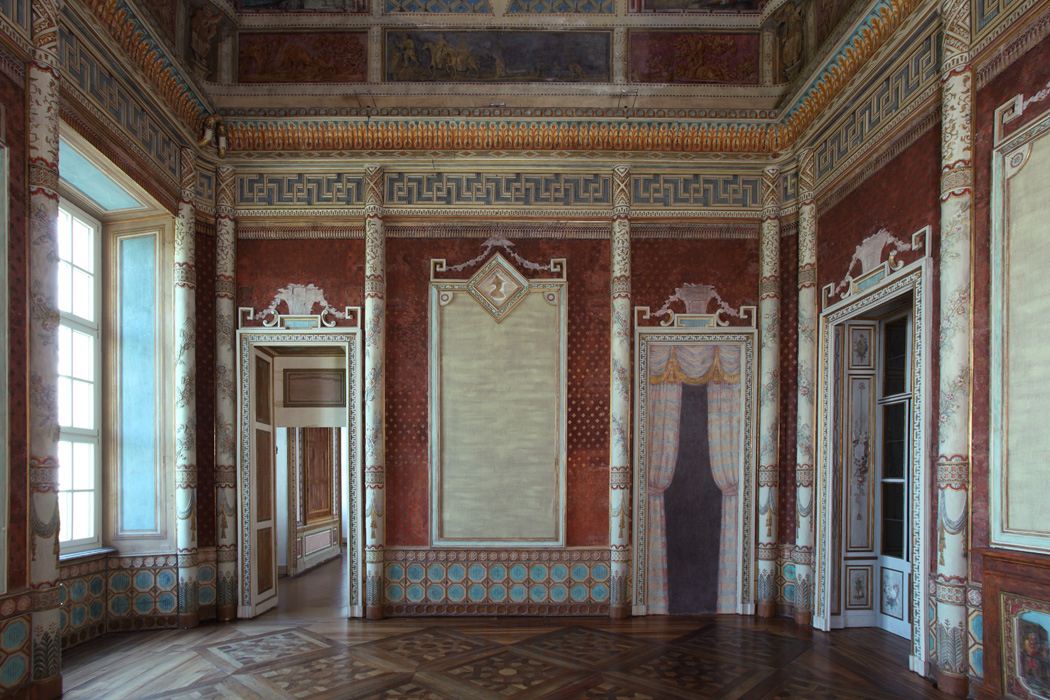
Rivoli is a municipality in the Metropolitan City of Turin, lying at about 390 metres above sea level on the eastern edge of the morainic amphitheatre that bears its name, where the Turin plain opens towards the Susa Valley. With an area of 29.5 km² and about fifty thousand inhabitants, it lies just west of Turin; for three centuries it was contested between bishops and counts, then it became the preferred residence of the Savoys for their stays on this side of the Alps, and its castle today houses a museum of contemporary art.[1]
From the Via delle Gallie to the year 1000
The hill of Rivoli was almost certainly inhabited as early as Roman times, thanks to its strategic position along the Via delle Gallie.[2] According to the Enciclopedia Italiana, at the foot of the hill Constantine won his first battle against Maxentius in 312.[3]
The town appears in documents from the eleventh century. In 1159 Emperor Frederick I confirmed the bishop of Turin's rule over Rivoli, and that same year the fortification called Castrum Riuollum is mentioned for the first time.[2][3] Possession of the place remained contested for three centuries between the bishops and the counts of Savoy, until in 1244 Frederick II assigned it to Count Amadeus IV, who granted the inhabitants various privileges; from then on Rivoli remained under Savoy.[1] The castle entered the Savoy domains in 1247.[4]
The residence of the Savoys
By the fourteenth century Rivoli was already a place of court life: in 1350 the castle hosted the wedding of Blanche of Savoy to Galeazzo Visconti.[2] Of the medieval town, what remains includes stretches of the walls, the bell tower of the old parish church, still Romanesque in form though erected at the start of the fourteenth century, the Gothic bell tower of Santa Maria della Stella, once San Domenico, and that of San Martino ai Campi, from the eleventh-twelfth centuries. In the oldest part of the centre stands the Casa del Conte Verde, a palace that the 1936 Enciclopedia Italiana singled out for its «rich terracotta decoration».[3] The façade rises over three levels marked by two horizontal cornices; today it is a municipal multi-purpose centre for exhibitions, conferences and meetings.[5]
When Emanuele Filiberto recovered the duchy, Turin was still garrisoned by the French, and the duke chose Rivoli as the seat of his court.[2] Here his heir, Charles Emmanuel I, was born on 12 January 1562.[6] A celebrated physician was called in to attend the duchess's pregnancy: the castle's official history records «Nostradamus, summoned to attend Duchess Margaret of Valois's pregnancy».[2] In the seventeenth century the architects Carlo and Amedeo di Castellamonte transformed the fortress into a courtly residence[4] and built the Manica Lunga, a wing 147 metres long and 6 wide intended for the ducal picture gallery.[7] On 10 February 1645 the castle was the setting for the party held for Christine of France's birthday.[2]
An act of European politics was also signed at Rivoli: the treaty of 11 July 1635 between Duke Victor Amadeus I and the French plenipotentiaries, which established «a league between the King of France, the Duke of Savoy and the other princes» to conquer the Duchy of Milan. France undertook to field 12,000 infantry and 1,500 cavalry, the duke 6,000 infantry and 1,200 cavalry.[3]
Destruction and Juvarra's dream
In 1690 and 1693 the French troops of Marshal Catinat devastated the castle; Victor Amadeus II, who watched the fire from Turin, promised to rebuild it.[2] The work was entrusted first to Michelangelo Garove, who laid out the Stradone del Re, and then to Filippo Juvarra, who around 1718 designed a royal palace capable of rivalling the great courts of Europe.[3][2] The building site came to a halt in 1734, however, owing to the high cost and to the events surrounding Victor Amadeus II's confinement; the project remained unfinished[4], and in the open-air atrium the bases still wait for the columns, which were left in the quarry in the Susa Valley.[2] In 1792 Victor Amadeus III assigned Rivoli to his son Victor Emmanuel, Duke of Aosta, with the title of marquess, and from 1793 Carlo Randoni resumed the work for him and for his wife Maria Teresa of Austria-Este.[3][2]
From barracks to museum
In the Napoleonic era the castle was closed and given to Marshal Ney. In 1883 the Savoys sold it to the town of Rivoli for 100,000 lire; the town leased it to the army, which occupied it until 1909; during the Second World War it suffered looting and the bombing left deep scars.[2] The Manica Lunga, used as barracks, served during the war as a shelter for displaced people.[7]
Revival came from 1979, when the Piedmont Region acquired it on a 29-year loan: the restoration led by the architect Andrea Bruno concluded in 1984 with the opening of the Museum of Contemporary Art, the first of its kind in Italy.[4] Work on the Manica Lunga, with external stairs and a lift in transparent materials and a new ribbed roof, lasted from 1986 to 2000.[7] In 1997 the castle entered the UNESCO site of the Savoy Residences, the «Crown of Delights» around Turin; UNESCO itself points to the opening of the Rivoli museum as the turning point in reopening the residences to the public.[8] Between 2017 and 2019 the museum added the Collection of the Fondazione Cerruti, with works ranging from the Renaissance to the contemporary. [4] For more detail, see: Castle of Rivoli.
The town today
In the early decades of the twentieth century Rivoli was still an agricultural town with an important textile industry: in 1927 it counted 193 businesses with 2,080 employees, 1,114 of them in textiles, and was linked to Turin by an 11-kilometre electric tramway. The population rose from 7,250 in 1901 to 11,470 in 1931.[3] In 2008 the inhabitants numbered 50,115, with an economy that pairs viticulture with engineering, textile and food-processing activities.[1]
Rivoli has also had a place in fine dining: in June 2016 the restaurant Combal.zero ranked 46th on the World's 50 Best Restaurants list.[9]
Pages that link here
- Anpas
- Change of officers at the provincial Carabinieri command of Turin (September 2026)
- Caselette
- Castle of Rivoli
- Metropolitan City of Turin
- Collegno
- Corso Francia
- Croce Verde Torino
- Dora Riparia
- Fred Buscaglione
- Gianni Vattimo
- The addresses of the Province of Turin
- Grugliasco
- Cyclist struck in piazza Rivoli (September 2026)
- Living institutions, dead addresses
- L'Agenda News
- Liceo Scientifico Statale "Charles Darwin" - Rivoli
- 10 October 2026 demonstration for the completion of metro Line 1
- Turin Metro
- Nebbiolo
- Orbassano
- Sant'Anna Hospital
- Parco della Pellerina
- Savoy Residences
- Change of officers at the provincial Carabinieri command of Turin (September 2026)
- Rocciamelone
- Sanctuary of the Consolata
- Disappearance and recovery of Andrea Perra
- Turin Ring Road
- Turin
- Turin tramway
- Hiker bitten on the neck by a viper at Quincinetto (September 2026)
- Victor Amadeus II
Timeline
- — A hiker in his fifties is bitten on the neck by a viper that had slipped into his backpack during a walk at Quincinetto, and is saved by the medical staff of Rivoli hospital. → ANSA Piemonte TorinoToday
- — Andrea Perra, a 53-year-old from Rivoli who had been missing since 7 September, is found safe and well, as his sister announces on social media on 25 September. → TorinoToday Quotidiano Piemontese
- — The mayors of Collegno, Grugliasco and Rivoli, together with unions and trade associations, announce at a press conference a demonstration on 10 October in support of completing metro Line 1, whose construction site has been stalled for months after the contractor went bankrupt. → ANSA Piemonte Il Torinese
Related articles: Castle of Rivoli, Christine of France