Porta Susa station
One of Torino's main railway stations: built in 1856 to a design by Carlo Promis, underground since 2009 beneath a glazed vault more than 400 metres long.
Porta Susa station is one of the main railway stations of Torino: an underground station on the passante line, covered by a glazed vault more than four hundred metres long[1]. Around thirteen million travellers pass through it every year[2]. Next to it, on piazza XVIII Dicembre, the building of the first station survives, opened in 1856 and now being converted into a hotel[1].
The name
The name comes from one of the gates of the Roman city of Augusta Taurinorum: the Porta Segusina, on the road to Susa, which opened at the corner of what are now via Garibaldi and via della Consolata. In the modern era, with the expansions ordered by Vittorio Amedeo II, a new Porta Susina was built[3].
Carlo Promis's station
The railway reached this part of the city with the line to Novara: the joint-stock company set up to build it was established in 1851 and the first stretch opened in May 1855. Porta Susa station was inaugurated on 20 October 1856, at the end of via Cernaia, designed by the architect Carlo Promis, who gave it an eclectic-classicist layout; the complex covered 5,261 square metres and had six tracks[1].
On 1 January 1916 a freight train struck a passenger train in the station: the impact was violent, but the passengers emerged unharmed[4].
The city newspaper's chronicles also recount everyday life in front of the station. In August 1950 a family was reported in the concourse, arrived in Torino under a compulsory order to relocate (foglio di via obbligatorio), with two young children suffering from polio in extremely serious condition, later admitted to the Amedeo di Savoia hospital[5]. In July 1954 a messenger was robbed in front of the station of a bag containing a million and a half lire, left on the seat of a parked van, without any of the roughly twenty bystanders noticing[6]. In June 1996 a Nigerian woman, who had got into a taxi near the station, was insulted and threatened with a steering-wheel lock by the driver, who had mistaken her for a prostitute; the taxi driver was reported to the carabinieri[7].
A century of plans
The station's position made it the object of constant rethinking. From 1922 work began on lowering the track level between the junction for Alessandria and Genoa and Porta Susa station[3]. In November 1937 the press pointed to the need to upgrade it, because trains arriving from Milano had to make a long detour to reach Porta Nuova station[8]. In August 1953, while work continued at Porta Nuova, a modernisation plan was presented providing for the redevelopment of piazza San Martino and the lowering of the line between corso Vittorio Emanuele and corso Regina Margherita[9].
The idea that would eventually prevail took shape in the early 1980s, with the project for a new station linked to putting the railway passante underground[1]. In October 1982 the Comune, the Region and Ferrovie dello Stato drew up a plan to move the passenger and freight station underground by 1986, leaving a large garden with public space on the surface; Porta Nuova would have stayed where it was[10]. The actual timeline turned out to be much longer.
The underground station
The first two tracks of the new station entered service on 14 December 2008, two more on 27 September 2009; on 18 October 2009 the old Promis building was closed to trains[1]. The metro stop, postponed until the railway station was finished, opened on 9 September 2011; the passante from Stura to Lingotto entered service on 9 December 2012[11]. The station was inaugurated in its complete form on 14 January 2013[1].
The glazed roof vault, fitted with a photovoltaic system, earned the station the European Solar Prize 2012 from the Eurosolar association; on 19 November 2013 the European Rail Congress awarded it as the best large station in the European Union[1].
In December 2016 a three-level car park opened inside the station, with an entrance from corso Bolzano: 168 car spaces, 16 for motorcycles and 22 for taxis, over about twelve thousand covered square metres[12]. Today the station has six tracks for passenger service[13] and is the hub of the metropolitan railway service: since 20 January 2024 its trains have reached Caselle airport in 31 minutes[14].
The old building: from shelter to hotel
Decommissioned, the Promis building was redeveloped in 2015 and housed the Mercato Metropolitano until September 2016; in 2017 it was occupied by homeless people and put up for sale by Ferrovie dello Stato, and in 2018 it passed to Vastint Hospitality Italy, part of the Ikea group[1]. In February 2018, as the cold wave known as Burian arrived, the City opened a night shelter there run by the municipal Civil Protection and the Red Cross, which "offers comfort items and forty beds in a covered, warm, safe place not far from the city centre"[15]. On subsequent nights it came to house fifty-five people, supported by volunteers and associations[16].
On 30 October 2018 the city council (Giunta comunale) approved the draft agreement with FS Sistemi Urbani and RFI to implement the building rights of Spina 2 in the Porta Susa district: 178,951 square metres in all, 114,644 belonging to the Railways and 65,307 to the City, with a hotel and the restoration of the historic building in the area north of the station; the link between corso Matteotti and via Cavalli and a car park in a five-thousand-square-metre portion of an underground structure had already been built[17].
In January 2022 the façade was repainted in "giallo Torino" ("Torino yellow"), colour number 21 of the city's palette, under the supervision of the Soprintendenza[18]; in May the bulldozers began demolishing the side sections of the entrance façade[19]. On 15 June 2023, after days of rain, about two hundred square metres of roof collapsed, just as asbestos removal was about to begin[20]; the square was reopened to traffic in early July, after the perimeter walls were made safe[21].
Management of the hotel has been entrusted to the Marriott group, with the lobby planned in the former ticket office[22]. The project, called «Scalo 1856», was approved by the Soprintendenza in October 2024: seven floors and 203 rooms for an investment of more than forty million euros, using prefabricated wooden modules[23]. The name recalls the year the building was born; work began at the end of March 2026 and opening is expected in early 2028, together with an underground car park beneath piazza XVIII Dicembre[24].
The station today
In May 2026 a supermarket opened at street level on corso Bolzano, the first step of a reorganisation entrusted by RFI to Altageres: the ticket offices will move up from level −1 to street level and the Polfer (railway police) will get new premises facing corso Matteotti. "With the opening of new businesses on level minus one, Rfi intends to reinterpret the imagery of Torino's arcades, combining historic identity with contemporary language," said councillor Paolo Chiavarino[2].
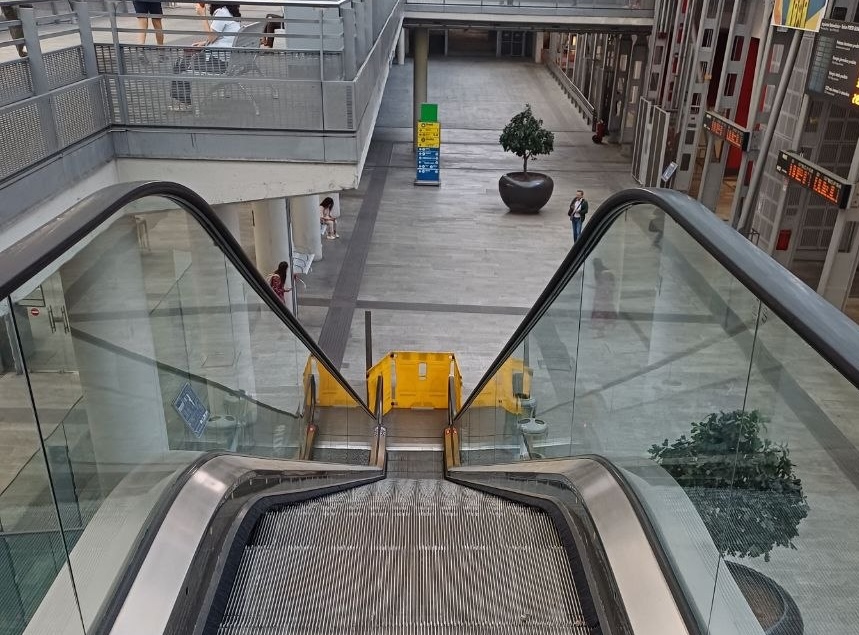
Weak points remain. On 27 July 2026 the City gave up on the planned bike station (velostazione): the spaces considered interfered with the station's safety or with escape routes, and RFI had no funds to build it[25]. In September the press reported that two escalators and two lifts between level −1 and street level had long been out of service[26].
Pages linking here
- Aeroporto di Torino-Caselle
- Askatasuna
- Collegno
- Escalator and Elevator Breakdown at Porta Susa (September 2026)
- Gruppo Torinese Trasporti
- Intesa Sanpaolo
- Intesa Sanpaolo Skyscraper
- Italia Viva
- Metropolitana di Torino
- Olimpiadi invernali di Torino 2006
- Settimo Torinese
- Stazione di Porta Nuova
- Transport in Turin
- Turin Metropolitan Railway Service
Twelve mobility systems out of service for emergency maintenance (September 2026)
On 29 September 2026, twelve of the 71 mobility systems at Porta Susa station are out of service — eight escalators and four lifts, 17% of the total — for emergency maintenance work under way for several days.
Related articles: Aeroporto di Torino-Caselle, Escalator and Elevator Breakdown at Porta Susa (September 2026), Metropolitana di Torino, Stazione di Porta Nuova, Transport in Turin
Sources
- Mole24 — 10 December 2020
- TorinoClick (Città di Torino) — 8 May 2026
- Treccani, Enciclopedia Italiana
- La Stampa, 01/01/1916, n. 1, p. 7 — 1 January 1916
- La Stampa, 11/08/1950, n. 190, p. 2 — 11 August 1950
- La Stampa, 01/07/1954, n. 155, p. 2 — 1 July 1954
- La Stampa, 25/06/1996, n. 173, p. 43 — 25 June 1996
- La Stampa, 30/11/1937, n. 285, p. 4 — 30 November 1937
- La Stampa, 01/08/1953, n. 182, p. 2 — 1 August 1953
- Stampa Sera, 11/10/1982, n. 255, p. 4 — 11 October 1982
- UrbanRail.net
- TorinoClick (Città di Torino) — 19 December 2016
- RFI – Rete Ferroviaria Italiana
- TorinoClick (Città di Torino) — 19 January 2024
- TorinoClick (Città di Torino) — 23 February 2018
- TorinoClick (Città di Torino) — 2 March 2018
- TorinoClick (Città di Torino) — 30 October 2018
- Mole24 — 11 January 2022
- Mole24 — 5 May 2022
- Mole24 — 15 June 2023
- TorinoClick (Città di Torino) — 7 July 2023
- Mole24 — 5 January 2023
- Mole24 — 10 October 2024
- Mole24 — 27 August 2026
- Mole24 — 4 August 2026
- Quotidiano Piemontese — 17 September 2026
- Quotidiano Piemontese — 17 September 2026
- CronacaQui Torino — 29 September 2026
- TorinoOggi — 29 September 2026