Turin Metropolitan Railway Service
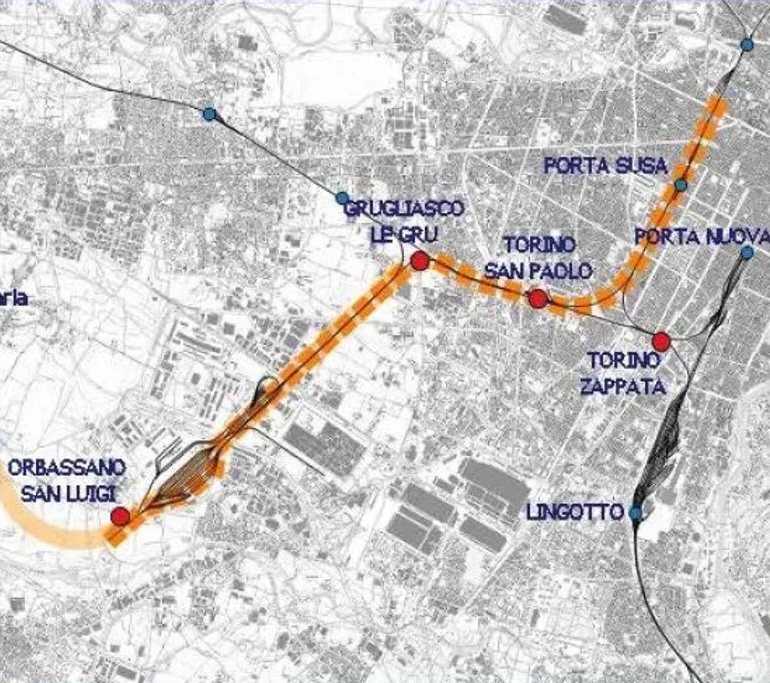
The Turin Metropolitan Railway Service (SFM) is the network of clock-faced suburban trains that run through the Piedmontese capital along the underground rail bypass and connect it with the municipalities of the Metropolitan City and with several nearby towns. Launched in 2012 with five lines[1], it now counts eight[2]: for many commuters from Canavese, the Pinerolese area or the Val di Susa it is the ordinary way of getting into the city, and along its urban stretch it works much like a north-south subway line.
Origins: the rail bypass
The SFM grew out of the "passante ferroviario", the underground line that crosses the city between Lingotto and Stura station and which, between Porta Susa and Stura, replaced the old above-ground Turin–Milan line. The idea dates back to 1979, and work to bury the tracks and add two more began in 1987; the result is a roughly 13-kilometre corridor with four tracks, two reserved for long-distance trains and two for metropolitan services[3]. The new Porta Susa station, a 386-metre-long, 21-metre-deep tube of glass and steel designed by the French firm Arep with Silvio D'Ascia and Agostino Magnaghi at a cost of 79 million euros, was officially inaugurated on 14 January 2013, by which time it was already serving commuters[4]. The main underground route had opened on 2 December 2012[3].
The idea of a metropolitan railway service entered regional planning with the 1998 three-year plan, whose stated goal was to "foster short- and medium-range mobility" and interchange with other means of transport, starting with Caselle airport. The scheme envisaged trains every thirty minutes on the outer stretches and every four to six minutes in the heart of the city, with new stops such as Grosseto, Grugliasco and Ospedale San Luigi[5].
The 2012 launch and the first expansion
The service began in 2012, when work on the bypass's second tunnel was completed, with five lines: SFM1 Pont-Rivarolo–Chieri, SFM2 Pinerolo–Chivasso, SFMA Turin–Caselle Airport–Ceres, SFM3 Turin–Susa/Bardonecchia and SFM4 Turin–Bra[1]. Two of these lines, SFM1 and SFMA, were operated by the Gruppo Torinese Trasporti, which a year after launch counted roughly 100,000 more passengers on them[6].
Within a year the network had outgrown its original boundaries. From 9 June 2013 trains reached Fossano and Alba via Cavallermaggiore; on 15 December of the same year the SFM6 Turin Stura–Asti line entered service, with 32 runs a day, and the 34 SFM7 trains to Fossano were permanently based at Stura after six months of trial operation from Porta Nuova. The number of connected stations rose to 93 across three provinces, with 358 daily runs and an SFM train every eight minutes between Lingotto, Porta Susa, Rebaudengo and Stura. Claudio Lubatti, chairman of the Metropolitan Agency, spoke of it as a second subway line for the city: with "an SFM train every 8 minutes, we can guarantee north–south connections in 15 minutes"[6]. According to the March figures released at the time, ridership had grown by 15% on SFM1 and by around 20% on SFM4[6].
Operators and contracts
From 1 January 2021 the SFM1, the Canavese line, passed from GTT to Trenitalia, which had won the tender called by the Piedmont Region two years earlier; the handover was presented on 17 December 2020 in Rivarolo Canavese[7]. With the change, GTT's extra-urban tickets stopped being valid on the trains, while integrated tickets remained valid[8]. Around the same time the Rivarolo–Pont stretch was suspended and served by bus for electrification works[7].
The link to Caselle and the Lanzo valleys
For years the Turin–Ceres railway remained cut off from the bypass, with its own separate terminus. The link was built with a new double-track tunnel running from Rebaudengo Fossata beneath Parco Sempione and Corso Grosseto, with a new Corso Grosseto stop; the project cost 230 million euros, and since 20 January 2024 trains have connected Porta Susa to Caselle in 31 minutes, every half hour, continuing on to Ciriè and Germagnano[9]. Presenting the link in December 2023, mayor Stefano Lo Russo called it "an infrastructure the city has been waiting for a long time", while Region president Alberto Cirio described it as "a historic achievement"[9]. Management of the line passed at the same time from GTT to RFI and Trenitalia; in 2024 the airport link carried about 800,000 people, more than 2,000 a day. In summer 2025 the line was closed for 83 days, from 16 June to 7 September, for works that allowed larger-capacity trains to be introduced[10].
Ongoing works
The bypass is not yet complete. The Dora and Zappata stops — the latter conceived as an interchange with the future line 2 of the subway — and the new San Paolo stop are planned or under construction[11]; according to the OTI Piemonte observatory the project is worth about 1.48 billion euros, of which around 291 million still need to be funded, with completion expected in 2027[3]. RFI is also introducing a four-minute spacing between trains, which will bring the Porta Susa–Rebaudengo Fossata stretch up to twelve trains an hour, with traffic managed from the Lingotto control centre[11].
Still to be activated is the SFM5, planned to run from Orbassano to Torino Stura with stops at the San Luigi hospital and at Borgata Quaglia–Le Gru in Grugliasco[1], and, in a second phase, at San Paolo[11]. A 2013 agreement had allocated 18.5 million euros and set June 2018 as the deadline for completing the San Luigi stop[1]; as of September 2026 the construction site was at a standstill, five years behind schedule, and the Region indicated that activation would take place in the second half of 2027[12].
Pages linking here
Related articles: Orbassano
Sources
- Osservatorio per l'asse ferroviario Torino-Lione (Presidenza del Consiglio dei ministri) — 22 January 2014
- Muoversi a Torino (Città di Torino)
- OTI Piemonte
- Il Sole 24 Ore — 12 January 2013
- MuseoTorino
- Mobility Press — 16 December 2013
- Quotidiano Canavese — 8 December 2020
- GTT – Gruppo Torinese Trasporti
- Torino Oggi — 22 December 2023
- OTI Piemonte
- RFI – Rete Ferroviaria Italiana
- Quotidiano Piemontese — 23 September 2026