Chieri
A municipality in the Turin hills: ancient Carreum Potentia, the free commune more populous than Turin in the 14th century, a city of textiles and of Don Bosco's youth.
Chieri (Cher in Piedmontese) is a municipality of the Metropolitan City of Turin, lying on the southern slope of the Turin hill, along the road leading from Turin towards Asti.[1] In the Middle Ages it was a rich and populous commune, able to rival Turin itself; for centuries it was one of Italy's oldest textile centres, and to Turinese people it is also known as the city where the young Giovanni Bosco was formed. The Piedmontese name, Cher, has remained alive in local use alongside the official one.[2]
Carreum Potentia
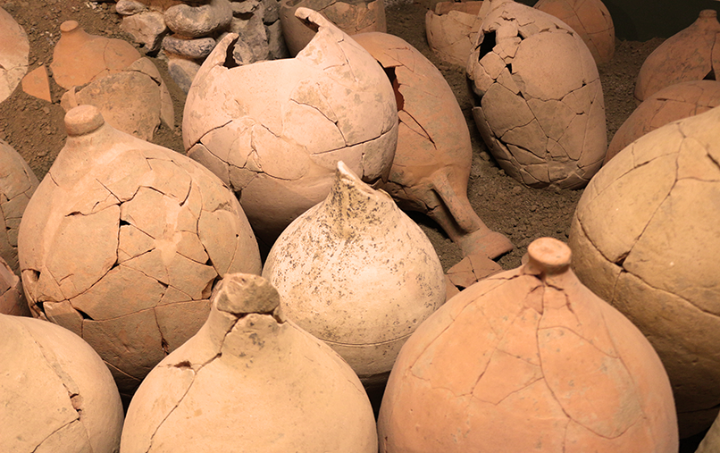
The ancient Carreum was a centre of Augustan Regio IX, known by the Latin epithet Potentia.[1] Excavations have yielded a large number of amphorae, produced locally or arriving from Greece, central Italy, Croatia and Spain, including one example with a Greek inscription found near the baptistery; a Roman necropolis was investigated at Ponte Nuovo in 1960 and 1993, along the road leaving the city to the south-west. Pottery was produced at Chieri in the imperial era and again at the end of the 12th century. These finds have been displayed since 2009 in the basement of the town hall, in the Chieri Archaeological Exhibition.[3]
The medieval commune and the House of Savoy
Before the year 1000 Chieri was dependent on the Bishop of Turin; in 1158 it was granted as a fief to Count Guido of Biandrate.[1] The commune prospered through trade, like Asti, especially after the destruction of its nearby rival Testona. In 1339 it submitted to Robert of Anjou, in 1347 it passed half to Amadeus VI of Savoy and half to James of Achaea, and in 1418 it came entirely under the rule of the House of Savoy. Its demographic importance is documented by a figure the 1931 Italian Encyclopaedia recorded as follows:[1]
«In 1363 the population of Chieri (6,665) exceeded that of Turin (4,220 inhabitants)»
In 1419, to escape the plague, the University of Turin moved to Chieri; six years later, because of another epidemic, it left the city for Savigliano. In 1785 Victor Amadeus III granted Chieri as an appanage, with the title of prince, to his second son Victor Emmanuel, Duke of Aosta.[1]
The Cathedral and the churches
The collegiate church of Santa Maria della Scala, the Cathedral, replaced a Romanesque church built around 1016 by the Turin bishop Landolfo. At the wish of the canons and citizens it was rebuilt from March 1405 and consecrated in 1436, in Lombard Gothic forms, with Lombard and French workers and with the church of the Carmine in Pavia as a model. In the 18th century Bernardo Antonio Vittone designed the chapel of the Madonna delle Grazie there; between 1875 and 1880 the architect Edoardo Arborio Mella removed the Baroque additions to restore the building's Gothic coherence.[4] The interior holds eight large canvases of the Doctors of the Church and works by Moncalvo; the baptistery preserves 15th-century frescoes depicting the life of Christ.[1] In September 2026 two 15th-century embossed silver reliquaries returned to the Cathedral, one of Saint Julian and one with the Madonna, stolen in 1973 and recovered in Switzerland in May 2026 by the Carabinieri's Cultural Heritage Protection Unit.[5]
Among the other churches, San Domenico is documented from the 14th century: in 1332 the town council granted a contribution to the Dominicans to build it.[6]
The textile city
Textiles accompanied Chieri from the Middle Ages to the 20th century. In the 16th century the fustian-makers' guild had yarns and fabrics bleached at the Vajro bleaching works, built away from the walls because of the smells and for the water of the Tepice stream. The monastery of Santa Chiara, built in 1494, was confiscated in the Napoleonic era and in 1809 was bought by the entrepreneur of Jewish origin David Levi, who turned it into the city's first factory. Since 1997 the former convent has housed the Textile Museum, founded on the initiative of the former industrialist Armando Brunetti: more than three thousand items, with looms kept running by volunteer technicians.[7]
In 1872 Felice Tabasso founded the cotton mill that bears his name, which came to employ more than three hundred people. From the 1980s production declined until the 1995 bankruptcy; in 1999 the municipality bought the complex, which today houses the civic library, the historical archive and other services.[8] Already in 1931 the Enciclopedia Italiana wrote that «Chieri is one of the oldest and, even today, one of the most notable centres in Italy for the textile industry (cotton and artificial silk)».[1]
The Jewish ghetto
A Jewish presence is attested at least from 1580, when Abram Serge obtained permission to open a synagogue. After the royal Constitutions of Victor Amadeus II, which imposed ghettos throughout Piedmont, from 1724 the community was gathered in three medieval buildings on via della Pace, known locally as l su dij Breu. The synagogue, on the first floor of Casa Solaro, had a vault painted in neo-Gothic style: in Piedmont frescoed ceilings of this kind are found only at Casale Monferrato and Saluzzo. After the 1848 emancipation many moved into the city; in 1930 the community merged with that of Turin, the synagogue closed in 1935, and the sacred furnishings passed to Turin after the war.[9]
Don Bosco in Chieri
In 1831 the young Giovanni Bosco moved to Chieri to continue his studies. The Colle Don Bosco chronology describes that period as follows: «They would be tiring and difficult years, but splendid ones for his brilliant results, for the esteem of teachers and companions, and for his friendships (the Società dell'allegria)».[10] He attended the royal college and in 1835 entered the Chieri seminary, established in 1829; he was ordained a priest in Turin on 5 June 1841.[11] In the San Filippo complex, seat of the old seminary, the municipality and the Cristo Re Salesian Institute reopened the Don Bosco Museum in 2024, a stop on the Cammino Don Bosco.[12]
Chieri today
In 2008 the municipality had 35,354 inhabitants across 54.3 square kilometres.[13] Since 6 July 1956 the Traforo del Pino, a 970-metre tunnel on a 6,765-metre route, has linked Turin to Chieri under the hill.[14] In the hamlet of Pessione, the Martini & Rossi plant has stood since 1964, next to the Turin-Genoa railway[15]: it is the Bacardi group's largest by production capacity and has housed, since 1961, a museum of the history of winemaking with more than six hundred pieces.[16] The city is linked to Freisa di Chieri, a wine of the Turin hills celebrated by the «Di Freisa in Freisa» festival[17], and in sport to women's volleyball: Reale Mutua Fenera Chieri won the CEV Challenge Cup on 23 March 2023, beating Lugoj 3-0 in Timișoara.[18]
Pages linking here
- Asti DOCG
- Bagna càuda
- Banche del Tempo della provincia di Torino
- Barbera
- Basilica di Maria Ausiliatrice
- Biblioteca Reale di Torino
- Chieri '76 vince al tie-break a Scandicci nella prima giornata di Serie A1
- Città metropolitana di Torino
- Emilio Salgari
- Giovanni Bosco
- Giuseppe Benedetto Cottolengo
- Giuseppe Cafasso
- Grissino torinese
- Impresa Edile Torino
- Martini & Rossi
- Mole Meccanica Lavorazioni Meccaniche di Precisione - STM Frizioni C
- Piccola Casa della Divina Provvidenza
- Reale Mutua Fenera Chieri '76
- Riduci, riusa, ricicla - ECO3R
- San Salvario
- Scelto il tracciato A per la Gronda Est (settembre 2026)
- Servizio ferroviario metropolitano di Torino
- Società salesiana di San Giovanni Bosco
- Tangenziale di Torino
- Taurini
- Università degli Studi di Torino
- Villa della Regina
- Volpiano
Related articles: Basilica di Maria Ausiliatrice, Giovanni Bosco, Martini & Rossi, Salesian Society of Saint John Bosco
Sources
- Treccani, Enciclopedia Italiana (1931) — 1 January 1931
- Mole24 — 18 August 2026
- Comune di Chieri
- Comune di Chieri
- Mole24 — 17 September 2026
- Comune di Chieri
- Comune di Chieri
- Comune di Chieri
- Comune di Chieri
- Colle Don Bosco
- Treccani, Dizionario Biografico degli Italiani
- Comune di Chieri
- Treccani
- Mole24 — 18 August 2026
- Mole24 — 1 July 2015
- Comune di Chieri
- Mole24 — 19 May 2026
- Mole24 — 23 March 2023