Basilica di Maria Ausiliatrice
Sanctuary built by Don Bosco at Valdocco between 1863 and 1868, mother church of the Salesians and keeper of the founder's remains.
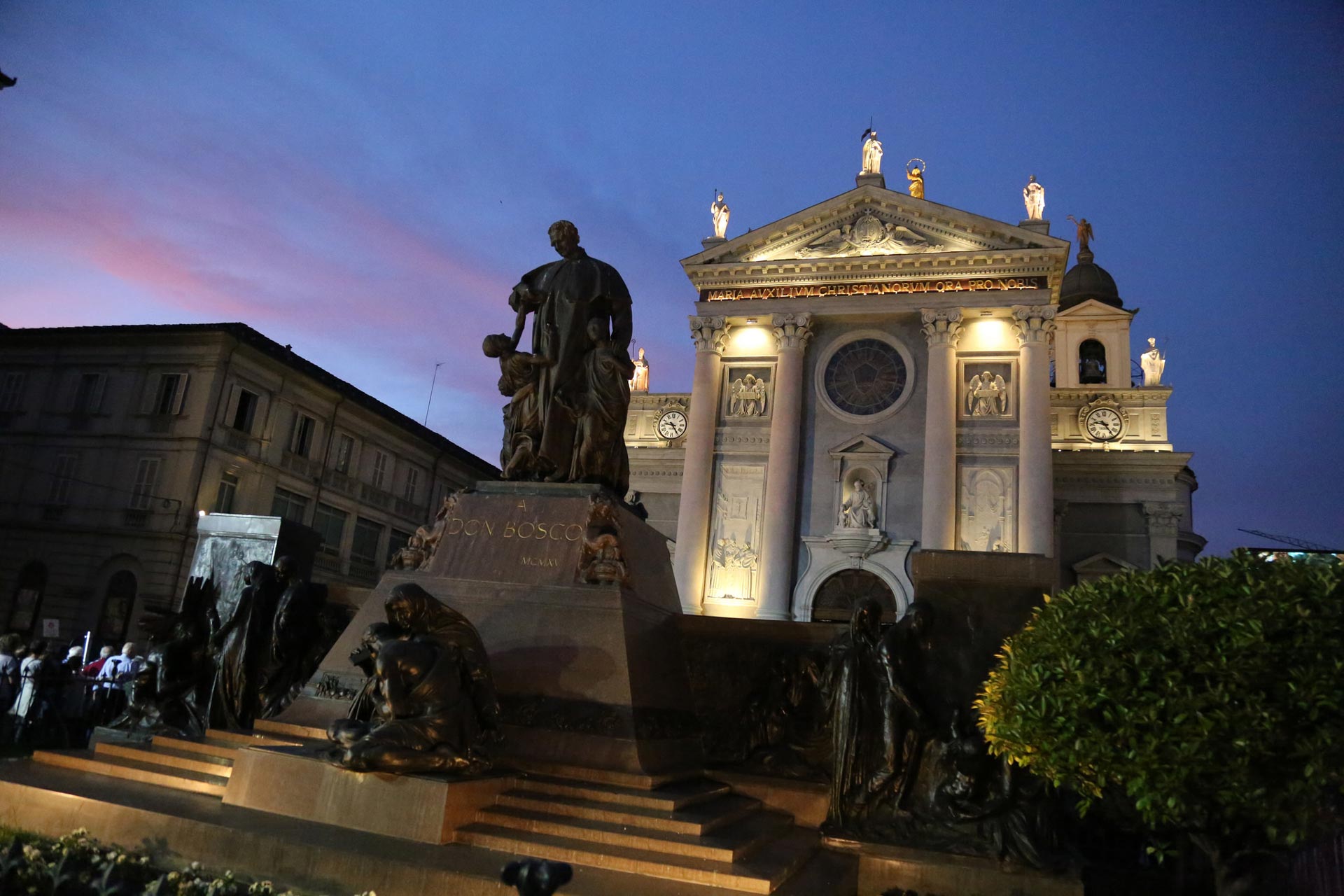
The Basilica of Maria Ausiliatrice is the Marian shrine that Don Giovanni Bosco had built at Valdocco, in the district north-west of central Turin, between 1863 and 1868. It stands next to the Pinardi chapel, where in 1846 the Salesian oratory found its first permanent home, and it holds the remains of Don Bosco himself, of Saint Maria Domenica Mazzarello, co-founder of the Daughters of Maria Ausiliatrice, and of Saint Domenico Savio.[1] It is the mother church of the Salesian Society.
From a shed to a sanctuary
In the mid-nineteenth century, Valdocco was an outlying district of hemp mills, fulling mills and workshops overlooking land sloping down toward the Dora, cut through in 1856 by the railway to Novara.[2] It was here that Don Bosco brought his oratory on 12 April 1846, into the shed rented from Francesco Pinardi; in 1852 he opened the church of San Francesco di Sales, and in December 1859 he founded the Salesian congregation.[3] As the number of young people taken in at the oratories and workshops of the adjoining house grew – shoemakers, tailors, bookbinders, carpenters, printers, blacksmiths – the resident population rose past a hundred and by 1868 reached more than eight hundred people.[4]
Salesian tradition links the church to a dream of 1844 in which the Madonna is said to have shown Don Bosco three successive buildings: a church that was «small and low», one «much bigger», and finally the sanctuary. Don Bosco spent 4,000 lire on the land and timber.[5]
The building site (1863-1868)
The design, entrusted to the architect Antonio Spezia, was submitted to the Municipality in February 1863.[5] The work, carried out by the firm of master builder Carlo Buzzetti, began in the autumn of that year; the excavation phase was completed in April 1864. Spezia drew up a Latin-cross plan and a façade inspired by that of San Giorgio Maggiore in Venice, the work of Andrea Palladio; the original interior was plain, with no marble cladding on the walls, and the single dome of that time was whitewashed with lime.[6]
The first stone was laid on 27 April 1865.[7] The ceremony was attended by Prince Amedeo di Savoia, son of Vittorio Emanuele II: for Don Bosco, who financed his works with charity lotteries featuring prizes donated by members of the ruling house, the bond with the monarchy was a support worth cultivating.[4] The Dizionario Biografico degli Italiani recalls the church as
«a large church dedicated to Maria Ausiliatrice (Auxilium christianorum), intended for the young and for the spiritual needs of the district»
The description refers to the 1868 inauguration.[4]
The consecration of 9 June 1868
The basilica was consecrated on 9 June 1868 by the Archbishop of Turin Alessandro Ottaviano Riccardi di Netro.[5] According to the account published by Mole24, more than ten thousand people gathered at Valdocco and the boys of the oratory served as altar boys; beneath the main altar a fragment of the True Cross donated by Pius IX was placed, the church was lit by gas, and atop the dome stood a gilded statue of the Madonna five metres tall. During the octave that followed, fifteen thousand communions were counted.[8]
The great altarpiece of the main altar is by the painter Tommaso Lorenzone, who painted it according to Don Bosco’s instructions: the Virgin, holding a sceptre in her right hand and the Child in her left, dominates a scene crowded with angels, and in the background appears the city of Turin, with the Valdocco sanctuary in the foreground and the hill of Superga on the horizon.[6] The same Lorenzone completed in 1873 the altarpiece of the altar of San Giuseppe, inaugurated on 26 April 1874 and left as it was in the founder’s time even through later expansions.[9]
The sanctuary also became a landmark for the district. In an appeal to local residents, Don Bosco announced a clock for the bell tower:
«A need universally felt in Valdocco is that of a clock that can serve the public good.»
The device was to mark «with precision the hours, the half-hours and the quarters» and cost 2,000 francs, to be raised among the neighbours; the original clock is now on display in the museum set up in the right-hand bell tower, reached by a spiral staircase of 80 steps.[10]
Don Bosco’s body and the expansion
Don Bosco died at Valdocco on 31 January 1888[3] and was buried at the Salesian college of Valsalice, with the authorization of the head of government Francesco Crispi.[4] On 2 June 1929, the day of his beatification proclaimed by Pius XI, his body was moved to the basilica. For the occasion the Salesian sculptor Sebastiano Concas made, to a design by the architect Giulio Valotti, an urn of gilded wood; the final casket, visible both from the church and from the rear, was designed by Giulio Casanova, while Mario Ceradini designed a forward altar that leaves worshippers space to approach the relics, clad in yellow marble from Siena and from Candoglia with gilded bronze decoration.[11]
It is to Valotti that the building’s most profound transformation is owed: the extension of the presbytery beneath a new, smaller dome, two large side chapels, the Neo-Renaissance main altar, and the altar of Saint Maria Domenica Mazzarello with the bronze urn for her remains. Monsignor Bovero praised its «ingenious Romanesque-Lombard conceptions».[12] During the Second World War the basilica was struck by bombing; between 1945 and 1956, behind the altar of San Giuseppe, the baptistery was created, frescoed by Carlo Morgari in 1956. The church, which had not originally been a parish, later received the title of minor basilica and also became a parish church.[13]
The square and the feast of 24 May
In front of the basilica, in the square that bears its name, stands the monument to Don Bosco by Gaetano Cellini: begun in 1914, halted by the war because bronze was reserved for military use, it was unveiled in 1920 thanks to 200,000 lire raised by former Salesian pupils from twenty-two countries and 20,000 lire from the City Council.[14] In 2024, core samples taken ahead of the square’s redevelopment brought to light a perimeter wall from the Napoleonic era, which was examined by the Soprintendenza (heritage authority).[15] The work, which began on 24 April 2024 and was funded with 1.5 million euros from ministerial funds under the PINQuA programme, was completed in January 2025 with the pedestrianization of the space, new permeable paving and more greenery; that same month the restoration of the two bell towers was finished, their chime having grown from eight to twelve bells.[16]
Every 24 May, the feast of the Ausiliatrice established by Pius VII in 1815, an evening procession sets out from the basilica through the streets of Valdocco, along the service lanes of Corso Regina Margherita and Corso Principe Oddone, Strada del Fortino and Via Cigna, before returning to the square; in 2024 the deputy mayor took part.[17] The sanctuary is also a destination for papal visits: in June 2015, during his trip to Turin for the bicentenary of Don Bosco’s birth, Pope Francis prayed there and recalled that his father, newly arrived in Argentina, had begun attending the Salesians of the Italian church, near which he met his future wife.[18]
«Don Bosco was not ashamed of the Madonna because he was not ashamed of his own mother, and he trusted in God by entrusting himself to the Madonna».
Today the basilica, a church of the Archdiocese of Turin, together with the Pinardi chapel, the church of San Francesco di Sales, the schools, the oratory and the museum set up in Don Bosco’s rooms, forms the Valdocco complex, the mother house of the Salesians.[7]
Pages linking here
Related articles: Chieri, Giovanni Bosco, Salesian Society of Saint John Bosco
Sources
- Basilica di Maria Ausiliatrice
- Mole24 — 24 December 2023
- Basilica di Maria Ausiliatrice
- Treccani – Dizionario Biografico degli Italiani —
- Mole24 — 22 January 2024
- Basilica di Maria Ausiliatrice
- MuseoTorino
- Mole24 — 9 June 2016
- Bollettino Salesiano —
- Basilica di Maria Ausiliatrice
- Bollettino Salesiano
- Bollettino Salesiano —
- Bollettino Salesiano —
- Mole24 — 26 January 2015
- Mole24 — 5 June 2024
- Torinoclick (Città di Torino) — 1 April 2025
- Torinoclick (Città di Torino) — 24 May 2024
- Famiglia Cristiana