Grugliasco
Municipality in Turin's western belt: a medieval parish, silk mills, silent-film studios, the Pininfarina and Bertone coachbuilding works, and the 1945 massacre.
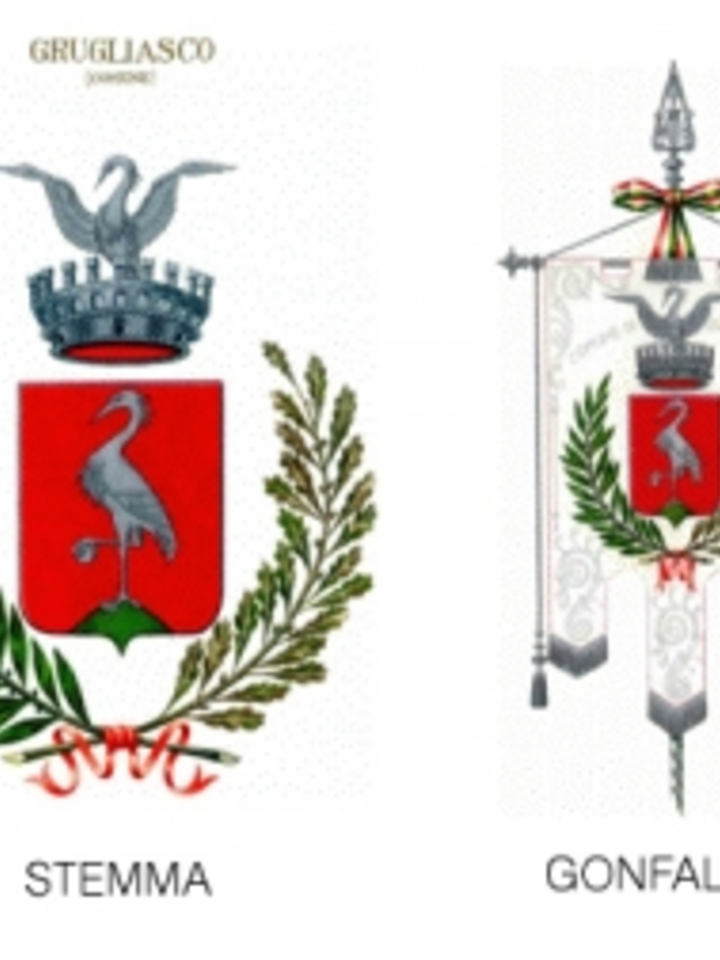
Grugliasco is a municipality in the Metropolitan City of Turin, on the plain west of the regional capital, between Turin, Collegno and Rivoli.[1] A rural village for nearly a thousand years, then a silk town, since the Second World War it has become an industrial city of the Turin belt, home to the plants of some of the major Turin coachbuilders. It has about 36,000-38,000 inhabitants over just over 13 square kilometres[2][1], and its name is also tied to the massacre carried out by retreating German troops at the end of April 1945.
The name and the crane
The origin of the place name is uncertain. The most likely hypothesis traces it to the name of a Roman settler, Currelius, with the suffix -asco, of Ligurian stamp, widespread in the area.[3] Popular tradition, however, read into the name the crane (gru), which has become the town's emblem. When in 1613 Duke Charles Emmanuel I ordered the communities to register their coats of arms, Grugliasco's was recorded with these words, preserved at the State Archives of Turin: «A silver crane standing on a green hill, on a red field».[4] In the blazon the crane holds a stone in its claw, the «vigilance»: should the watchful bird fall asleep, the falling stone would wake it. The coat of arms and banner were officially recognized by decree of the President of the Republic on 3 July 1962.[4]
From the parish of San Cassiano to the Savoy fief
The first certain record dates to 1047, when Emperor Henry III confirmed to the Chapter of Turin Cathedral the rights over the curtis of Grugliasco and over the church of San Cassiano.[3] Around this church property the village grew, remaining agricultural throughout the Middle Ages; it passed under the direct jurisdiction of Turin and then into the principality of Savoy-Acaia, which ended in 1418. In 1619 Charles Emmanuel I raised the territory to a county.[3]
The parish church of San Cassiano was rebuilt in 1647 by workshops from Lugano, with a Latin-cross plan still legible today, enlarged in 1779-1780 to a design by Mario Ludovico Quarini and completed only in the nineteenth century: the neo-Gothic façade, raised in 1848, was redesigned in 1880 by Giovanni Battista Ferrante, who gave it its present appearance.[5] Serving as its bell tower, some fifteen metres from the façade, is an old defensive and watch tower: the Civic Tower, built in the fifteenth century, the only authentic fragment of the medieval village to survive to this day. In the Napoleonic era it was adapted as an optical telegraph station.[6]
Court villas and silk mills
Closeness to the capital attracted officials and nobles of the Savoy court. The oldest core of Villa Claretta Assandri dates to the mid-seventeenth century: in 1643 Christine of France had granted as a fief to Carlo Bernardino Ferreri, ordinary secretary of the court, the moats, earthworks and ravelins that surrounded the village; the property then passed to Francesco Antonio Allemandi, governor of the royal palaces, and in 1718 to Count Giuseppe Provana di Pralungo, who enlarged the villa, the farm buildings and the garden. In the mid-nineteenth century it was bought at auction by Camillo Spanna, related by marriage to the Counts Claretta Assandri, from whom the villa takes its name; the coffered ceilings painted with mythological scenes date from the seventeenth and eighteenth centuries.[7]
The mill-race, drawn from the Dora near Alpignano and already active in the fifteenth century, fed mills and, from the end of the seventeenth century, silk-throwing mills: in 1787 there were three of them, fifteen years later five throwing mills and two spinning mills, with about five hundred workers, many of them seasonal.[3]
The Serre film studio
A little-known chapter concerns silent cinema. In 1913 Alfredo Gandolfi bought the eighteenth-century Villa Boriglione with its park of about 35,000 square metres and, with Alberto Stevani and the American producer George Kleine, founded the Photodrama Producing Company.[8] In the park rose sound stages, chemical laboratories for developing and printing film, special-effects departments, workshops for sets and costumes, Swiss- and German-style chalets and a winter garden; the large building known as «la Nave» («the Ship»), still standing on the south side of the park, was built to hold sets, furnishings and costumes.[8][9] In 1927 the property was bought by the City of Turin, which set up there the «G. Ratti» gardeners' school and the municipal greenhouses: hence the name by which the complex is known, «Le Serre» («the Greenhouses»).[8]
The 1945 massacre
In the last days of the war, while the cities of the North rose up, retreating German units killed partisans and civilians at Grugliasco and Collegno. According to an account published by Mole24, those responsible belonged to the 34th division of General Hans Schlemmer, the killings took place on 30 April and 1 May 1945, and the victims numbered 67, including a priest.[10] The Municipality of Grugliasco gives the date as 30 April and the number killed as 68, twenty of them residents of Grugliasco and thirty-two of Collegno.[11] For these events President Carlo Azeglio Ciampi awarded Grugliasco, as he did Collegno, the silver medal of civil merit, pinned to the town's banner on 2 June 2006.[11] The citation recalls the town as it was then:
«A small rural municipality of about five thousand four hundred inhabitants, generously committed to the partisan struggle, it suffered a brutal massacre by Nazi troops, who savagely slaughtered twenty heroic citizens, half of them youths not yet twenty years old.»
The city of the coachbuilders
From the late 1950s Grugliasco became one of the destinations of the automotive and metalworking industry spreading out from Turin: among others, Pininfarina, Bertone and Vignale moved there.[3] In June 1958 Battista Pininfarina moved the whole operation from the old Turin plant to a new facility «on the threshold of Turin», organized into five departments, from the experimental studios to testing; in 1963 he promoted a vocational and recreational centre for young people in Grugliasco itself.[12] In 1966 the new Research and Development Centre was opened there; only in 1986 and 1987 did the company open the plants of San Giorgio Canavese and Bairo.[13]
The industry, together with the ancillary businesses of FIAT and the Mirafiori plant, brought massive immigration: between the postwar years and the early 1970s the population multiplied sixfold and the town merged into a continuous urban fabric with Turin and the neighbouring municipalities.[3][1] The nearby Leumann cotton mill favoured the growth of the Fabbrichetta district.[1]
Grugliasco today
Since 1985 Villa Boriglione and the Serre park have been on free loan to the Municipality of Grugliasco and since 2000 have housed a cultural park devoted to the visual arts, cinema, theatre and music.[8] Circus and puppet schools and design and photography workshops operate there.[9] Villa Claretta Assandri is today a university hall of residence run by EDISU[7] and houses the Museum of the Grande Torino and the granata legend, curated by the Associazione Memoria Storica Granata: born at Superga in 2002 and moved here in 2008, it holds more than 1,500 memorabilia, including a wheel and a propeller of the Fiat G.212 that crashed in the Superga air disaster, the Balilla car and personal items of Gigi Meroni, and part of the wooden stand of the Filadelfia stadium.[14]
Every year, on the first Sunday of June, the town's districts compete in the Palio della Gru, begun in 1984 in memory of the vow and devotion of the people of Grugliasco to Saint Roch after the plague of the sixteenth century: the festival lasts a week, with a re-enactment of the saint's statue arriving, the women's «Pallastraccia» and, at the end, a race of ox-drawn carts.[15] Grugliasco is affected by the extension of metro line 1 from Fermi to Cascine Vica: on 9 July 2026 mayor Emanuele Gaito signed, together with his colleagues from Turin, Collegno and Rivoli, a letter to the Government requesting an urgent meeting and about 70 million euros in additional funding.[16]
Timeline
- — Grugliasco's Palavillage will host, from 26 October to 1 November, the FIP Gold Mediolanum Padel Cup, the first Gold-category tournament of the worldwide Cupra Fip Tour circuit held in the Turin area, with 50,000 euros in prize money and more than 250 athletes competing. → ANSA Piemonte Il Torinese
- — The Turin police commissioner orders the ten-day closure of a bar on via Don Caustico in Grugliasco, where checks also led to the detention of a wanted man found in possession of hashish: it is the third suspension of the venue's licence in under ten months. → TorinoOggi CronacaQui Torino
- — The mayors of Collegno, Grugliasco and Rivoli, together with unions and trade associations, announce at a press conference a demonstration on 10 October in support of completing metro Line 1, whose construction site has been stalled for months after the contractor went bankrupt. → ANSA Piemonte Il Torinese
Related articles: Battista Pininfarina, Collegno, Turin Metro, Pininfarina
Pages that link here
- A+A Monferrato
- Alberto Cirio
- Anpas
- Battista Pininfarina
- Civil suit by former Postalcoop employees against Poste Italiane (September 2026)
- Metropolitan City of Turin
- Collegno
- Comau
- Two Piedmontese women to the fore at Miss Italia 2026
- FIP Gold Mediolanum Padel Cup in Grugliasco (October 2026)
- Francesca Longobardi
- Gigi Meroni
- Grande Torino
- 10 October 2026 demonstration for the completion of metro Line 1
- Turin Metro
- Mirafiori
- Miss Eleganza 2026 awarded to Francesca Longobardi
- Museum of the Grande Torino
- Orbassano
- Padel
- Pininfarina
- Turin Metropolitan Railway Service
- Soris
- Turin Ring Road
- Third closure in ten months for a Grugliasco bar (October 2026)
- Superga air disaster
Sources
- Mole24 — 30 November 2025
- Treccani, Enciclopedia
- Città di Grugliasco
- Città di Grugliasco
- Mole24 — 2 December 2025
- Mole24 — 3 December 2025
- Città di Grugliasco
- Città di Grugliasco
- Mole24 — 6 December 2025
- Mole24 — 6 April 2025
- Città di Grugliasco
- Treccani, Dizionario Biografico degli Italiani
- Pininfarina
- Mole24 — 1 December 2025
- Città di Grugliasco
- TorinoClick — 9 July 2026