Mirafiori Plant
FIAT's great plant in the southern outskirts of Turin, opened in 1939: the heart of Italy's motorization, of labour struggles, and today a Stellantis site.
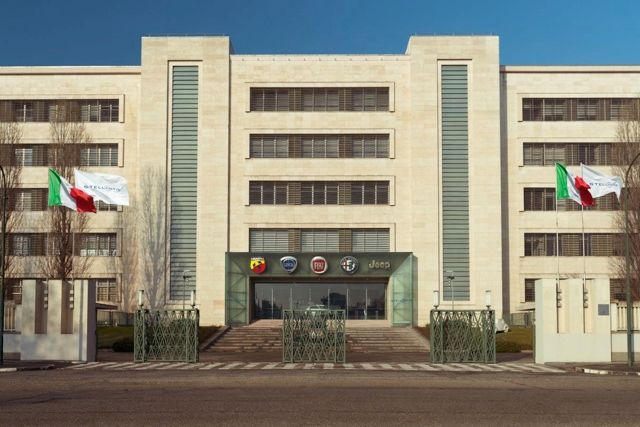
The Mirafiori plant is the great industrial complex of FIAT in the southern outskirts of Turin, in the suburb that, before the factory was built, had been known chiefly for its racecourse and airfield[1]. Opened in 1939, doubled in size in the 1960s and employing more than sixty thousand people at the start of the 1980s, for half a century it was the place where Italy's motorization, the city's growth and its seasons of social conflict were all decided together[2].
The 1930s project
The factory was willed into being by Giovanni Agnelli and Vittorio Valletta, and the plan was conceived and launched by Agnelli in 1936, in years when FIAT's choice of independence from the totalitarian claims of fascism was clear to Mussolini and to the regime's apparatus[3]. The design was entrusted to the engineer Vittorio Bonadè Bottino, who in the autumn of 1936 made a study trip to the United States and drew from it the design methods he then applied to the organization of FIAT's building sites. Unlike the Lingotto, which was developed vertically, Mirafiori was conceived on the principle of maximum horizontal expansion, built entirely in reinforced concrete: the autarkic policy of the time in fact banned the use of structural steelwork. The plant was sized for eighteen thousand workers[4]. According to MuseoTorino, the plant occupied a hundred hectares, with three million cubic metres built, 22,000 workers, six kilometres of underground tunnels used as air-raid shelters for 11,000 people, eleven kilometres of rail track and a test track; besides automobiles it also produced aircraft engines and metal castings. [12]
The inauguration of 15 May 1939
Built between 1937 and 1939, the plant was inaugurated by Benito Mussolini, who had initially opposed the project and who called it the «perfect factory of the fascist age»[5]. Management gathered tens of thousands of workers in front of the plant, before a ceremonial platform, but the day did not go as planned: the head of government arrived two hours late, met an icy reception and, failing to receive the acclaim he expected, left the ceremony before it ended. The episode is read as a sign of workers' discontent over the price rises and the restrictions on consumption imposed by the autarkic policy[5]. In March 1943 Mirafiori was among the factories hit by the strikes that, from 5 to 17 March, brought more than 100,000 Turin workers to a halt, with 850 arrests. [13] Between 1940 and 1944 the plant was bombed seven times by British and American aircraft, and most of its buildings suffered extremely serious damage. [12]
Rebuilding and doubling
The plan drawn up in 1936 was only brought to completion after the war. For the renewal of the plant Valletta obtained about 31 million dollars in Marshall Plan funding, and in 1955, as production of the 600 began, he launched the doubling of Mirafiori[3]. The new complex of Mirafiori Sud, built between 1960 and 1963 to a design by Bonadè Bottino with L. Ravelli, received the In-Arch prize of the Piedmont section, and from 1961 the plant's capacity had been doubled[4]. Between 1950 and 1963 FIAT multiplied its car production tenfold, passing the million cars a year mark in 1963[3]. Between 1970 and 1974 Sergio Jaretti Sodano and Elio Luzi built the Torre Mirafiori, fifteen storeys and sixty metres high on a butterfly-shaped plan. [15] In September 1969, 98% of Mirafiori's workers joined the metalworkers' general strike that began the «hot autumn». [14]
The 1980 autumn dispute
The harshest moment in the factory's history came in the autumn of 1980. Having asked in May for eight days of short-time working (cassa integrazione) for 78,000 workers, on 31 July FIAT gave full powers to its managing director Cesare Romiti; on 6 September it announced 24,000 redundancies and, on 10 September, after the breakdown of negotiations, 14,469 dismissals[6]. The unions responded with strikes and the picketing of the plants. The secretary of the UIL, Giorgio Benvenuto, summed up the line of head-on confrontation in a phrase that became famous: «Either FIAT backs down, or FIAT goes down»[7].
On 26 September the secretary of the PCI, Enrico Berlinguer, spoke to the workers at gate 5 of Mirafiori[6], promising that[7]
«if it comes to the occupation of FIAT, we will put our political commitment, our organization and our ideas at the service of the working class»
Three days later the company replaced the dismissals with zero-hours short-time working for 23,000 employees[6]. On 14 October white-collar staff and managers marched through the city centre in the March of the Forty Thousand, and the agreement was signed at six in the morning the following day[6], with about twenty-two thousand workers on short-time working[7].
The long decline
Since then Mirafiori has gone through a series of crises. According to the account given by the diocesan weekly La Voce e il Tempo, from the more than sixty thousand employees of the early 1980s the workforce has fallen to a few thousand on a site of two and a half million square metres; in July 2021 Stellantis chose Termoli rather than Turin for its battery factory, and in December 2023 Archbishop Roberto Repole publicly called for clarity over the plant's future[2]. A decisive moment had been the referendum of January 2011 on the contract proposed by managing director Sergio Marchionne, with more intensive shifts and shorter breaks, a few months after the one at Pomigliano, where the company had warned the plant would close if the "no" side won: at Mirafiori the "yes" prevailed among the workers by just nine votes[8]. In 2005 local authorities had bought 300,000 square metres of the site to redevelop it. [12]
Mirafiori today
Under the Mirafiori Automotive Park 2030 project, Stellantis has announced more than 240 million euros to transform the site: it produces the Fiat 500e, the Abarth 500e and the Maserati GranTurismo and GranCabrio, more than 90% of which are exported, and, from April 2024, the electrified eDCT gearboxes, with a capacity of 600,000 units a year; alongside the production lines a 40-million-euro battery technology centre and a circular-economy hub have been built, and the complex also hosts several of the group's global decision-making centres, including the worldwide headquarters of Stellantis Pro One commercial vehicles and the style centre[9]. In the first half of 2025 the plant produced 15,315 cars, 21.5% fewer than the year before, and production of the Maserati GranTurismo and GranCabrio was moved to Modena by October 2025. [16] In mid-November 2025 production of the hybrid 500 began, with the announcement of about four hundred new hires for a second shift from March 2026; on 25 November, the day celebrating the new model, in the presence of John Elkann, renovation work began on the historic Palazzina Uffici office building, 61,000 square metres over five above-ground floors, with 1,670 new windows and photovoltaic panels, to be completed in 2027[10]. At the end of May 2026 Stellantis's European head Emanuele Cappellano tied the target of 100,000 hybrids to how the market performs, and confirmed that Mirafiori's head office would reopen in 2027. [17]
The recovery remains fragile. In the first half of 2026 Mirafiori produced more cars than in all of 2025, but the company nonetheless ordered short-time working from 19 to 30 October 2026 for about a thousand workers on the 500 line, citing the market crisis and the cost of energy; the unions have called for a second model to bring the plant up to full capacity[11]. Already by the summer of 2026 stoppages for lack of components had become almost weekly, and the summer holidays had been extended from two to four weeks. [18]
Pages that link here
- Alberto Cirio
- Comau
- FIAT
- Gianni Agnelli
- Giovanni Agnelli (1866-1945)
- Grugliasco
- John Elkann
- Lingotto
- March of the Forty Thousand
- Mirafiori
- Orbassano
- Sergio Marchionne
- Stellantis
- Turin Ring Road
- Turin
- Umberto Agnelli
- Vittorio Valletta
Related articles: FIAT, Gianni Agnelli, Giovanni Agnelli (1866-1945), Mirafiori, Stellantis, Umberto Agnelli
Sources
- Treccani, Enciclopedia on line
- La Voce e il Tempo — 8 March 2024
- Treccani, Dizionario Biografico degli Italiani
- Treccani, Dizionario Biografico degli Italiani
- MuseoTorino
- La Voce e il Tempo — 14 October 2020
- Il Post — 14 October 2020
- Il Post — 25 July 2018
- Stellantis — 10 April 2024
- Stellantis Media — 25 November 2025
- ANSA — 22 September 2026
- MuseoTorino
- MuseoTorino
- MuseoTorino
- MuseoTorino
- ANSA Piemonte — 7 July 2025
- ANSA — 29 May 2026
- Il Post — 17 August 2026