Sergio Marchionne
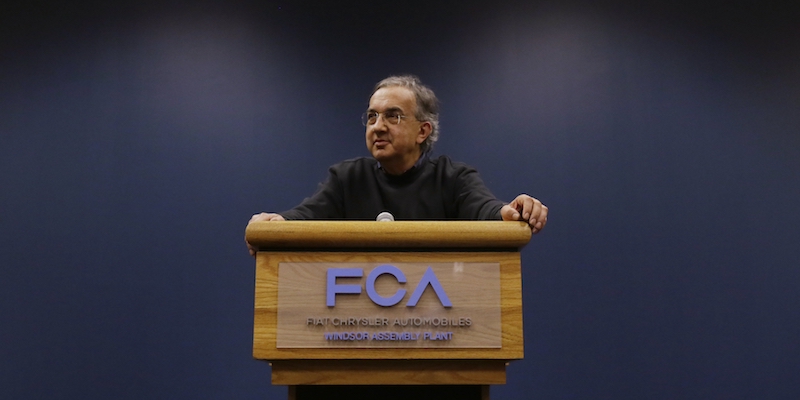
Sergio Marchionne (Chieti, 1952 – Zurich, 25 July 2018) was the manager who led FIAT from 2004 to 2018, pulled it out of a crisis that threatened its very existence, and transformed it, through the acquisition of Chrysler, into Fiat Chrysler Automobiles (FCA). For Turin his name marks a double turning point: the rescue of the company that had made the city, and at the same time the end of an era, with the group's headquarters moved outside Italy.[1][2]
From Abruzzo to Canada
He was born in Chieti in 1952 and emigrated as a young man with his family to Canada.[1] His family history had roots in Istria: his father Concezio, a carabiniere, had met his mother Maria at the general store that her father Giacomo Zuccon ran in Carnizza, near Pola; her father was killed by Yugoslav partisans and an uncle, Giuseppe, was shot by the Germans. The bond with that memory remained alive: in 2012 Marchionne took part in Turin in the gathering of Istrian exiles.[3]
In Canada he earned a law degree at Osgoode Hall Law School in Toronto and an MBA from the University of Windsor. He worked as a consultant for Deloitte Touche and was head of research and development at the Lawson Mardon Group of Toronto; between 2000 and 2001 he chaired the Swiss group Lonza and held positions at Serono, Philip Morris International and the Geneva-based group SGS.[1]
The rescue of FIAT
He joined FIAT's board of directors in 2003 and became chief executive officer on 1 June 2004; from 2005 he also led Fiat Auto.[1][2] He found a group that in the first three months of 2002 was losing about 5 million euros a day: one of his first moves was to settle the matter with General Motors, which paid 2 billion dollars to free itself from the obligation to buy FIAT, and to use that money to cut debt. In 2005 the company returned to profit.[2] In the early months he repeated the same principle at every public appearance: «Our business is making cars».[2]
Chrysler and the birth of FCA
In January 2009, at the height of the American car industry crisis, FIAT signed a preliminary agreement to take over 35% of Chrysler with no cash outlay; at the beginning of May Marchionne announced that he would become its chief executive officer, and on 24 July the European Commission authorised the deal.[4][5] The stake rose to 46% in May 2011 and to 58.5% in 2012; in January 2014 the Turin-based group bought the remaining 41.5% for about 3.6 billion dollars.[4] This gave rise to Fiat Chrysler Automobiles, a holding company incorporated under Dutch law with tax residence in the United Kingdom, which debuted on Wall Street on 13 October 2014.[4][5]
For Turin it was a symbolic passage: founded in the city on 11 July 1899, FIAT had always had its headquarters there, from corso Re Umberto to the Lingotto, from Mirafiori to corso Marconi and back to the Lingotto from 1997. Announcing the move, Marchionne assured that there would be no effects on employment in Italy.[6] In 2016 Ferrari, of which he had been chairman since 2014, was spun off from the group and listed in Milan and New York.[1][2]
Pomigliano, Mirafiori and the clash with the FIOM
The most contentious chapter concerned labour relations. In June 2010 the new contract linked to the World Class Manufacturing production system was put to a referendum at Pomigliano d'Arco, where the yes votes reached 63%. Shortly afterwards a vote was held at Mirafiori, where among the workers the yes votes prevailed by just nine votes. FIAT left Confindustria in order to negotiate directly with the unions, excluding the FIOM, which rejected the new contract.[2] According to the FIOM, the ergonomics of the lines improved but the pace of work became more intense: at Pomigliano output rose from 360 to 440 Pandas per shift. In 2012 almost a third of the group's workers in Italy were on temporary layoff (cassa integrazione); in 2018 about 10% still were.[2]
The record in figures
Between 2004 and 2018 sales rose from 2.4 to 4.7 million cars and employees from 180,000 to 309,000, with employment in Italy remaining at around 80,000 workers.[2] With Chrysler the group had become the world's seventh largest carmaker.[7] Chairman John Elkann summed up those fourteen years as follows: «Marchionne saved FIAT and took it to the world».[2]
Death and legacy
Marchionne had announced his departure from the group for the early months of 2019. Hospitalised in Zurich from 27 June 2018, on 21 July he was replaced due to unexpected complications by the British manager Mike Manley, who until then had been head of the Jeep brand.[7][8] He died on 25 July 2018, aged 66.[7] Elkann remembered him with these words:
«What we feared has, unfortunately, happened. Sergio, the man and the friend, is gone.»
The Fondazione Agnelli of Turin, on whose board he had sat since 2004, recalled his «capacity for vision» and his intellectual curiosity.[9] On 16 January 2021 FCA merged with the French group PSA to form Stellantis, chaired by Elkann; according to Il Post, FCA's skepticism towards electric cars during Marchionne's years is one of the delays the new group has inherited.[10]
Pages linking here
Related articles: FIAT, John Elkann, Stabilimento di Mirafiori, Stellantis, Umberto Agnelli
Sources
- Treccani
- Il Post — 25 July 2018
- il Giornale — 23 July 2018
- AGI — 22 July 2018
- LaPresse — 1 August 2014
- Automoto.it — 30 January 2014
- Il Post — 25 July 2018
- Il Post — 21 July 2018
- Fondazione Agnelli — 25 July 2018
- Il Post — 10 January 2021