March of the Forty Thousand
The march of FIAT foremen and middle managers that paraded through Turin on 14 October 1980 against the strike, closing the thirty-five-day dispute.
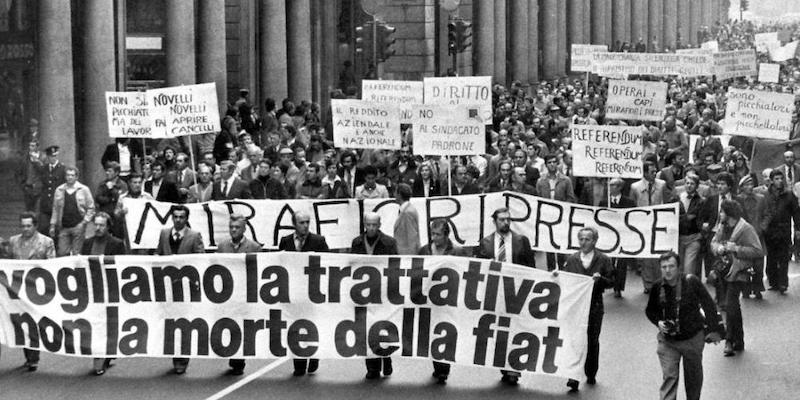
The march of the forty thousand was the procession of foremen, team leaders, clerical staff and middle managers of FIAT that on 14 October 1980 crossed the centre of Turin to demand an end to the strike and to the picket lines outside the plants. It came after five weeks of halted production and overturned, within a few hours, the course of one of the harshest labour disputes of the postwar period: the next day the company and the unions signed an agreement that largely accepted FIAT's position.[1][2] For a city built for half a century around the factory, that day is remembered as the moment the "white collars" publicly broke away from the "blue overalls."[3]
The thirty-five days
The crisis began in early September 1980. On 6 September FIAT announced 24,000 redundancies; on the 10th, after talks broke down, it announced 14,469 dismissals. The unions responded with an indefinite strike that halted the Mirafiori plant, which the diocesan weekly La Voce e il Tempo would later call "the hardest, longest and most fiercely fought battle in the history of the labour movement."[2] The three main union confederations sided with the workers, led by Luciano Lama for the CGIL, Pierre Carniti for the CISL and Giorgio Benvenuto for the UIL; it was Benvenuto who coined the slogan "Either FIAT gives in, or FIAT gives up."[1][2]
On 26 September the secretary of the Communist Party, Enrico Berlinguer, addressed workers in front of gate 5 of Mirafiori, promising that "if it comes to the occupation of FIAT, we will place our political, organisational and intellectual commitment at the service of the working class."[1][2] In the following days the company replaced the dismissals with an announcement of zero-hours temporary layoffs (cassa integrazione) for 23,000 employees.[2] The group was led by Cesare Romiti, who had remained sole managing director after Umberto Agnelli had stepped back from operational roles; Gianni Agnelli, at Romiti's own request, stayed out of the confrontation.[3][1] The backdrop was tense: a little over a year earlier, FIAT executive Carlo Ghiglieno had been murdered in Turin, not far from the spot where the march would later set off.[1]
Foreman Arisio
The organiser was Luigi Arisio, foreman of the upholstery department at the Rivalta plant since 1968 and chairman of the National Coordination of Industrial Middle Managers.[4][2] Thirty years later, in an interview with il Giornale, he recounted having summoned the middle managers to the Teatro Nuovo, sending out 18,000 letters of invitation and spending 17 million lire from the Coordination's funds; the last straw, by his account, had been the death from a heart attack of a colleague, Bonsignore, as he tried to get in to work.[4] The idea of turning the assembly into a march, he said, "came from Callieri" — that is, from Carlo Callieri, FIAT's personnel director for about a year.[4][2] La Repubblica reporter Salvatore Tropea, quoted by Il Post, also wrote that the march was prepared with the backing of Romiti and other group executives.[1]
14 October
The procession set off at 10:30 from corso Massimo d'Azeglio, near via Petrarca, heading for the Palazzo Civico;[1] the managers had first gathered in an assembly at the Teatro Nuovo.[4] The placards read "We want negotiation, not the death of FIAT" and "No to a union-run company"; another slogan was "Jobs are defended by working."[1][4]
There was never agreement on the number of participants. La Stampa of 15 October wrote of thirty thousand people, other reports of forty thousand, and the second figure gave the event its name.[1][2] Arisio himself stuck to the lower number:[4]
"In my view, there were a good 30,000."
The effect was immediate in Rome too. According to Giorgio Benvenuto's account as reported by Il Post, that morning the union leaders were at the Hotel Boston with Romiti and were about to close a deal; on learning of the managers' protest, the managing director stood up and said: "I'm sorry, Agnelli has beaten me. The agreement cannot be made."[1]
The agreement and its aftermath
The dispute ended on 15 October. The 14,469 dismissals were replaced by two years of extraordinary temporary layoffs for 23,000 workers and by the transfer of surplus staff to other companies.[2] When Lama, Carniti and Benvenuto went to Turin, the workers gave them a cool reception.[1] According to Il Post, the negotiation ended in FIAT's favour; the march, the same paper wrote in an obituary of Romiti, unblocked the dispute to the company's advantage and became the symbol of the rift between white-collar staff and factory workers.[1][3]
Arisio went on to politics: in 1983, at the request of Giovanni Spadolini, he was elected to parliament on the Republican Party's lists with 11,325 preference votes and sat in the Chamber of Deputies until 1987.[4] In 2010, during the Pomigliano d'Arco dispute, he said he was ready to march again, but added a warning to FIAT's management: "Be careful, winning too completely never pays off."[4]
A turning point in the city's history
In the years that followed, even the left's reading of autumn 1980 changed. Piero Fassino, then head of the Turin Communist Party's factories commission and later mayor of Turin, acknowledged:[2]
"We communists got it wrong and failed to understand the strength of the middle classes and the structural change under way."
The historian Aurelio Lepre described the Italy of the two preceding decades as a society made up of "homogeneous blocs" (workers, clerks, shopkeepers), a homogeneity that faded in the years that followed; in his book Operai (1988), Gad Lerner read the unions' 1980 defeat as the beginning of the end of the role factory workers had held until then, at the close of a restructuring that FIAT had set in motion years earlier, almost unnoticed.[1] For La Voce e il Tempo, the march also closed a decade marked by violence in the factories.[2]
Pages linking here
Related articles: Gianni Agnelli, Stabilimento di Mirafiori, Umberto Agnelli
Sources
- Il Post — 14 October 2020
- La Voce e il Tempo — 14 October 2020
- Il Post — 18 August 2020
- il Giornale — 4 July 2010