Piccola Casa della Divina Provvidenza
Charitable institute founded in Turin in 1828 by Saint Giuseppe Benedetto Cottolengo: since 1832 a citadel in Valdocco with houses, a school and a hospital.
The Piccola Casa della Divina Provvidenza, which Turinese simply call "il Cottolengo" after its founder, is a Catholic charitable institute founded in Turin in 1828 to take in the sick and the poor whom the city's hospitals turned away.[1] Established by canon Giuseppe Benedetto Cottolengo, it has been based since 1832 in the Valdocco area, on the edge of Borgo Dora, where it grew into a citadel of houses, churches, schools and a hospital along via Cottolengo.[1][2][3]
The evening of 2 September 1827
Its origin lies in a specific episode. A woman from out of town, Jeanne Marie Gonnet, six months pregnant, ill with tuberculosis and struck by a severe haemorrhage, was turned away by the city's hospitals, which feared contagion; her husband searched in vain for a shelter, and canon Cottolengo gave her the last rites in the inn room where she died.[1] According to the SIR news agency's account, it was this woman's death, "turned away by every hospital in the city," that gave the canon the inspiration for his work.[2] A plaque on the house at via Corte d'Appello 4 commemorates that night:
"On the evening of 2 September 1827, Canon Cottolengo attended, in this house, a poor sick woman from out of town, and, moved by boundless pity for human misfortune, was set ablaze with that yearning for good which became a daily wonder in the Piccola Casa della Divina Provvidenza"
The inscription is reproduced in an article by Sergio Donna devoted to the two plaques in the city that commemorate the founder.[1]
From the Volta Rossa to Valdocco
On 17 January 1828 Cottolengo opened, in via Palazzo di Città, in the building known as "della volta rossa," the Deposito de' Poveri Infermi del Corpus Domini: a shelter with just four beds.[1] It did not last long. After three years, as cholera spread through the city, the government of the Kingdom of Sardinia ordered the shelter closed.[1] Speaking in 2010 to the house's guests, Benedict XVI recalled that this first nucleus "did not have an easy life and did not last long."[3]
The canon did not give up. On 27 April 1832 he moved the work to Borgo Dora and there founded the Piccola Casa della Divina Provvidenza.[1] The pope's 2010 address places the new institution in the Valdocco district and recalls that it arose "with the help, too, of some religious families."[3] In 1838 a school for professional nurses was set up on the same site.[1] The founder spent his last days in Chieri, where he died of typhus on 30 April 1842.[1]
"The poor are our masters"
The house's internal rule descends from a few phrases of the founder. One, recalled in local accounts as well, says that the poor are the masters of the house and that whoever fails to treat them as such risks being "dismissed."[1] Benedict XVI quoted it in another form before the sick gathered in the Piccola Casa's church on 2 May 2010:
"The poor are Jesus, he used to say — they are not an image of him. They are Jesus in person, and as such they must be served."
In the same address the pope recalled the three religious families born of Cottolengo's work and the figure of the venerable Brother Luigi Bordino, a nursing religious of the house.[3] The other pillar is trust in Providence, which gives the institute its name: the founder took in, as Pope Francis said in 2015, poor, abandoned and sick people "who could not be admitted to hospitals."[4]
Two popes on via Cottolengo
The Piccola Casa's church has received two papal visits in five years. On 2 May 2010 Benedict XVI met the sick there;[3] on 21 June 2015 Pope Francis spoke there to the sick and disabled, recalling that the Piccola Casa had been "founded almost two centuries ago" and denouncing the spread of "a culture of waste."[4] Francis dwelt on the elderly, "welcomed in great numbers in this house," and on a trait of Cottolengo spirituality:
"a work like this does not go forward without prayer, which is the first and most important work of the Piccola Casa"
The phrase takes up, the pope said, a teaching the founder "loved to repeat."[4]
Hospital, school and houses
Today the Piccola Casa is a system of services. In 2017 it counted some forty care homes across Italy and helped nearly two thousand people; the Cottolengo School in Turin had just under five hundred students.[5] That year, in the presence of undersecretary Maria Elena Boschi and Alfredo Altavilla, an executive of FCA, MeccaniCotto was opened, a workshop-laboratory with Mopar, the group's service brand, in which the school's students acquire the skills to "handle" vehicles.[5]
The Cottolengo Hospital serves the city's northern area. Its Breast Unit carried out more than fifty thousand procedures in 2024, and in September 2026 it received two digital mammography machines as a gift from the Reale Foundation; its general management is entrusted to Gian Paolo Zanetta, while the Piccola Casa's father general is don Carmine Arice.[6] In 2019 the institute's 2018 social report, titled "Together in the service of human dignity," was presented in the auditorium at via Cottolengo 12 before the president of the Region, Alberto Cirio, and the mayor, Chiara Appendino.[7]
Alongside the staff works a large body of volunteers: the Associazione Volontariato Cottolenghino runs a free training course every winter for those who wish to serve in the listening centres, in the reception house's dining hall, in the homes for the elderly and in the hospital, with guided visits to the citadel.[8]
Toward the bicentenary
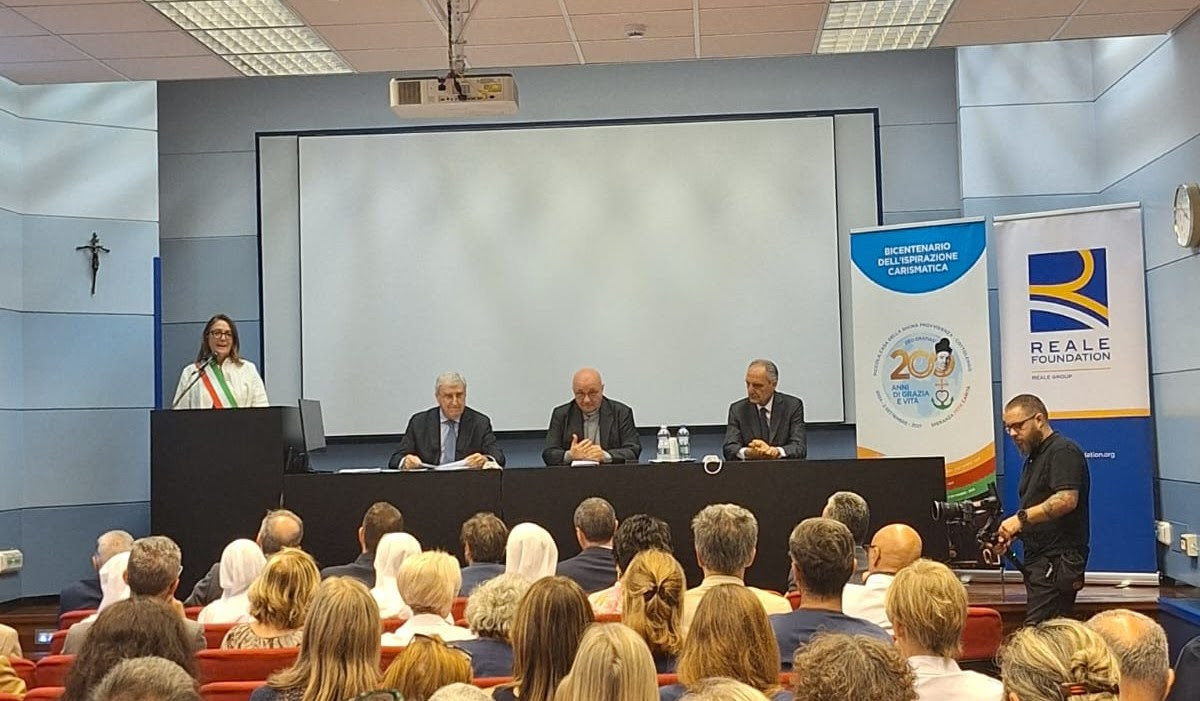
On 2 September 2024, with a mass presided over by the bishop of Aosta, Franco Lovignana, president of the Piedmontese bishops' conference, a three-year period of preparation began for the work's two hundredth anniversary, under the theme "200 years of grace and life"; the celebrations are set for between 2 September 2027 and 17 January 2028, that is, between the anniversary of the night on via Corte d'Appello and that of the opening of the Volta Rossa.[2] 30 April, the anniversary of the founder's death,[1] is his feast day: in 2026 the solemn mass was presided over by the archbishop of Turin, cardinal Roberto Repole, and the Cottolengo family's pastoral year took as its theme "To those who trust extraordinarily, the Lord provides extraordinarily," with the subtitle "Faith and Divine Providence."[9] Born as a four-bed shelter in the centre of Turin, the work now numbers some forty houses in Italy,[5] and its feast day remains a fixture of the Archdiocese of Turin.[9]
Related articles: Giuseppe Benedetto Cottolengo
Pages linking here
Sources
- Piemonte Top News
- SIR – Servizio Informazione Religiosa — 31 August 2024
- Santa Sede — 2 May 2010
- Santa Sede — 21 June 2015
- Affaritaliani — 18 October 2017
- Torino Oggi — 12 September 2026
- Quotidiano Sanità — 7 October 2019
- SIR – Servizio Informazione Religiosa — 27 January 2026
- SIR – Servizio Informazione Religiosa — 29 April 2026