Giuseppe Benedetto Cottolengo
Priest born in Bra in 1786, he founded the Piccola Casa della Divina Provvidenza in Turin; he died in Chieri in 1842 and has been a saint since 1934.
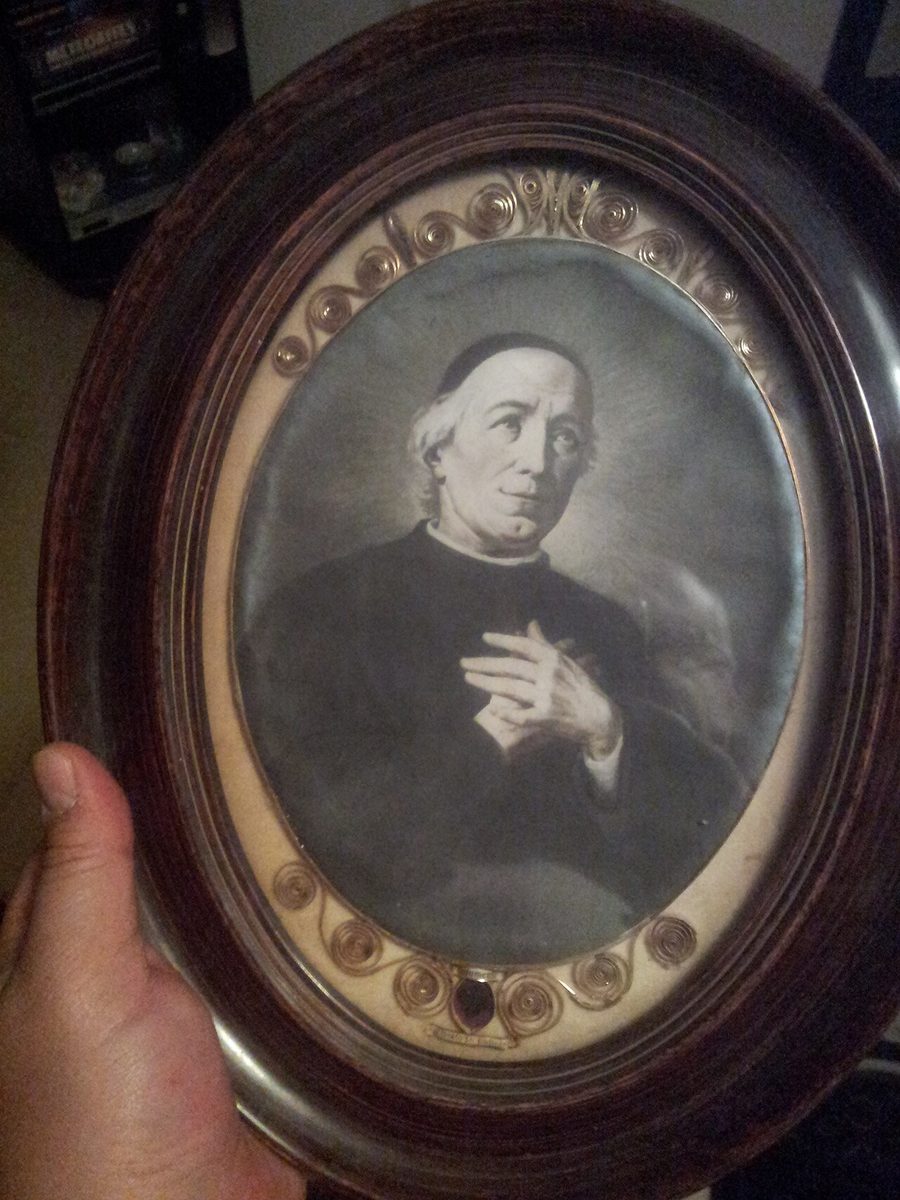

Giuseppe Benedetto Cottolengo (Bra, 3 May 1786 – Chieri, 30 April 1842) is the Piedmontese priest who founded in Turin the Piccola Casa della Divina Provvidenza, the charitable institute known simply as «il Cottolengo». Beatified in 1917 and canonised in 1934, his feast day is 30 April.[1][2]
From Bra to the seminary
He was born in Bra, in the Cuneo area, the first of twelve children of Giuseppe Antonio Cottolengo and Benedetta Chiarotti; six of his siblings died in infancy.[2][3] His youth coincided with what Benedict XVI, in the catechesis devoted to the saint in 2010, called «the Napoleonic adventure», with the religious and social hardships that followed.[2] His theological studies, begun on 5 December 1802, took place in secret, first in Bra and then in Asti, during the years of the French Revolution and the Napoleonic occupation of Piedmont.[3]
On 8 June 1811 he was ordained a priest in the chapel of the seminary of Turin by Monsignor Paolo Giuseppe Solaro, and the following day he celebrated his first Mass in his home town; in November 1813 he became deputy parish priest at Corneliano d'Alba.[3] In 1818 he entered the chapter of canons of the church of Corpus Domini, in the heart of old Turin[3]: he was thirty-two.[2]
The evening of 2 September 1827
The turning point came with a news event. On Sunday 2 September 1827 a French family arrived in Turin by stagecoach from Milan: the wife, Jeanne Marie Gonnet, was pregnant, suffering from tuberculosis and struck by a severe haemorrhage.[2][3] The husband knocked in vain at the doors of several hospitals; the family found shelter in lodgings on via Corte d'Appello, where Cottolengo, called in as a priest, accompanied the woman to her death.[2][3] According to the account given by Benedict XVI, immediately afterwards, praying before the Blessed Sacrament, Cottolengo exclaimed:
«My God, why? Why did you want me as a witness? What do you want from me? Something must be done!»
The prayer is recorded in the pope's catechesis.[2] He then had all the bells rung and the candles lit, and to the onlookers who gathered in the church he said: «The grace has been granted! The grace has been granted!»[2] The episode is recalled by a plaque on the façade of the house at via Corte d'Appello 4.[3] The Piccola Casa marks this as the date of its own founding: the bicentenary will be celebrated on 2 September 2027, after a three-year preparation opened with a Mass on 2 September 2024.[4]
From the Volta Rossa to Valdocco
On 17 January 1828 Cottolengo opened, on via Palazzo di Città, in the building known as «della volta rossa» (of the red vault), the Deposito de' Poveri Infermi del Corpus Domini — a shelter with just four beds for the sick whom no one else would take in.[3] A second plaque, at via Palazzo di Città 6, recalls that first shelter;[3] Treccani instead places the opening of the «house of the red vault» as early as 1827.[1] The bicentenary celebrations will close on 17 January 2028, two hundred years after the opening of the Volta Rossa.[4] When cholera broke out in 1831, the small shelter proved inadequate and the government of the Kingdom of Sardinia ordered its closure.[1][3]
The canon did not stop there: he moved the work to Borgo Dora, in the Valdocco district, and on 27 April 1832 gave it the name Piccola Casa della Divina Provvidenza.[1][3] In 1838 he had a school for professional nurses set up there.[3] Of himself he said he was merely «the labourer of Divine Providence».[2]
The «families» of the Piccola Casa
Cottolengo organised his work into «families», communities in which volunteers, religious and laypeople shared work, prayer, service and administration.[2] From this came the Sisters of Cottolengo and the Institute of the Priests of Cottolengo;[3] Benedict XVI spoke of «three religious Families born from the heart of Cottolengo».[5] At the centre of the work the founder wanted five monasteries of contemplative nuns and one of hermits, which he considered the «heart» of the House.[2] Pope Francis, visiting in 2015, recalled a teaching that the saint «loved to repeat»: that prayer is «the first and most important work of the Piccola Casa».[6]
The principle underlying the institute is condensed in a phrase that Benedict XVI quoted before the sick of the House on 2 May 2010[5]:
«The poor are Jesus — he used to say — they are not an image of him. They are Jesus in person, and as such they must be served.»
In the same address the pope called him «a true champion of charity», attentive above all to those not received and cared for by others.[5] The saint is also credited with a more popular maxim: «The poor are our masters and must be treated as such, otherwise they dismiss us».[3]
Death at Chieri and veneration
Falling ill with typhus, Cottolengo withdrew to Chieri, to the house of his brother Luigi, himself a priest, and died there on 30 April 1842.[3] His last words, as related by Benedict XVI, were an invocation: «Misericordia, Domine; Misericordia, Domine. Good and Holy Providence… Holy Virgin, now it is up to you».[2]
Benedict XV beatified him on 29 April 1917 and Pius XI canonised him on 19 March 1934.[3] The feast of 30 April remains a fixture of the Archdiocese of Turin: in 2026 the solemn Mass in the great church of the Piccola Casa, at via Cottolengo 12, was presided over by Cardinal Roberto Repole, on the theme «To whoever trusts extraordinarily, the Lord extraordinarily provides».[7]
Pages linking here
Related articles: Piccola Casa della Divina Provvidenza
Sources
- Treccani
- Santa Sede — 28 April 2010
- Piemonte Top News
- SIR – Servizio Informazione Religiosa — 31 August 2024
- Santa Sede — 2 May 2010
- Santa Sede — 21 June 2015
- SIR – Servizio Informazione Religiosa — 29 April 2026